
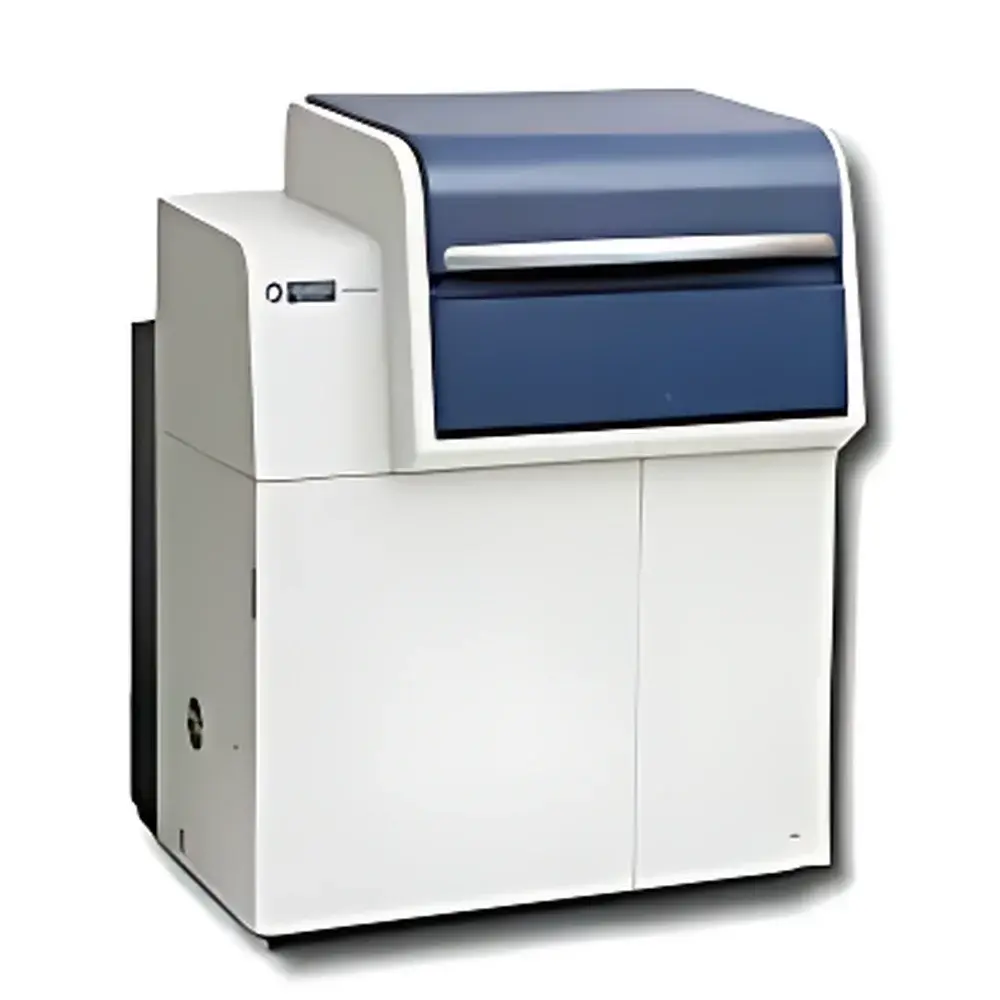
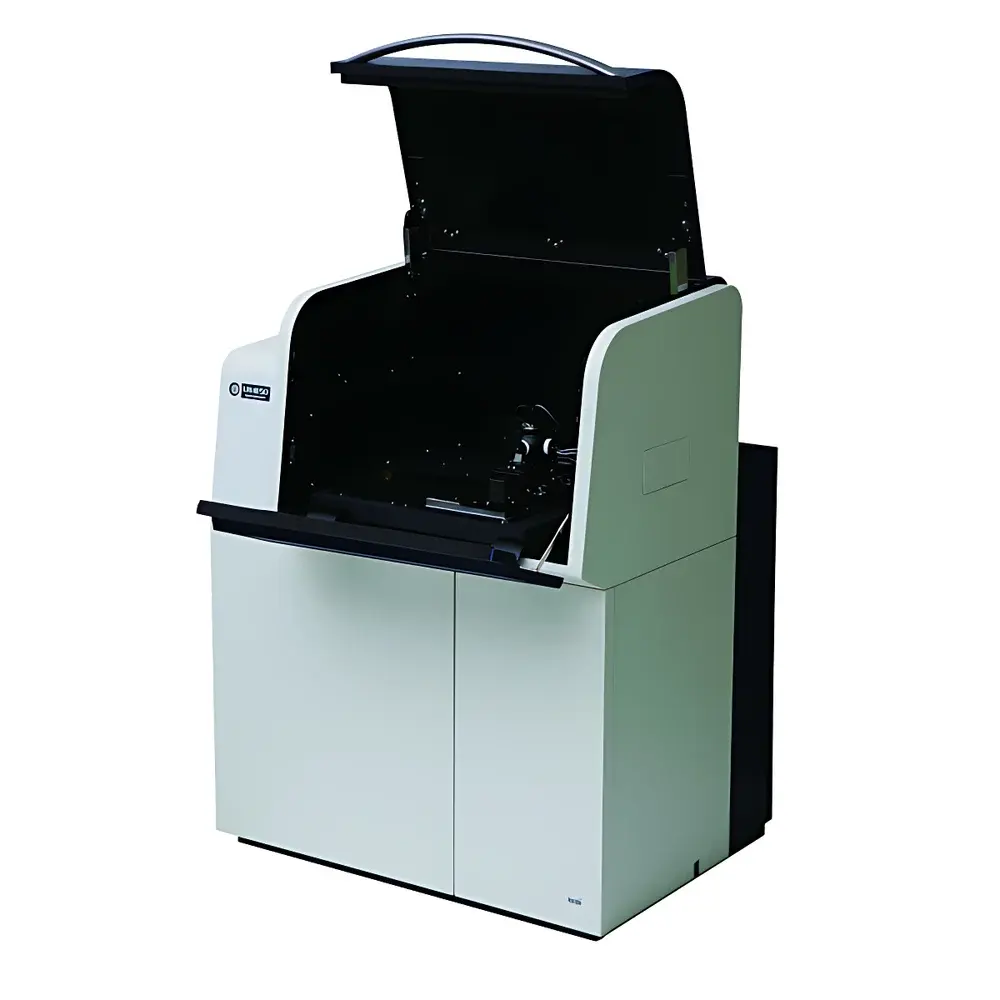
Hitachi UH4150 UV-Vis-NIR Spectrophotometer
| Brand | Hitachi |
|---|---|
| Origin | Japan |
| Manufacturer Type | Original Equipment Manufacturer (OEM) |
| Product Category | Imported Instrument |
| Model | UH4150 |
| Optical Design | Double-Beam |
| Detector Type | Photomultiplier Tube (PMT) for UV-Vis |
| Wavelength Range | 175–3300 nm |
| Wavelength Accuracy | ±0.1 nm (UV-Vis) |
| Spectral Bandwidth | UV-Vis: Auto-adjustable up to 14.4 nm |
| NIR | Auto-adjustable up to 36 nm |
| Stray Light | ≤0.00008% at 220 nm (NaI) |
| Scan Speed | Up to 1200 nm/min (1 nm data interval) |
| Beam Geometry | Collimated Parallel Beam |
| Detector Switching | Seamless dual-detector transition with minimized absorbance discontinuity |
| Integrating Sphere Options | Multiple 60 mm spheres (BaSO₄ or Spectralon® coating), optional 150 mm sphere and goniometric absolute reflectance accessory |
Overview
The Hitachi UH4150 UV-Vis-NIR Spectrophotometer is a high-performance, double-beam optical instrument engineered for quantitative and qualitative analysis across an exceptionally broad spectral range—from deep ultraviolet (175 nm) through visible light to near-infrared (3300 nm). It employs a proprietary prism-grating (P-G) dual monochromator optical architecture, comprising a Littrow-type prism pre-monochromator and a Czerny-Turner grating main monochromator with two interchangeable diffraction gratings. This design delivers ultra-low stray light, minimal polarization dependence, and high photometric stability—critical for accurate measurement of low-transmittance, low-reflectance, and highly scattering samples. Unlike conventional grating-grating (G-G) systems, the P-G configuration maintains consistent S- and P-polarization intensity ratios across the spectrum, ensuring fidelity in thin-film optical modeling and metrology. The instrument utilizes a collimated parallel beam geometry, eliminating angular dispersion artifacts inherent in convergent-beam systems—enabling traceable, angle-resolved specular reflectance measurements essential for optical coating validation, solar reflectance evaluation, and material characterization per ASTM E903 and ISO 9050.
Key Features
- Collimated parallel-beam optics for reproducible, angle-independent specular reflectance and haze (diffuse transmittance) measurements
- Seamless dual-detector system: PMT for UV-Vis (175–900 nm) and thermoelectrically cooled PbS detector for NIR (900–3300 nm), with real-time signal normalization to suppress discontinuities at detector crossover wavelengths
- Modular integrating sphere platform supporting eight standardized configurations—including 60 mm BaSO₄-coated, 60 mm Spectralon®-coated, full-sphere, and goniometric variants—each compliant with NIST-traceable calibration protocols
- High-speed scanning capability: 1200 nm/min at 1 nm data interval, reducing full-range (240–2600 nm) acquisition time to approximately 2 minutes—ideal for high-throughput solar reflectance, photovoltaic material screening, and QC workflows
- Ergonomic sample compartment with re-engineered access door, tool-free attachment interface, and backward compatibility with U-4100 accessories (e.g., micro-sample holders, absolute reflectance stages, and fiber-optic couplers)
- Automated spectral bandwidth control with fine manual override (0.01–8 nm in UV-Vis; 0.1–20 nm in NIR), optimized for resolution/sensitivity trade-off in compliance with USP and EP 2.2.25 requirements
Sample Compatibility & Compliance
The UH4150 accommodates solid, liquid, and powder samples via interchangeable optical modules—including direct-beam transmission, 60 mm integrating spheres (with 0°/8° or 10°/10° illumination geometries), and goniometric reflectance stages. Its collimated beam enables precise specular reflectance measurement of multilayer dielectric stacks, metallic films, and AR-coated optics—directly supporting thin-film design verification against simulated performance per ISO 9211-3 and MIL-C-48497A. For diffuse reflectance analysis (e.g., TiO₂ pigments, catalysts, or pharmaceutical excipients), the instrument meets ASTM E1331 (diffuse reflectance) and ISO 2813 (gloss) measurement conditions. All optical paths are sealed and purged-capable to minimize atmospheric absorption interference—critical for reliable water vapor and CO₂ band analysis in NIR. The system conforms to IEC 61000-4 electromagnetic compatibility standards and operates within GLP-compliant environments when paired with audit-trail-enabled software.
Software & Data Management
Controlled via Windows® 7 Professional (32/64-bit) software, the UH4150 supports full instrument parameterization, spectral acquisition, baseline correction, derivative analysis, and multi-curve overlay. Data export complies with ASTM E1421 and JCAMP-DX v5.0 formats for interoperability with third-party chemometric platforms (e.g., Unscrambler®, MATLAB®). The software includes built-in validation tools for wavelength accuracy (using holmium oxide and didymium filters), photometric linearity (neutral density filters), and stray light assessment—documented per IQ/OQ protocols aligned with FDA 21 CFR Part 11 requirements when used with electronic signature and audit trail modules. Raw spectral data are stored in hierarchical binary format with embedded metadata (date/time, operator ID, lamp status, detector mode), enabling retrospective traceability for regulatory submissions.
Applications
- Solar reflectance and thermal emittance characterization of cool roofing materials (ASTM E1918, ASTM C1549)
- Optical constants determination of transparent conductive oxides (ITO, AZO) and dielectric interference filters
- Quantitative analysis of nanomaterials (e.g., Au nanorods, quantum dots) via localized surface plasmon resonance (LSPR) peak deconvolution
- Pharmaceutical solid-state analysis: polymorph identification, excipient compatibility, and tablet coating uniformity (USP )
- Diffuse reflectance spectroscopy (DRS) of powdered catalysts, pigments, and soil samples for Kubelka-Munk transformation
- Haze and clarity evaluation of optical lenses, display cover glasses, and polymer films per ASTM D1003
FAQ
What is the significance of the collimated beam design in the UH4150?
The collimated beam ensures constant incident angle across the entire sample surface—eliminating focal-spot variation and enabling metrologically traceable specular reflectance measurements required for thin-film optical design validation.
Can the UH4150 perform absolute reflectance measurements?
Yes—when equipped with the optional goniometric absolute reflectance accessory, it measures bidirectional reflectance distribution function (BRDF) data across user-defined incidence and collection angles, compliant with ASTM E259 and ISO/CIE 11664-4.
Is the UH4150 compatible with regulated pharmaceutical laboratories?
It supports 21 CFR Part 11 compliance when deployed with validated software modules that enforce electronic signatures, audit trails, and role-based access control—meeting GMP/GLP documentation requirements for method validation and release testing.
How does the P-G monochromator reduce polarization artifacts?
The prism-based pre-monochromator minimizes differential polarization loss compared to all-grating systems, preserving the intrinsic polarization state of light—essential for accurate measurement of birefringent and anisotropic optical materials.
What maintenance is required for long-term photometric stability?
Routine verification using NIST-traceable standard reference materials (SRMs) every 6 months is recommended; lamp alignment and detector gain calibration are automated during startup and require no user intervention.




