
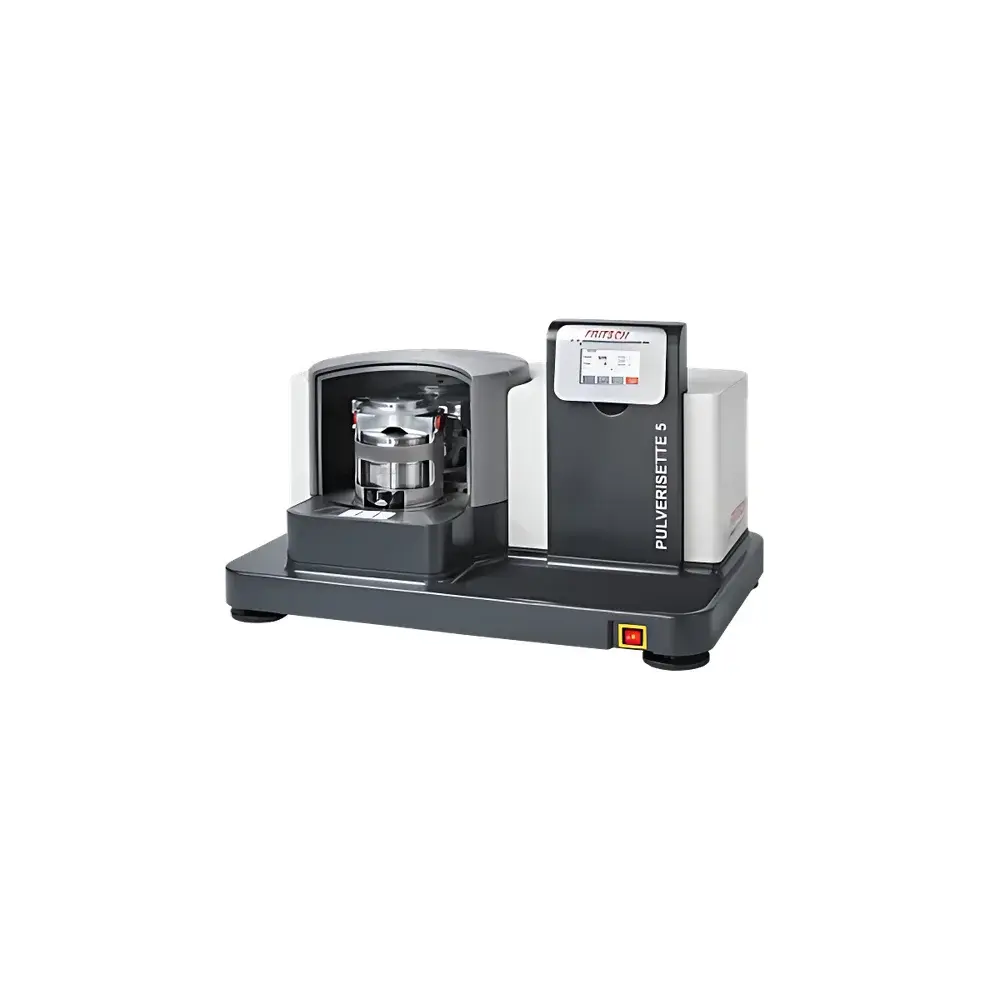
FRITSCH PULVERISETTE 5 Premium Planetary Ball Mill
| Brand | FRITSCH |
|---|---|
| Origin | Germany |
| Model | PULVERISETTE 5 |
| Type | Planetary Ball Mill |
| Max Feed Size | <10 mm |
| Max Batch Volume | 2 × 225 mL |
| Final Particle Size | <0.1 µm |
| Speed Range | 100–800 rpm |
| Grinding Bowl Volumes | 160 mL, 250 mL, 500 mL |
| Grinding Ball Diameters | 3, 5, 10, 15, 20, 30, 40 mm |
| Grinding Modes | Dry & Wet |
| Inert Atmosphere Capability | Yes (pressurized sealing) |
| Power Supply | 100–120 V / 200–240 V, 1–phase, 50–60 Hz, 2200 W |
| Dimensions (W×H×D) | 82 × 48 × 52 cm |
| Net Weight | 110 kg |
| Gross Weight | 145 kg |
| Sound Pressure Level (250 mL bowl, 10 mm balls) | ~70 dB(A) |
| Bowl Materials | Agate, Zirconium Oxide, Stainless Steel, Tempered Steel, Tungsten Carbide (up to 500 mL) |
| Integrated GTM System Compatibility | Yes (real-time gas temperature & pressure monitoring) |
Overview
The FRITSCH PULVERISETTE 5 Premium Planetary Ball Mill is an engineered solution for high-energy comminution of solid materials in research and quality control laboratories. Based on the planetary grinding principle—where grinding bowls rotate in the opposite direction to the sun wheel while simultaneously revolving around it—the system generates centrifugal accelerations up to 95 g, enabling efficient particle size reduction through impact, shear, and friction forces. Designed for reproducible, scalable, and contamination-controlled processing, this mill supports both dry and wet grinding protocols and is uniquely capable of operation under inert or pressurized atmospheres. Its dual-drive motor architecture delivers synchronized, high-torque rotation essential for achieving sub-100 nm final particle sizes—critical for advanced material synthesis, catalyst development, pharmaceutical formulation, and nanomaterial characterization.
Key Features
- Dual independent drive motors ensure precise, balanced rotational dynamics between the sun wheel and grinding bowls—enhancing throughput and reducing mechanical wear.
- ServoLOCK electric clamping system provides fully automated, repeatable, and force-calibrated bowl fixation—eliminating manual torque application and minimizing operator variability.
- Programmable time resolution down to 1 second for both grinding duration and active cooling intervals—enabling strict thermal management during extended milling cycles.
- Hermetically sealed grinding bowls with integrated pressure-resistant O-rings allow safe operation under nitrogen, argon, or other inert gases at elevated pressures—preventing oxidation and moisture ingress during sensitive sample preparation.
- All external bowl jackets constructed from corrosion-resistant stainless steel; internal bowl and ball options include agate (for ultra-low contamination), zirconium oxide (high density, chemically inert), tempered steel (general-purpose durability), and tungsten carbide (maximum hardness, suitable for abrasive ceramics and alloys).
- Integrated compatibility with FRITSCH’s Gas Temperature & Pressure Monitoring (GTM) system—providing real-time in-situ data on thermodynamic conditions inside the grinding chamber to support process validation and kinetic modeling.
Sample Compatibility & Compliance
The PULVERISETTE 5 accommodates a broad spectrum of inorganic, organic, and composite materials—including oxides, metals, polymers, pharmaceutical actives, geological samples, and battery electrode precursors. Its modular bowl and ball configuration permits optimization for hardness, density, and chemical reactivity. The instrument complies with IEC 61000-6-2 (EMC immunity) and IEC 61000-6-4 (EMC emission) standards. When operated with validated SOPs and GTM-integrated logging, it supports GLP-compliant workflows and can be configured for 21 CFR Part 11–aligned audit trails via optional software modules. All wet grinding accessories meet ISO 8502-9 for residual chloride testing, and stainless steel components conform to ASTM A276 for martensitic stainless alloys.
Software & Data Management
While the base unit features an intuitive tactile interface with alphanumeric display and non-volatile parameter storage, full traceability is achieved through optional FRITSCH MillSoft software. This platform enables remote scheduling, multi-user access control, electronic signature capture, and export of timestamped grinding logs—including speed profiles, thermal events, pressure transients (when GTM-equipped), and bowl identification metadata. Export formats include CSV and XML, facilitating integration into LIMS environments and statistical process control (SPC) dashboards. Data integrity safeguards include write-protected archives, checksum verification, and configurable retention policies aligned with ISO/IEC 17025 documentation requirements.
Applications
- Preparation of homogenous nano-dispersions for XRD, BET surface area analysis, and TEM specimen mounting.
- Mechanochemical synthesis of metal–organic frameworks (MOFs), solid electrolytes, and amorphous pharmaceutical intermediates.
- Homogenization of heterogeneous catalysts prior to elemental mapping (EDS/WDS) or catalytic activity testing.
- Routine QC grinding of cement, ores, and construction aggregates per ASTM C114 and ISO 679 protocols.
- Production of reference materials with certified particle size distributions (PSD) traceable to NIST SRMs.
- High-energy activation of powders for cold sintering and spark plasma sintering (SPS) feedstock preparation.
FAQ
What is the maximum recommended continuous operating time per cycle?
Continuous operation is supported up to 99 hours 59 minutes per program; however, thermal management—especially in high-speed dry grinding—requires periodic cooling intervals. Recommended duty cycles are defined per material class in FRITSCH’s Application Notes No. AN-05 and AN-12.
Can the PULVERISETTE 5 be integrated into automated lab systems?
Yes—via RS-232/RS-485 serial interface or optional Ethernet module, enabling PLC-level handshake signals (start/stop/pause), status reporting, and alarm forwarding to central lab automation platforms.
Is validation documentation available for GMP environments?
FRITSCH provides IQ/OQ templates compliant with Annex 15 and USP , including test protocols for speed accuracy, temperature stability, bowl clamping force repeatability, and GTM sensor calibration traceability to NPL or PTB standards.
How does bowl material selection affect contamination limits in ultra-trace analysis?
Agate bowls yield <0.1 ng/g Al/Si background in ICP-MS analysis; zirconium oxide introduces <5 ng/g Zr; tungsten carbide requires post-grinding acid leaching for trace-metal-sensitive applications—detailed contamination thresholds are tabulated in FRITSCH Technical Bulletin TB-07.
What maintenance intervals are recommended for the dual-drive transmission system?
Lubrication-free planetary gearboxes require no scheduled lubrication; annual inspection of motor brushes, belt tension (if applicable), and ServoLOCK actuator calibration is advised per FRITSCH Maintenance Schedule MS-5P.
Related Products



