
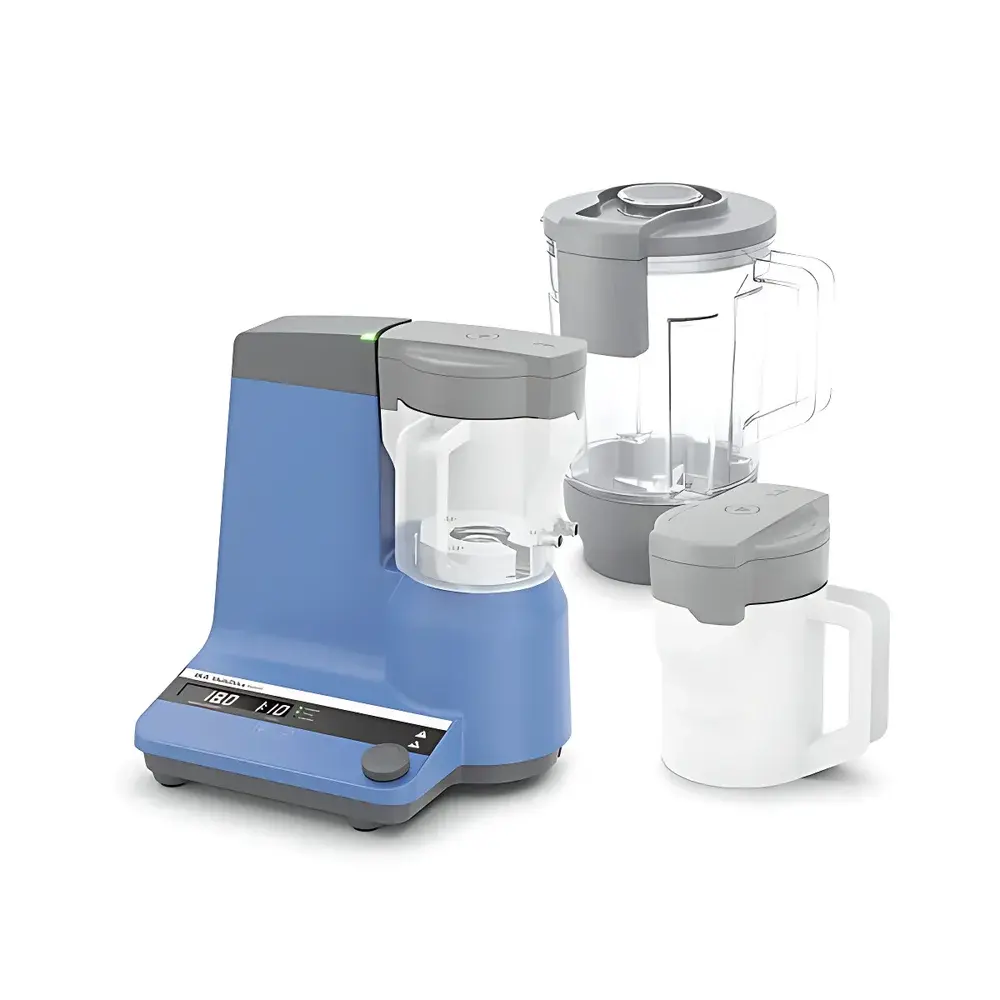
IKA MultiDrive Basic Grinder
| Brand | IKA |
|---|---|
| Origin | Germany |
| Model | IKA MultiDrive Basic |
| Instrument Type | Grinder |
| Sample Suitability | Hard materials |
| Output Particle Size | ≥ 0.5 mm |
| Motor Input Power | 1000 W |
| Motor Output Power | 800 W |
| Speed Range | 3000 – 20000 rpm |
| Speed Accuracy | ±5 % |
| Duty Cycle | 5 min ON / 10 min OFF |
| Motor Type | Brushless DC Motor |
| Display | 7-segment LED |
| Chamber Recognition | Yes |
| Dimensions (W × D × H) | 300 × 350 × 250 mm |
| Weight | 8.5 kg |
| Ambient Temperature Range | 5 – 40 °C |
| Relative Humidity Limit | ≤ 80 % RH |
| Ingress Protection | IP 31 (per DIN EN 60529) |
| USB Interface | Yes |
| Voltage | 220 – 240 V AC |
| Frequency | 50/60 Hz |
| Optional Voltages | 100 – 120 V, 100 V, 230 V |
Overview
The IKA MultiDrive Basic Grinder is a high-performance, benchtop laboratory grinder engineered for reproducible coarse and fine comminution of hard, brittle, and semi-fibrous samples. Operating on the principle of high-speed rotor-stator impact and shear, it delivers consistent particle size reduction through controlled mechanical energy transfer—without thermal degradation or cross-contamination risks associated with direct refrigerant contact. Designed and manufactured in Staufen, Germany, the instrument integrates a brushless DC motor architecture to ensure low maintenance, extended service life, and stable torque delivery across its full 3000–20000 rpm speed range. Its modular design supports rapid interchange of grinding chambers—including the MI 250 cup—enabling functional equivalence to legacy IKA M 20 systems while offering enhanced operational flexibility and digital parameter traceability via integrated USB interface.
Key Features
- Brushless DC motor delivering 800 W continuous output power and 1000 W peak input capacity, optimized for high-torque intermittent operation (5 min ON / 10 min OFF duty cycle)
- Precise speed control from 3000 to 20000 rpm with ±5 % accuracy, enabling method-specific optimization for hardness-dependent fragmentation
- Integrated chamber recognition system ensures automatic validation of compatible grinding cups prior to activation
- 7-segment LED display provides real-time feedback on speed, operating time, and status indicators
- IP 31-rated enclosure (DIN EN 60529) ensures protection against vertically falling drips and solid objects > 2.5 mm—suitable for standard laboratory environments (5–40 °C, ≤80 % RH)
- Dedicated cooling jacket on optional grinding cups enables indirect temperature management during prolonged operation, eliminating risk of cryogen-sample interaction
- USB port supports export of user-defined protocols, runtime logs, and calibration metadata for audit-ready documentation
Sample Compatibility & Compliance
The MultiDrive Basic accommodates a broad spectrum of sample types—including minerals, ceramics, dried plant tissues, polymers, and pharmaceutical tablets—provided they fall within the defined hardness and moisture constraints for dry grinding. It achieves nominal final particle sizes ≥ 0.5 mm, making it suitable for preparatory milling prior to XRD, elemental analysis, or sieve classification. While not certified for GMP production environments, the system supports GLP-aligned workflows through traceable parameter storage and repeatable mechanical processing. Its electrical design complies with IEC 61000-6-3 (EMC emission limits) and IEC 61000-6-2 (immunity standards), and meets CE marking requirements under the EU Machinery Directive 2006/42/EC and Low Voltage Directive 2014/35/EU.
Software & Data Management
No proprietary software installation is required; the USB interface functions as a mass-storage device for direct file transfer of configuration files (.txt or .csv) containing speed profiles, dwell times, and batch identifiers. All parameter sets are timestamped and retain operator-assigned labels, facilitating retrospective review during internal audits or method validation exercises. The absence of embedded operating systems or network connectivity eliminates cybersecurity concerns while maintaining compatibility with validated IT infrastructures governed by FDA 21 CFR Part 11 Annex 11 principles—provided local institutional policies govern access control and data integrity verification.
Applications
- Preparatory size reduction of geological core fragments for geochemical assay
- Homogenization of composite polymer blends prior to rheological or thermal characterization
- Crude milling of botanical extracts for subsequent solvent extraction or HPLC analysis
- Batch-wise comminution of ceramic precursors prior to sintering studies
- Replacement of aging IKA M 20 units in QC laboratories requiring backward-compatible grinding performance
- Method development for ASTM D7420 (Standard Test Method for Determining Particle Size Distribution of Powders Using Laser Diffraction) sample preparation
FAQ
Is the MultiDrive Basic suitable for wet grinding or cryogenic applications?
No—this model is designed exclusively for dry, ambient-temperature comminution. Cooling jackets on compatible cups provide only indirect thermal regulation; liquid nitrogen or slurry-based processing is not supported.
Does the system include a grinding cup?
No—the base unit ships without any grinding chamber. Users must select and purchase appropriate cups (e.g., MI 250, MI 400, or specialized fiber cups) based on sample characteristics and desired throughput.
Can speed profiles be locked or password-protected?
Not natively—the USB-exported parameters are editable externally, but the device itself lacks user-level access control. Institutional IT policies should govern file integrity and version control.
What safety interlocks are implemented?
Operation requires correct chamber insertion and lid closure; the system will not start if chamber recognition fails or the safety latch is unengaged. Overheat protection automatically halts rotation if internal thermal thresholds are exceeded.
Is routine calibration required?
Speed calibration is factory-verified and does not require periodic recalibration under normal use. However, users performing ISO/IEC 17025-accredited testing may elect to verify rotational accuracy annually using a traceable tachometer.



