
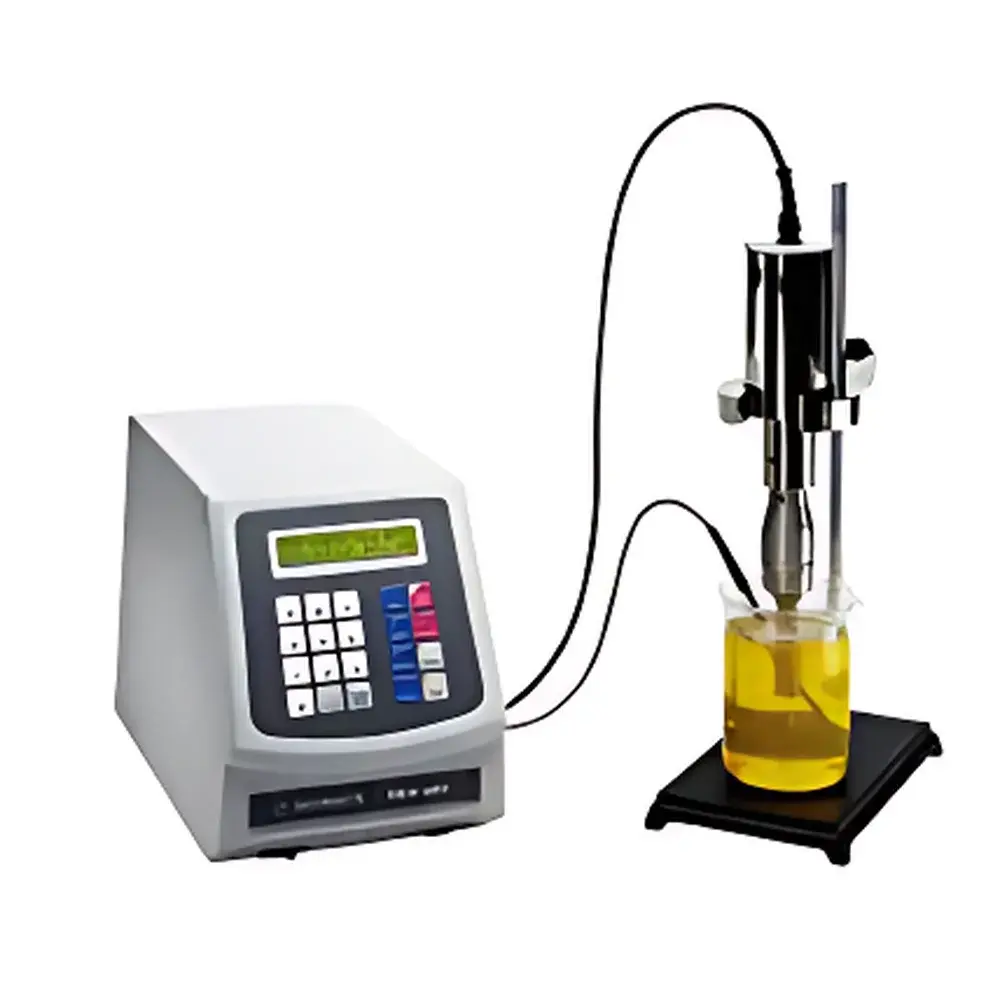
Sonics VC255 / VC505 / VC800 Ultrasonic Sonicator
| Brand | Sonics |
|---|---|
| Origin | USA |
| Model | VC255 / VC505 / VC800 |
| Output Power | 800 W |
| Operating Frequency | 20 kHz |
| Sample Volume Range | 250 µL to several liters |
| Dimensions (H×W×D) | 235 × 190 × 340 mm |
| Weight | 6.8 kg |
| Transducer Type | CV334 Sealed Piezoelectric Converter (PZT) |
| Probe Standard | Φ13 mm Titanium Alloy (Ti-6Al-4V), 136 mm length, 340 g |
| Timer Range | 0–99 min 59 sec (microprocessor-controlled) |
| Pulse Mode | Adjustable 1–59 sec ON/OFF cycles |
| Remote Control Capability | Yes |
| Input Voltage | 220–240 V, 50/60 Hz |
Overview
The Sonics VC255, VC505, and VC800 ultrasonic sonicators are benchtop high-intensity probe-type sonicators engineered for reproducible cell disruption, emulsification, homogenization, and particle size reduction in life science and bioprocessing laboratories. These instruments operate on the principle of piezoelectric transduction: electrical energy is converted into high-frequency mechanical vibrations (20 kHz) at the tip of a titanium alloy probe, generating intense cavitation within the liquid medium. This localized cavitation produces rapid pressure fluctuations, resulting in shear forces sufficient to lyse microbial cells, mammalian tissues, and subcellular organelles—without significant thermal degradation when used with appropriate pulse settings. The VC series is designed for flexibility across scale: the VC255 supports low-volume microscale applications (250 µL–10 mL), the VC505 accommodates mid-scale processing (10–250 mL), and the VC800 delivers robust performance for large-volume protocols (up to several liters) using optional flow-through or cup-horn accessories.
Key Features
- Microprocessor-controlled digital timer with precision range from 0.1 second to 99 minutes 59 seconds, supporting both continuous and programmable pulsed operation.
- Adjustable pulse mode (1–59 seconds ON/OFF intervals) to minimize sample heating and preserve labile biomolecules such as proteins, nucleic acids, and enzyme complexes.
- Digital power display and continuously variable output control (0–100% of nominal 800 W), enabling precise optimization of energy delivery per application.
- Hermetically sealed CV334 piezoelectric converter using lead zirconate titanate (PZT) ceramics—designed for long-term stability, minimal drift, and resistance to solvent ingress or acoustic loading variations.
- Titanium alloy (Ti-6Al-4V) probes with standardized threading (Φ13 mm tip); compatible with interchangeable tips (e.g., microtips, blunt probes, flow cells) for method scalability and GMP-compliant process transfer.
- Remote operation capability via external TTL trigger interface, facilitating integration into automated workflows or biosafety cabinet–constrained environments.
Sample Compatibility & Compliance
The VC series accommodates a broad spectrum of biological matrices—including bacterial cultures (E. coli, Bacillus spp.), yeast suspensions (S. cerevisiae), mammalian cell lines (HEK293, CHO), plant tissue homogenates, and viral lysates—across volumes from microliter-scale microcentrifuge tubes to liter-scale jacketed reactors. All models comply with IEC 61000-6-3 (EMC emission standards) and IEC 61010-1 (safety requirements for laboratory equipment). When operated under validated SOPs, the system supports GLP and GMP documentation frameworks; audit trails for time, power, and pulse parameters can be manually logged or exported via optional RS-232 connectivity for 21 CFR Part 11–aligned data integrity workflows. Probe sterilization is achievable via autoclaving (121°C, 20 min) or ethanol immersion—validated per ISO 13408-1 for aseptic processing support.
Software & Data Management
While the VC series operates via intuitive front-panel controls without mandatory software dependency, digital logging and protocol replication are enabled through optional serial (RS-232) or analog (0–5 V) interfaces. Third-party SCADA or LIMS systems may capture real-time operational metadata—including elapsed time, set power level, pulse cycle status, and transducer temperature (when paired with optional external thermocouple input). For regulatory environments, users routinely implement controlled electronic notebooks (e.g., LabArchives, Benchling) to record instrument settings, calibration dates (per ASTM E2917), and maintenance logs—ensuring traceability aligned with ISO/IEC 17025 and FDA guidance on analytical instrument qualification (AIQ).
Applications
- Preparative lysis of Gram-negative and Gram-positive bacteria for plasmid DNA isolation and recombinant protein extraction.
- Nuclear and mitochondrial isolation from cultured mammalian cells with minimal membrane fragmentation.
- Preparation of submicron liposomes and nanoemulsions for drug delivery formulation development.
- Disaggregation of amyloid fibrils and protein aggregates in neurodegenerative disease research.
- Enhancement of enzymatic digestion efficiency in chromatin immunoprecipitation (ChIP) and ATAC-seq library preparation.
- Routine homogenization of soil, biofilm, or environmental samples prior to metagenomic DNA recovery.
FAQ
What is the difference between VC255, VC505, and VC800 models?
VC255 is optimized for microvolume applications (≤10 mL) with lower thermal mass; VC505 balances versatility and throughput (10–250 mL); VC800 provides higher sustained power delivery and thermal management for large-batch processing (≥500 mL), often deployed with external cooling jackets or flow-cell accessories.
Can I use the same probe across all three models?
Yes—Sonics standardizes probe threading and impedance matching across the VC series. The Φ13 mm titanium probe supplied with VC800 is fully compatible with VC255 and VC505, though optimal amplitude transmission requires matching probe mass to generator capacity per ASTM F2146.
Is calibration required, and how often?
Annual verification of output power (via calorimetric or radiation-force methods per ISO 20443) and timer accuracy is recommended. In regulated labs, calibration must follow internal SOPs aligned with ISO/IEC 17025 and documented in instrument history files.
How do I prevent overheating during extended sonication?
Use pulse mode (e.g., 5 sec ON / 10 sec OFF), immerse samples in ice-water baths, and limit total exposure time per aliquot. For high-throughput workflows, consider integrating a recirculating chiller (e.g., PolyScience 10–30°C units) with jacketed vessels.





