
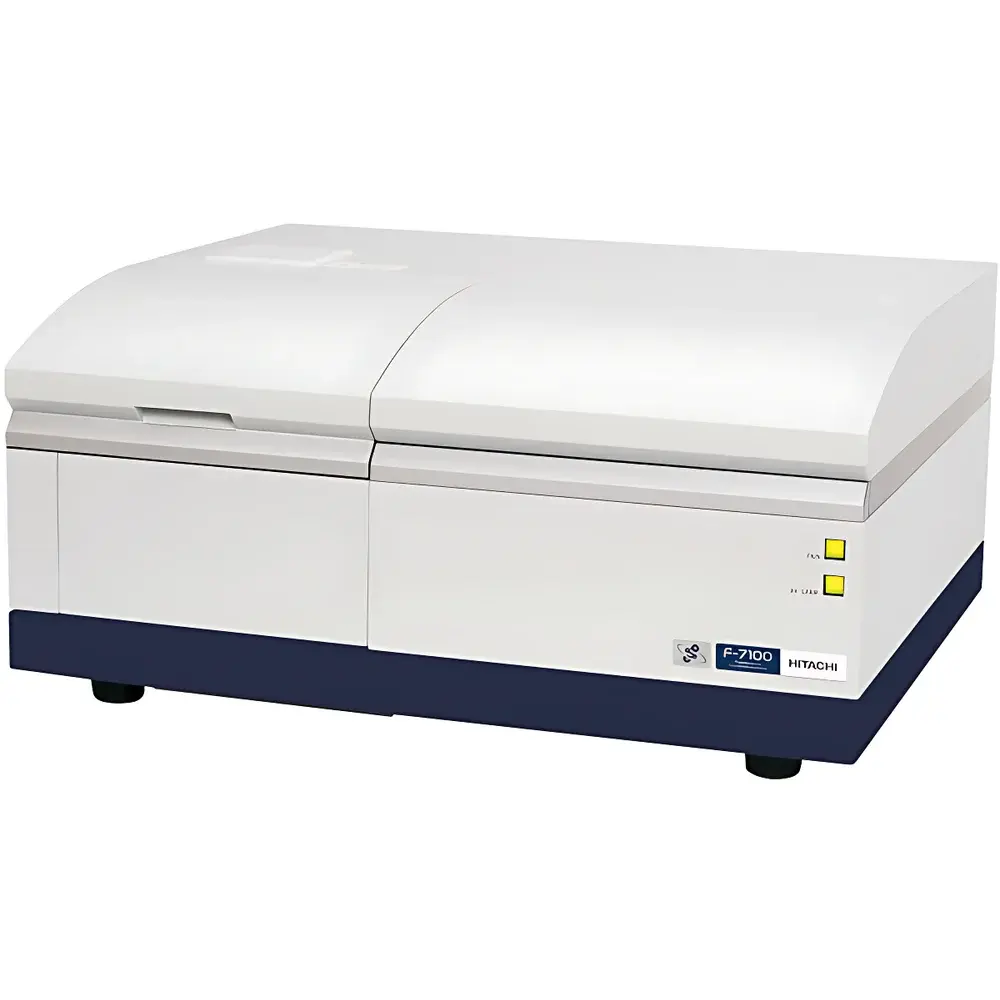
Hitachi F-7100 Molecular Fluorescence Spectrometer
| Brand | Hitachi |
|---|---|
| Origin | Japan |
| Manufacturer Type | Original Equipment Manufacturer (OEM) |
| Instrument Type | Steady-State Fluorescence Spectrometer |
| Excitation Source | Xenon Arc Lamp |
| Monochromator | Holographic Grating |
| Slit Width (Spectral Bandpass) | 1–20 nm |
| Wavelength Scanning Speed | Up to 60,000 nm/min |
| Typical Detection Limit (Fluorescein) | 1 × 10⁻¹³ mol/L |
| Lamp Lifetime | ≥2,500 hours |
| Software Platform | FL Solutions v3.x (with ASTM E2899-compliant audit trail, USP <1058> validated operation mode) |
Overview
The Hitachi F-7100 Molecular Fluorescence Spectrometer is a high-performance steady-state fluorimeter engineered for quantitative and qualitative analysis of fluorescent compounds across research, quality control, and regulatory environments. It operates on the principle of photoluminescence: a xenon arc lamp excites electrons in analyte molecules to higher energy states; upon relaxation, photons are emitted at longer wavelengths, which are resolved by dual holographic grating monochromators and detected via a high-quantum-efficiency photomultiplier tube (PMT). The instrument delivers exceptional signal-to-noise (S/N) performance—1.5× higher than its predecessor (F-7000)—enabling reliable detection down to sub-picomolar concentrations (e.g., 1 × 10⁻¹³ mol/L fluorescein in aqueous matrix). Its optical architecture minimizes stray light and thermal drift, ensuring long-term spectral fidelity essential for longitudinal studies and multi-instrument data harmonization.
Key Features
- Enhanced Sensitivity Architecture: Combines a stabilized high-brightness xenon lamp with optimized excitation/emission optical paths, low-noise PMT electronics, and real-time dark-current compensation—achieving S/N >1,000 for water Raman scattering (350 nm ex / 397 nm em), critical for trace-level environmental and biochemical assays.
- Extended Lamp Lifetime & Stability: Features a next-generation xenon lamp with improved cathode geometry and regulated power supply, sustaining ≥95% nominal intensity after 2,500 hours of operation—reducing maintenance frequency, calibration drift, and consumables cost per analysis hour.
- Fluorescence Intensity Standardization (FIS): A built-in reference-based correction algorithm that normalizes sample fluorescence intensity against a user-defined standard (e.g., quinine sulfate for water matrices, fluorescein for chlorophyll quantification), compensating for diurnal variations in lamp output, ambient temperature, and optical alignment—ensuring cross-day and cross-platform comparability per ISO 17025 and GLP requirements.
- High-Speed Scanning Capability: Supports wavelength scanning up to 60,000 nm/min without spectral distortion or photobleaching artifacts—ideal for kinetic monitoring, screening applications, and rapid spectral library acquisition.
Sample Compatibility & Compliance
The F-7100 accommodates standard 10 mm quartz cuvettes (pathlengths: 1–10 mm), microvolume cells (down to 50 µL), solid-sample holders, and fiber-optic probes for non-contact measurements. It complies with key international standards including ASTM E2899 (Standard Guide for Fluorescence Spectroscopy), ISO 10678 (Water quality — Determination of polycyclic aromatic hydrocarbons — Fluorescence method), and USP (Analytical Instrument Qualification). When operated in FL Solutions’ 21 CFR Part 11-compliant mode, the system provides electronic signatures, full audit trails, role-based access control, and immutable data archiving—meeting FDA, EMA, and PMDA regulatory expectations for pharmaceutical and clinical laboratories.
Software & Data Management
FL Solutions v3.x provides an integrated environment for instrument control, spectral acquisition, multivariate analysis, and report generation. Key capabilities include:
- Batch processing of 3D excitation-emission matrix (EEM) datasets with automatic baseline correction and inner-filter effect compensation;
- One-click export of EEM data to Excel® in customizable matrix formats (e.g., excitation-wavelength rows, emission-wavelength columns), including optional high-order light filtering (removal of 2nd-order diffraction artifacts) and Rayleigh/Raman scatter masking;
- Native support for PARAFAC, PCA, and cluster analysis via direct export to MATLAB®, Python (NumPy/Pandas), or commercial chemometrics platforms;
- Configurable validation protocols aligned with IQ/OQ/PQ documentation templates and automated calibration verification logs.
Applications
The F-7100 serves diverse analytical workflows across regulated and academic sectors:
- Environmental Monitoring: Quantification of dissolved organic matter (DOM), humic/fulvic acids, PAHs, and algal pigments (chlorophyll-a, phycocyanin) in surface and wastewater using EEM fingerprinting and parallel factor analysis (PARAFAC).
- Pharmaceutical Development: Excipient compatibility testing, degradation product identification, and potency assay of fluorescent APIs (e.g., tetracyclines, quinolones) per ICH Q5C and Q2(R2) guidelines.
- Food & Beverage Safety: Detection of melamine, aflatoxins, and vitamin B2 (riboflavin) in dairy, cereals, and infant formula; authentication of honey and olive oil via native fluorophore profiling.
- Materials Science: Characterization of quantum dots, OLED emitters, perovskite precursors, and photocatalytic nanoparticles through lifetime-resolved spectral mapping (when coupled with optional TCSPC modules).
FAQ
What is the typical detection limit for fluorescein under standard conditions?
The F-7100 achieves a practical detection limit of 1 × 10⁻¹³ mol/L fluorescein in deionized water using 1-cm quartz cuvettes, 5-nm slit widths, and signal averaging over 3 scans.
Does the F-7100 support time-resolved fluorescence measurements?
No—the F-7100 is a steady-state fluorimeter. For lifetime measurements, Hitachi offers complementary time-correlated single-photon counting (TCSPC) systems compatible with the same sample compartment and FL Solutions software framework.
Can FL Solutions generate 21 CFR Part 11-compliant reports?
Yes—when configured in validated mode, FL Solutions v3.x enforces electronic signatures, session locking, and immutable audit trails for all acquisition, processing, and export events.
Is the instrument suitable for GMP-regulated QC laboratories?
Yes—its design supports full IQ/OQ/PQ execution, meets USP AIQ criteria, and includes hardware interlocks, calibration certificate management, and deviation logging tools required for pharmaceutical QC compliance.
How does the Fluorescence Intensity Standardization function improve data reproducibility?
It mathematically transforms raw intensity values into relative units normalized to a daily-calibrated reference standard—eliminating systematic bias from lamp aging, temperature fluctuations, and detector gain drift—thus enabling statistically valid trend analysis across months or multi-site studies.




