
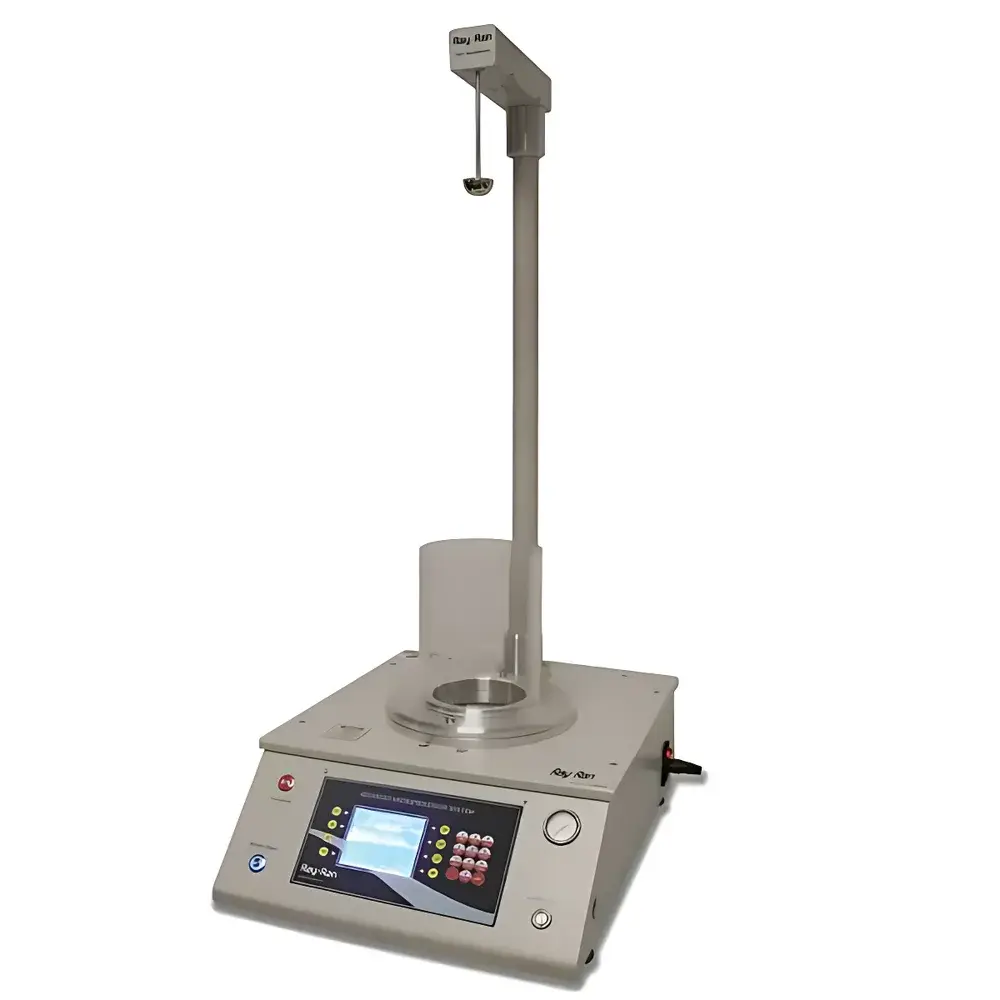
Ray-Ran FDT Falling Dart Impact Tester
| Brand | Ray-Ran |
|---|---|
| Origin | United Kingdom |
| Model | FDT |
| Net Weight | 50 kg |
| Dimensions (W×D×H) | 530 × 720 × 1100 mm (standard) |
| Power Supply | 110–240 VAC, 50–60 Hz |
| Display | 160 × 128 pixel alphanumeric graphic LCD with keypad |
| Compliance | ISO 7765, ASTM D1709 Method A |
| Fixture | Pneumatic clamping system |
| Drop Height | Fixed at 0.66 m |
| Standard Weights | 2 × 5 g, 8 × 15 g, 8 × 30 g, 8 × 60 g |
| Test Modes | Pass/Fail counter for impact failure assessment |
| Safety | Dual-hand release mechanism |
| Mounting | Benchtop configuration |
Overview
The Ray-Ran FDT Falling Dart Impact Tester is a precision-engineered benchtop instrument designed to quantify the impact resistance of thin plastic films, sheets, and flexible packaging materials under standardized conditions. It operates on the principle of gravitational energy transfer: a calibrated dart is dropped from a fixed height onto a horizontally clamped specimen, and the threshold mass or energy required to cause failure—defined as puncture or tear—is determined through incremental weight testing. This method aligns with the fundamental physics of dynamic tensile stress propagation in viscoelastic polymer substrates. The FDT implements the classical free-fall dart impact paradigm, where kinetic energy (E = mgh) is systematically varied by changing the dart mass while maintaining constant drop height (0.66 m), enabling direct correlation to industry-accepted failure energy metrics. Its architecture prioritizes mechanical stability, operator safety, and metrological traceability—critical requirements for QC laboratories operating under ISO/IEC 17025-accredited environments.
Key Features
- Compliance with internationally recognized standards: fully configured for ISO 7765-1 (Plastics — Film and sheeting — Determination of impact resistance by the free-falling dart method — Part 1: Staircase method) and ASTM D1709 Method A (Standard Test Methods for Impact Resistance of Plastic Film by the Free-Falling Dart Method).
- Integrated microprocessor-based control system ensures consistent drop initiation timing, eliminates manual release variability, and records test sequence metadata including date, time, weight increment, and pass/fail outcome.
- Pneumatic clamping mechanism delivers uniform, repeatable specimen tension across the clamping annulus—minimizing edge effects and ensuring planar alignment during impact, thereby enhancing inter-laboratory reproducibility.
- Dual-hand safety release system physically prevents single-handed operation, satisfying EN 61000-1-2 and OSHA-compliant machine guarding requirements for laboratory impact testers.
- Fixed-height drop tower (0.66 m) engineered for dimensional stability and minimal vertical deflection; optional Method B accessory kit extends maximum drop height to 2600 mm for high-energy testing per ASTM D1709 Method B.
- Robust cast-aluminum frame and vibration-damped base reduce environmental interference, supporting reliable measurement of low-mass darts (5 g minimum) with high positional repeatability.
Sample Compatibility & Compliance
The FDT accommodates specimens up to 150 mm in diameter, suitable for standard film rolls, laminates, coated foils, and thermoformed trays. Specimen thickness range spans 25 µm to 1.0 mm, covering common LDPE, LLDPE, PET, OPP, and metallized barrier structures. Clamping force is adjustable via regulated air pressure (0–0.7 MPa), allowing optimization for low-modulus elastomers and high-stiffness engineering films without slippage or creep-induced error. All calibration weights are certified to ISO 17025-accredited mass standards, traceable to NPL (UK) or NIST (US). The instrument’s design supports GLP documentation workflows, with audit-ready test logs exportable via RS-232 interface for integration into LIMS or electronic lab notebooks.
Software & Data Management
While the FDT operates as a standalone unit with embedded firmware, its serial output enables seamless data capture using third-party acquisition software compliant with FDA 21 CFR Part 11 requirements. Each test record includes timestamp, operator ID (via keypad entry), weight selection, observed failure mode (puncture vs. partial tear), and cumulative pass/fail counts. Firmware supports user-defined test sequences (e.g., ascending staircase protocols per ISO 7765 Annex A), automatic pass/fail threshold calculation, and statistical summary generation (mean impact energy, standard deviation, confidence intervals). Raw data exports as CSV or ASCII text, facilitating post-test analysis in MATLAB, JMP, or Minitab for DOE and SPC applications.
Applications
- Quality control of blown and cast polyethylene films in packaging converters.
- Development validation of impact-modified polypropylene blends for automotive interior trim.
- Regulatory submission testing for medical device pouches per ISO 11607-1.
- Comparative assessment of recyclate performance in multilayer food packaging structures.
- In-process monitoring of extrusion line consistency via rapid impact screening at defined intervals.
- Failure analysis of heat-seal integrity in pouches subjected to distribution-level shock loads.
FAQ
What standards does the FDT support out-of-the-box?
ISO 7765-1 and ASTM D1709 Method A are natively supported; Method B requires the optional extended-height tower kit.
Can the FDT be used for non-plastic materials such as paperboard or aluminum foil?
Yes—provided the material exhibits ductile-to-brittle transition behavior within the 5–60 g dart mass range and can be uniformly clamped without deformation.
Is calibration certification included with shipment?
A factory calibration report is supplied; users must perform periodic verification using NIST-traceable mass standards and height gauges per ISO/IEC 17025 clause 6.5.
Does the instrument meet electromagnetic compatibility (EMC) requirements for EU laboratories?
Yes—the FDT complies with EN 61326-1 (Laboratory equipment EMC standard) and bears CE marking for use in EEA member states.
How is specimen thickness accounted for in impact energy calculations?
Thickness is not directly factored into the standard calculation; however, it is recorded as a contextual variable in test logs to support correlation studies with tensile properties per ASTM D882.



