
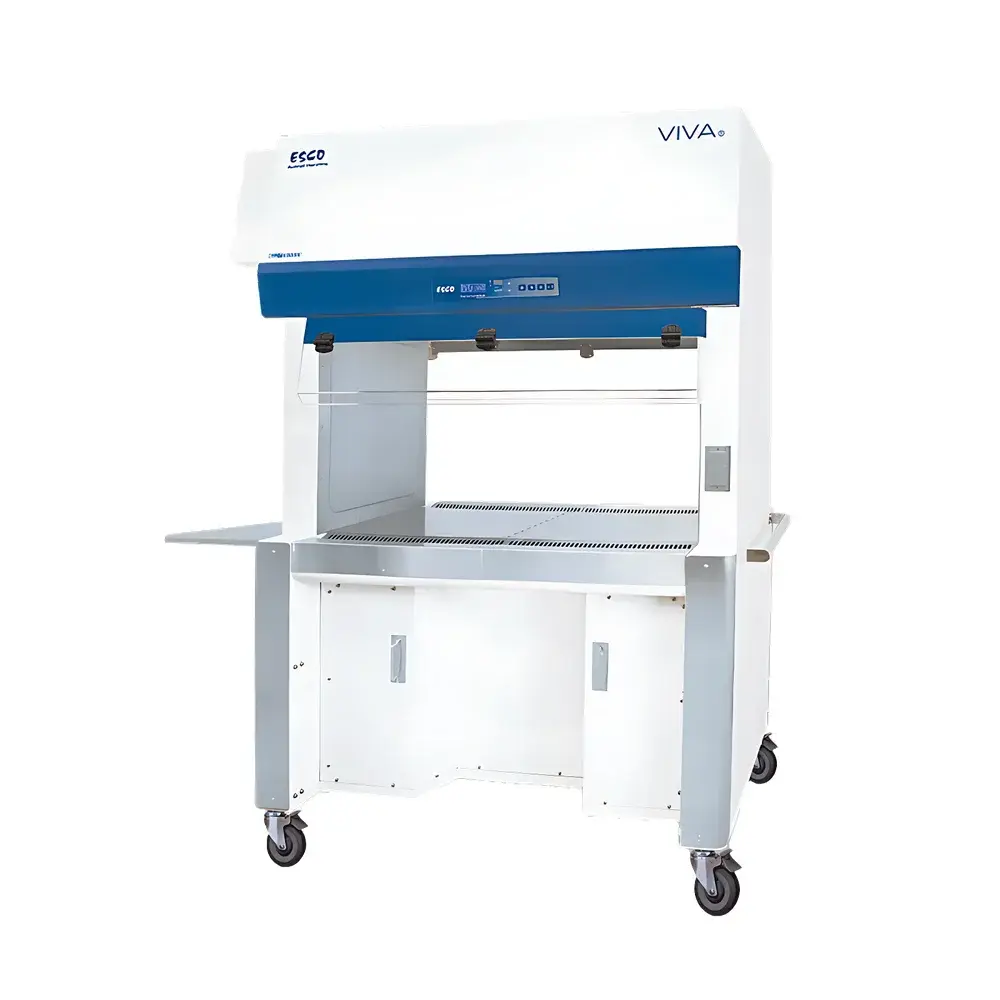
Esco VIVA Dual-Access Open-Design Animal Cage Changing Station
| Brand | Esco |
|---|---|
| Origin | Singapore |
| Manufacturer Type | Authorized Distributor |
| Origin Category | Imported |
| Model | VDA-A |
| Pricing | Available Upon Request |
| External Dimensions (L×W×H) | 1340 × 762 × 1961 mm (Low-Height Configuration) / 1340 × 762 × 2245 mm (High-Height Configuration) |
| Internal Work Area (L×W×H) | 1100 × 465 × 564 mm |
| Downflow Air Velocity | 0.24 m/s (47 fpm) |
| Power Supply | 220–240 VAC, 50/60 Hz, Single-Phase |
Overview
The Esco VIVA Dual-Access Open-Design Animal Cage Changing Station is an ISO Class 4-certified (ISO 14644-1) biosafety enclosure engineered specifically for high-integrity animal husbandry and experimental procedures requiring simultaneous operator access from both sides. Unlike conventional laminar flow cabinets or single-operator biosafety cabinets, the VIVA platform employs a dual-front open architecture with balanced vertical downflow and inward-facing front air curtains—establishing a physical and aerodynamic barrier between “dirty” (used cage handling) and “clean” (fresh cage preparation) work zones. Its core airflow management relies on electronically commutated motor (ECM)-driven ULPA filtration, delivering stable, low-turbulence downflow at 0.24 m/s even under ±10% voltage fluctuation. This ensures consistent containment of allergens, dander, and microbial aerosols while minimizing cross-contamination risk during routine cage changes in SPF (Specific Pathogen-Free) and conventional rodent facilities.
Key Features
- Dual-access ergonomic design with symmetrical leg clearance on both sides—enabling two technicians to perform synchronized cage transfer without compromising containment integrity or workflow efficiency.
- ULPA filtration system (Minipleat unpleated, separatorless media) certified to >99.999% particle capture efficiency at MPPS (Most Penetrating Particle Size) of 0.12 µm and 0.3 µm—providing 10× higher allergen retention than standard HEPA filters (EN 1822-1:2019).
- ISO Class 4 cleanroom-grade internal environment maintained via continuous downflow and dynamic air curtain separation—validated per NSF/ANSI 49 and EN 12469 Annex D for personnel, product, and environmental protection.
- Esco Sentinal™ microprocessor control system with LCD interface, real-time airflow monitoring, audible/visual alarms for sash position deviation and airflow decay (>15% reduction), and automatic fan speed compensation.
- ISOCIDE® antimicrobial coating applied to all exposed stainless-steel surfaces—including work surface, front grille, and side panels—to inhibit bacterial colonization and support GLP-compliant cleaning validation protocols.
- Recessed front air grille design prevents obstruction by gloves, sleeves, or equipment—preserving laminar stability and preventing localized turbulence that could compromise containment performance.
Sample Compatibility & Compliance
The VIVA station accommodates standard IVC (Individually Ventilated Cage) systems, static and ventilated shoebox cages, and auxiliary equipment such as cage washers, water bottle fillers, and automated bedding dispensers. It complies with international standards governing laboratory animal facility infrastructure, including AAALAC International accreditation requirements, EU Directive 2010/63/EU Annex III (housing and care), and NIH Guide for the Care and Use of Laboratory Animals (8th Edition). All airflow performance data are traceable to NIST-calibrated anemometers and validated using iodide ionization and TSI 9500 particle counters. The ULPA filter integrity is tested annually per ISO 14644-3 Annex B using PAO-4 (polyalphaolefin) challenge and photometer scanning.
Software & Data Management
The Sentinal™ controller logs operational parameters—including sash height, airflow velocity, runtime hours, alarm events, and filter usage time—in non-volatile memory. Data export is supported via USB-C port in CSV format for integration into institutional LIMS or electronic lab notebooks (ELN). Audit trail functionality meets FDA 21 CFR Part 11 requirements for electronic records, with user-level access control (admin/operator modes), timestamped event logging, and tamper-resistant data storage. Optional Ethernet connectivity enables remote diagnostics and centralized fleet monitoring across multi-room vivarium deployments.
Applications
- Routine cage changing in SPF and conventional rodent housing units.
- Preparation of sterile bedding, feed, and enrichment materials under controlled air quality.
- Transfer of animals between transport containers and IVC racks during health monitoring or experimental cohort assignment.
- Supporting immunocompromised or allergy-sensitive research models where airborne allergen suppression is critical (e.g., asthma, atopy, or transplant studies).
- Integration into ALF (Animal Living Facility) HVAC master control systems via Modbus RTU protocol for coordinated pressure cascade management.
FAQ
What is the difference between ULPA and HEPA filtration in this context?
ULPA filters used in the VIVA station meet ISO 29463-1:2011 Class U15 specifications, offering ≥99.999% efficiency at 0.12 µm MPPS—significantly exceeding HEPA’s minimum 99.97% at 0.3 µm. This is essential for capturing rodent dander (typically 0.5–10 µm) and associated endotoxin-bearing particles.
Can the unit be integrated into existing vivarium pressure cascades?
Yes—the VIVA station operates as a self-contained negative-pressure zone with adjustable exhaust ducting options (ducted or thimble connection) and supports differential pressure setpoint synchronization via analog 0–10 VDC input.
Is validation documentation provided with shipment?
Each unit ships with a Factory Acceptance Test (FAT) report, ULPA filter certification (including scan test results), and airflow mapping summary per ISO 14644-3. IQ/OQ documentation templates compliant with GxP are available upon request.
How often must the ULPA filter be replaced?
Under typical use (8 hrs/day, 5 days/week), filter service life averages 3–5 years. Replacement intervals are tracked automatically by the Sentinal™ system and triggered by cumulative runtime and pressure drop thresholds.
Does the unit support glove port integration for enhanced containment?
Glove ports (ISO 14644-7 compliant) can be retrofitted to the side panels or rear wall as a factory-installed option, enabling manipulation of high-risk biological agents during cage change procedures without breaching the primary air barrier.



