
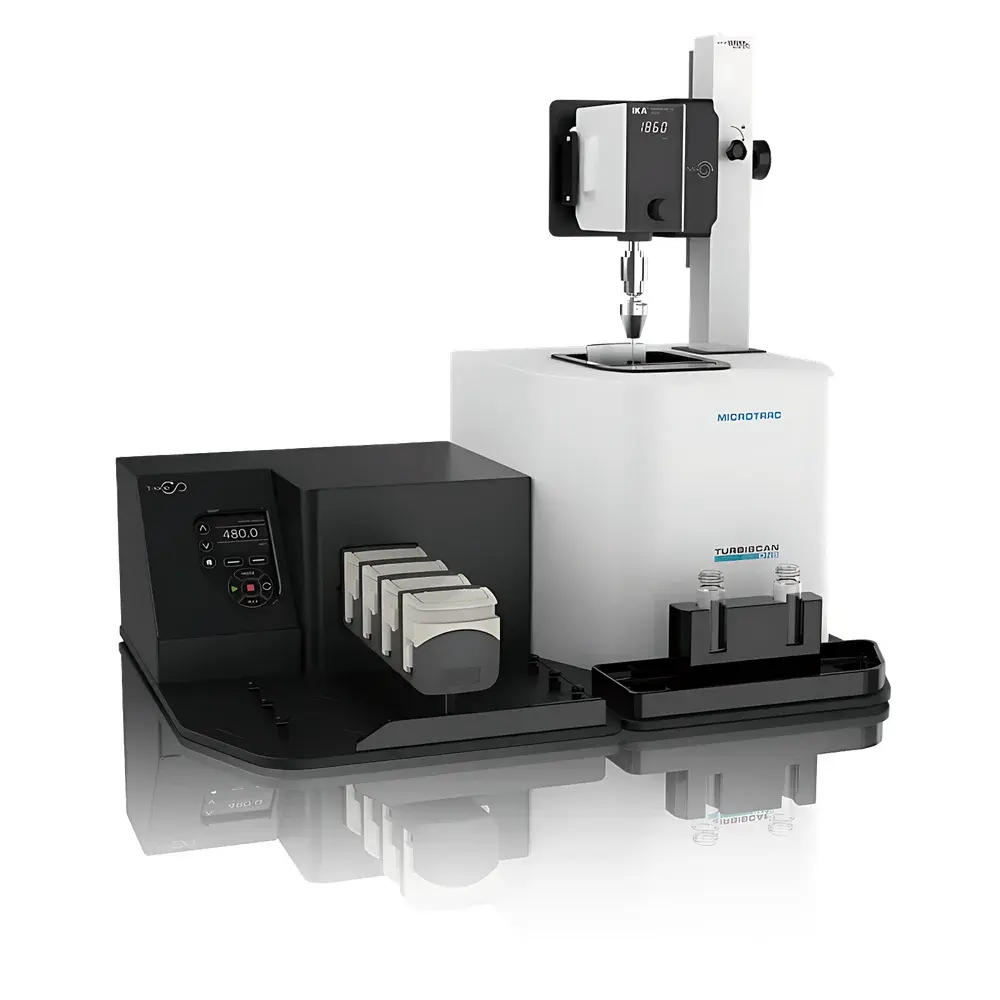
TURBISCAN DNS Static Multiple Light Scattering Analyzer by Formulaction
| Brand | Formulaction |
|---|---|
| Origin | France |
| Model | DNS |
| Measurement Principle | Static Multiple Light Scattering (SMLS) |
| Sample Volume | 1.5–30 mL |
| Concentration Range | 0.0001–95% v/v |
| Particle Size Range | 10 nm–1 mm |
| Detection Modes | Transmitted Light (T) & Backscattered Light (BS) |
| Scan Mode | Vertical high-frequency scanning of static sample |
| Optional Functions | T-MIX (in-situ stirring), T-LOOP (circulation coupling) |
| Output Metric | Turbiscan Stability Index (TSI) |
| Compliance Context | Designed for GLP-compliant formulation development and stability assessment per ICH Q1/Q5, USP <729>, ISO 13321 |
Overview
The TURBISCAN DNS is a benchtop static multiple light scattering (SMLS) analyzer engineered by Formulaction (France) for quantitative, non-invasive characterization of colloidal and particulate dispersion systems. Unlike conventional particle sizing instruments that rely on dynamic light scattering or laser diffraction—methods requiring dilution, calibration standards, or assumptions about particle shape—the DNS applies SMLS to measure real-time changes in both transmitted (T) and backscattered (BS) light intensities across the full height of a static sample tube. This dual-detection geometry enables simultaneous quantification of particle migration (creaming, sedimentation, coalescence), size evolution (aggregation, Ostwald ripening), and concentration gradients—without sample preparation, dilution, or disruption. Its core application lies in pharmaceutical formulation development, where physical stability and homogeneity directly impact drug product performance, bioavailability, shelf-life prediction, and regulatory filing readiness.
Key Features
- True static measurement: No centrifugation, shaking, or dilution required—preserves native dispersion state.
- Dual-wavelength detection (850 nm and 650 nm): Enables discrimination between optical effects driven by particle size shifts versus concentration changes.
- High-resolution vertical scanning: 10 µm step resolution over 45 mm sample height, capturing spatial heterogeneity with sub-millimeter precision.
- Real-time kinetics: Continuous monitoring from seconds to months; data acquisition intervals configurable from 30 s to 24 h.
- T-MIX module: Integrated magnetic stirring system for in situ homogenization during measurement—ideal for assessing dispersion robustness under shear.
- T-LOOP interface: Direct coupling to external pumps, reactors, or process lines for inline or at-line dispersion uniformity validation in GMP-relevant environments.
- Turbiscan Stability Index (TSI): A dimensionless, algorithm-derived metric aggregating all destabilization phenomena into a single time-dependent value—enabling objective, operator-independent stability ranking.
Sample Compatibility & Compliance
The DNS accommodates opaque, highly concentrated, and optically dense formulations—including suspensions, emulsions, liposomes, nanosuspensions, microemulsions, and polymer dispersions—across viscosity ranges up to 10,000 mPa·s (with optional rotor configuration). It supports vial formats from 5 mm to 25 mm diameter and complies with analytical traceability requirements for pharmaceutical development. Data acquisition and reporting align with ALCOA+ principles (Attributable, Legible, Contemporaneous, Original, Accurate, Complete, Consistent, Enduring, Available). Audit trails, electronic signatures, and user access control are implemented via optional software modules compliant with FDA 21 CFR Part 11 and EU Annex 11 for regulated environments. Method validation documentation supports ICH Q5C (stability testing of biotechnological/biological products) and Q1A(R3) (stability testing of new drug substances and products).
Software & Data Management
The TURBISCAN Lab™ software provides full control of acquisition parameters, real-time visualization of T/BS profiles, and automated TSI calculation. Raw intensity profiles are stored in HDF5 format for long-term archival and third-party analysis. Batch processing tools allow comparative analysis across multiple samples or time points. Export options include CSV, PDF reports, and image sequences compatible with LIMS integration. Advanced modules support statistical process control (SPC), trend analysis, failure mode identification (e.g., distinguishing flocculation from creaming), and predictive modeling of shelf-life endpoints using Arrhenius-based accelerated stability protocols.
Applications
- Early-stage excipient screening and surfactant selection for suspension and emulsion formulations.
- Quantitative comparison of physical stability under varying storage conditions (temperature, humidity, light exposure).
- Optimization of milling, homogenization, and lyophilization cycles via real-time dispersion uniformity feedback.
- Assessment of compatibility between active pharmaceutical ingredients (APIs) and vehicle components—detecting subtle phase separation undetectable by eye.
- Supporting regulatory submissions with objective, reproducible stability datasets aligned with ICH guidelines.
- Monitoring batch-to-batch consistency in manufacturing scale-up and technology transfer.
- Studying colloidal interactions in complex matrices (e.g., biological fluids, topical gels, oral suspensions).
FAQ
Does the DNS require sample dilution before analysis?
No. The SMLS principle allows direct measurement of undiluted samples across a concentration range of 0.0001–95% v/v.
Can the DNS detect early-stage aggregation before it becomes visible?
Yes. Changes in backscattering intensity at the top of the sample tube often precede macroscopic phase separation by hours or days—enabling proactive formulation adjustment.
How does the DNS differentiate between creaming and coalescence?
By analyzing the temporal evolution of both T and BS profiles: creaming produces a progressive increase in BS at the top without significant T reduction; coalescence yields concurrent T decrease and localized BS spikes due to droplet merging.
Is method transfer possible between DNS instruments?
Yes—inter-instrument reproducibility is validated per ISO 13321, with relative standard deviation (RSD) <3% for TSI values across identical samples measured on different units.
What regulatory standards does the DNS support in pharmaceutical QA/QC?
It supports stability protocol execution per ICH Q1, physical characterization per USP (light scattering for emulsions), and data integrity compliance per 21 CFR Part 11 when configured with validated software and access controls.





