
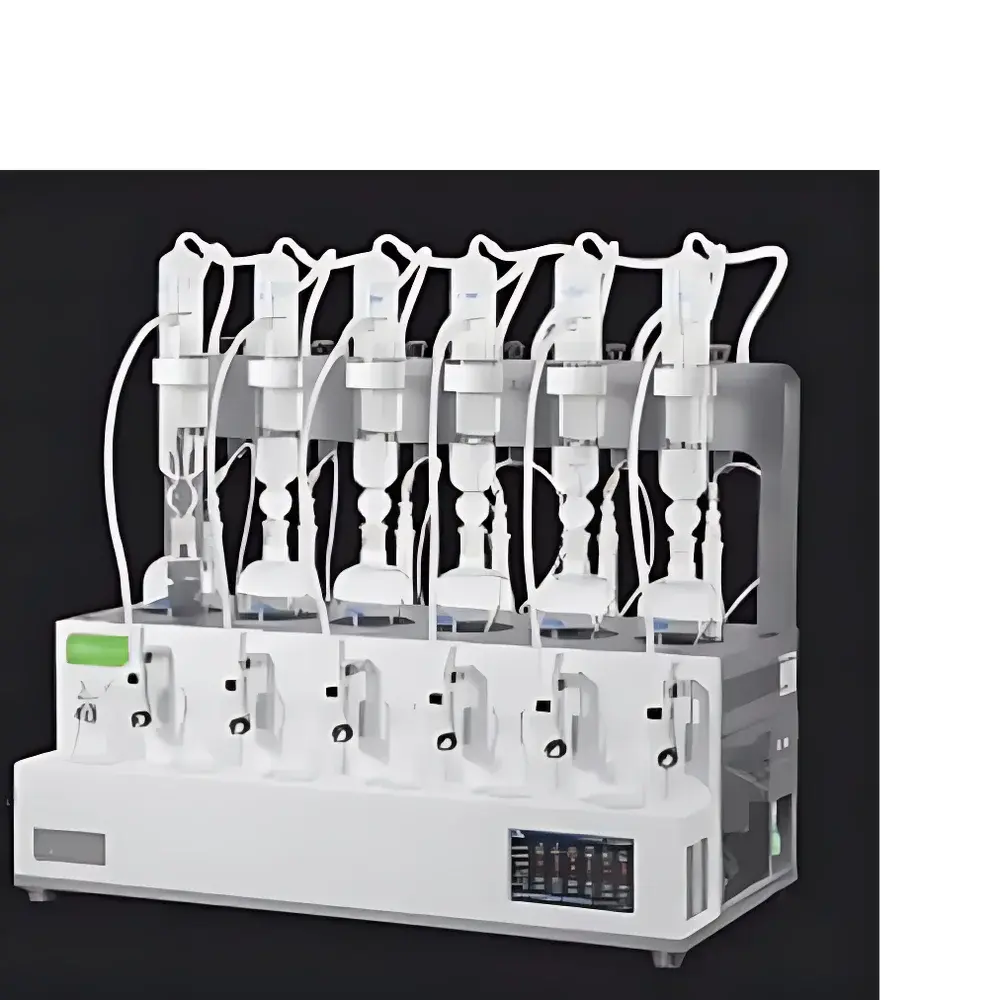
SENTE DSF109E Intelligent Sulfur Dioxide Analyzer for Food and Traditional Chinese Medicine
| Brand | SENTE |
|---|---|
| Origin | Shandong, China |
| Manufacturer Type | Direct Manufacturer |
| Product Type | Intelligent Analyzer |
| Model | DSF109E |
| Heating Method | Automatic Far-Infrared Ceramic Heating with Dry-Run Protection |
| Condenser | Standard-Reflux Condenser (Compliant with GB 5009.34) |
| Temperature Control | Programmable Dual-Mode Heating (Gentle Boil & Full Boil) |
| Timing Range | 0–999 min (Auto-Termination) |
| Reagent Delivery | Precision Motorized Reagent Pump |
| Nitrogen Flow Control | Rotameter, 100–2000 mL/min |
| Leak Detection | Automated Pre-Run Seal Integrity Check |
Overview
The SENTE DSF109E Intelligent Sulfur Dioxide Analyzer is a dedicated, fully automated distillation-based system engineered for quantitative determination of total sulfur dioxide (SO₂) in food matrices and traditional Chinese medicinal materials. It implements the official Chinese national standard method GB 5009.34–2022 (“Determination of Sulfur Dioxide in Foods”) and aligns with pharmacopoeial principles used in TCM quality control—specifically those referenced in the Chinese Pharmacopoeia (ChP) Volume IV, General Chapter 2331. The instrument employs acid liberation followed by steam distillation under controlled nitrogen purge, selective condensation, and subsequent iodometric titration or spectrophotometric quantification (user-configurable). Its architecture integrates thermal, fluidic, and pneumatic subsystems into a single benchtop platform designed for reproducible, operator-independent SO₂ recovery across heterogeneous solid and semi-solid samples—including dried herbs, preserved fruits, wine musts, and processed seafood.
Key Features
- Far-infrared ceramic heating module with real-time temperature feedback and automatic dry-run cutoff—ensures uniform thermal distribution and eliminates risk of glassware fracture or charring during prolonged distillation cycles.
- Standard reflux condenser conforming to GB 5009.34 dimensional and thermal specifications, optimized for high-efficiency vapor condensation and minimal SO₂ loss during return flow.
- Dual-mode programmable heating: “Gentle boil” mode maintains sub-boiling temperature ramp for volatile-sensitive matrices; “Full boil” mode delivers rapid, consistent distillation kinetics for high-SO₂ samples.
- Motor-driven reagent dosing pump with ±0.5% volumetric accuracy across 1–10 mL range—enables precise, repeatable addition of phosphoric acid, hydrochloric acid, or other liberating agents without manual pipetting.
- Calibrated rotameter-based nitrogen flow regulation (100–2000 mL/min), supporting method-specific purge rates required for quantitative SO₂ transfer while minimizing oxidation side reactions.
- Integrated pre-run leak integrity verification: applies slight positive pressure to the sealed distillation path and monitors decay rate over 30 s; triggers audible/visual alarm and halts sequence if >5% pressure loss is detected.
Sample Compatibility & Compliance
The DSF109E accommodates sample weights from 1.0 g to 25.0 g (depending on expected SO₂ concentration), with compatibility extended to powdered, granular, lyophilized, and macerated herbal materials as well as viscous food pastes and fermented substrates. Sample vessels are constructed from borosilicate glass (DIN 7080) and fitted with PTFE-sealed joints to withstand acidic vapors and thermal cycling. The system supports full traceability per GLP requirements: all method parameters (heating profile, timing, reagent volume, N₂ flow) are logged with timestamp and user ID. Data export complies with CSV and PDF report formats suitable for internal QA review or regulatory submission. While not 21 CFR Part 11–validated out-of-the-box, the firmware architecture permits audit trail configuration and electronic signature integration when deployed within validated laboratory environments.
Software & Data Management
The embedded control interface features a 7-inch capacitive touchscreen running a deterministic real-time OS. Users configure methods via intuitive wizards—selecting matrix type, target detection limit, titration endpoint criteria (potentiometric or visual), and reporting units (mg/kg, ppm, or µg/g). All run logs—including raw temperature curves, flow stability metrics, and reagent delivery timestamps—are stored locally on industrial-grade microSD (16 GB included) with optional network upload via Ethernet or Wi-Fi. Exported data files include MD5 checksums for integrity verification. Firmware updates are performed via signed binary packages to prevent unauthorized modification.
Applications
- Quantitative SO₂ residual analysis in dried goji berries, licorice root, hawthorn slices, and other ChP-listed crude drugs.
- Monitoring sulfite levels in fruit juices, candied ginger, pickled vegetables, and wine production intermediates.
- Batch release testing for SO₂-compliant packaging materials and preservative blends used in nutraceutical manufacturing.
- Method development and validation studies supporting ICH Q2(R2) guidelines for analytical procedure verification.
- Teaching laboratories requiring robust, low-maintenance instrumentation for undergraduate food chemistry and pharmacognosy curricula.
FAQ
Does the DSF109E support direct titration output, or is external titrator integration required?
The DSF109E provides distilled absorbate collection in standardized receiving flasks; endpoint detection (e.g., potentiometric or starch-iodine) is performed externally using user-supplied titrators or spectrophotometers. No built-in titration hardware is included.
Can the instrument be calibrated with certified SO₂ reference standards?
Yes—calibration verification is performed using potassium metabisulfite (K₂S₂O₅) reference solutions traceable to NIM (National Institute of Metrology, China) or equivalent CRM providers. Calibration curves are stored per method ID.
Is remote monitoring or LIMS connectivity supported?
Ethernet port enables TCP/IP communication for status polling and log retrieval. Native HL7 or ASTM E1384 interfaces are not implemented, but middleware integration is feasible via RESTful API (available under OEM agreement).
What maintenance intervals are recommended for the reagent pump and heating module?
Reagent pump tubing requires replacement every 6 months under daily use; ceramic heater elements are rated for ≥10,000 operational hours with no scheduled recalibration needed.
Are consumables such as condenser gaskets or distillation flasks available through SENTE?
Yes—original equipment manufacturer (OEM) spares including DIN-standard glassware kits, PTFE joint sleeves, and pump tubing sets are stocked and shipped globally from Jinan headquarters.






