
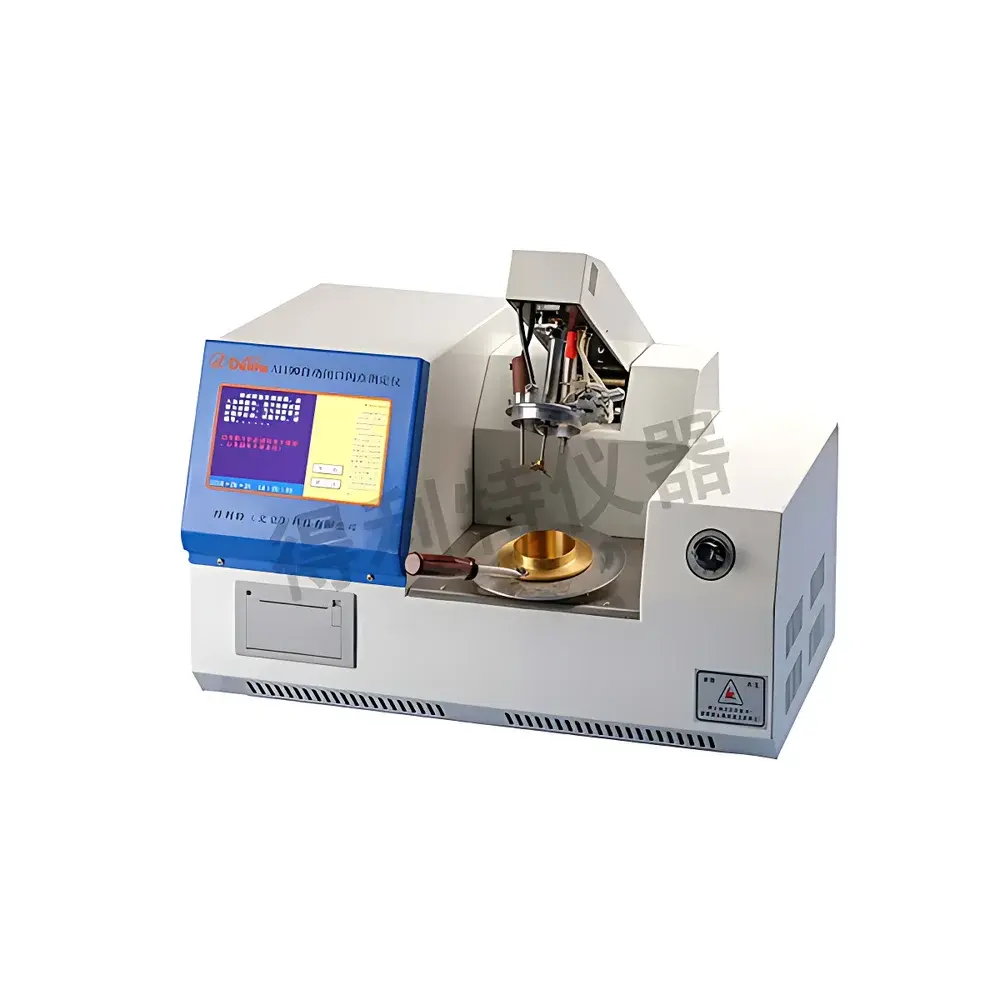
Delite A-1190 Automatic Closed-Cup Flash Point Tester
| Brand | Delite |
|---|---|
| Origin | Beijing, China |
| Manufacturer Type | Manufacturer |
| Country of Origin | Domestic (China) |
| Model | A-1190 |
| Price Range | USD 4,200 – 7,000 |
| Test Method | Closed-Cup (Pensky-Martens) |
| Operation Mode | Fully Automatic |
| Compliant Standards | GB/T 261-2008, GB/T 21615-2008, ASTM D93 |
| Repeatability | ≤2 °C |
| Ignition Method | Electronic spark ignition and adjustable gas flame |
| Temperature Range | 10–40 °C (ambient operating), 0–350 °C (test range) |
| Resolution | 0.1 °C |
| Data Storage | 120 test records onboard |
| Interface | RS-232 & RS-485 |
| Power Supply | AC 220 V ±10%, 50 Hz |
| Max. Power Consumption | ≤300 W |
| Relative Humidity | <85% RH |
Overview
The Delite A-1190 Automatic Closed-Cup Flash Point Tester is an engineered solution for precise determination of the flash point of petroleum products, solvents, lubricants, and other flammable liquids using the standardized Pensky-Martens closed-cup method. Designed in strict accordance with GB/T 261–2008, GB/T 21615–2008, and ASTM D93, the instrument delivers traceable, reproducible results under controlled thermal and atmospheric conditions. Its operation relies on the fundamental principle that flash point is the lowest temperature at which vapors above a liquid sample—confined in a sealed cup—form an ignitable mixture with air upon exposure to an ignition source. The A-1190 integrates real-time temperature ramping control, automated lid actuation, dual-mode ignition (electronic spark and regulated gas flame), and intelligent barometric correction to ensure measurement integrity across varying laboratory environments.
Key Features
- Fully automated test sequence: lid closure, temperature ramping, ignition timing, flash detection, and result reporting—all executed without manual intervention.
- High-resolution 0.1 °C temperature sensing and closed-loop PID control over a 0–350 °C operational range, enabling accurate thermal profiling per standard-defined heating rates.
- Intelligent atmospheric pressure compensation: integrated sensor measures ambient pressure and applies algorithmic correction to flash point values in real time, aligning outputs with reference-standard reporting conditions.
- 7-inch color LCD touchscreen interface with full Chinese menu navigation; supports parameter input for sample ID, test date/time, atmospheric pressure, and user-defined temperature presets.
- Graphical real-time display of temperature vs. time curves during testing, with visual alerts for out-of-spec deviations or procedural anomalies.
- Dual ignition capability: programmable electronic spark ignition for repeatable low-energy initiation, plus auxiliary gas flame mode for validation or legacy method alignment.
- Onboard non-volatile memory stores up to 120 complete test records, including raw temperature data, ignition events, detected flash temperatures, and environmental metadata.
- Standard RS-232 and RS-485 serial interfaces support integration into LIMS environments and enable bidirectional communication for remote parameter configuration and firmware updates.
Sample Compatibility & Compliance
The A-1190 is validated for use with volatile hydrocarbon-based samples including diesel fuel, jet fuel (Jet A-1), gasoline blends, base oils, transformer oils, biodiesel, and industrial solvents. It excludes highly viscous or thermally unstable materials requiring open-cup or Tagliabue methods. Regulatory compliance extends beyond national standards: its design architecture and software logic accommodate audit requirements under ISO/IEC 17025–accredited laboratories, supports GLP documentation workflows, and provides timestamped, user-attributed test logs suitable for internal QA review. While not FDA 21 CFR Part 11–certified out-of-the-box, its data export capabilities (CSV/ASCII) and immutable record timestamps facilitate compliant archival when deployed within validated IT infrastructure.
Software & Data Management
The embedded microprocessor firmware implements deterministic state-machine control and maintains a tamper-evident event log—including operator ID (if configured), start/stop timestamps, ambient pressure readings, and final flash point calculation parameters. Data export via serial interface enables seamless ingestion into third-party analytical platforms or custom database systems. No proprietary software installation is required on host PCs; ASCII-formatted output includes columnar headers for traceability (e.g., “Sample_ID,Timestamp,Flash_Point_C,Atmospheric_Pressure_kPa,Repeatability_Flag”). Optional PC-based utility software (available upon request) provides graphical trend analysis, batch report generation (PDF/Excel), and comparative statistical evaluation across multiple instruments or shifts.
Applications
This instrument serves quality control laboratories in refining facilities, aviation fuel testing centers, power generation utilities (for insulating oil monitoring), railway maintenance depots (lubricant certification), and academic research groups studying hydrocarbon volatility kinetics. Routine applications include incoming inspection of crude fractions, stability assessment of formulated fuels after storage, regulatory submission testing for transportation classification (UN 3391, UN 1203), and specification conformance verification against ASTM D93 Class B or GB/T 261 Category I–III limits. Its repeatability of ≤2 °C meets the precision requirements for inter-laboratory proficiency testing programs aligned with ISO 4256.
FAQ
Does the A-1190 comply with ASTM D93 Method A (manual) or Method B (automated)?
It conforms to ASTM D93 Method B, which specifies automated Pensky-Martens instrumentation with electronic ignition and programmed temperature control.
Can the instrument be calibrated using certified reference materials?
Yes—calibration verification is supported using NIST-traceable flash point standards such as n-decane (flash point ≈ 46 °C) or tetralin (flash point ≈ 81 °C), with documented deviation tracking per ISO/IEC 17025 Clause 6.6.
Is external cooling required during operation?
No—integrated forced-air cooling ensures rapid thermal recovery between tests; ambient temperature must remain within 10–40 °C per specification.
What safety protections are built into the system?
Hardware interlocks prevent ignition unless the test cup lid is fully sealed; overtemperature cutoff disables heating at 360 °C; gas flow is electronically metered and terminated immediately post-ignition.
How is data integrity ensured during power interruption?
Non-volatile memory retains all active and completed test records; the system resumes operation from last stable state upon power restoration, with no loss of stored data or configuration settings.





