
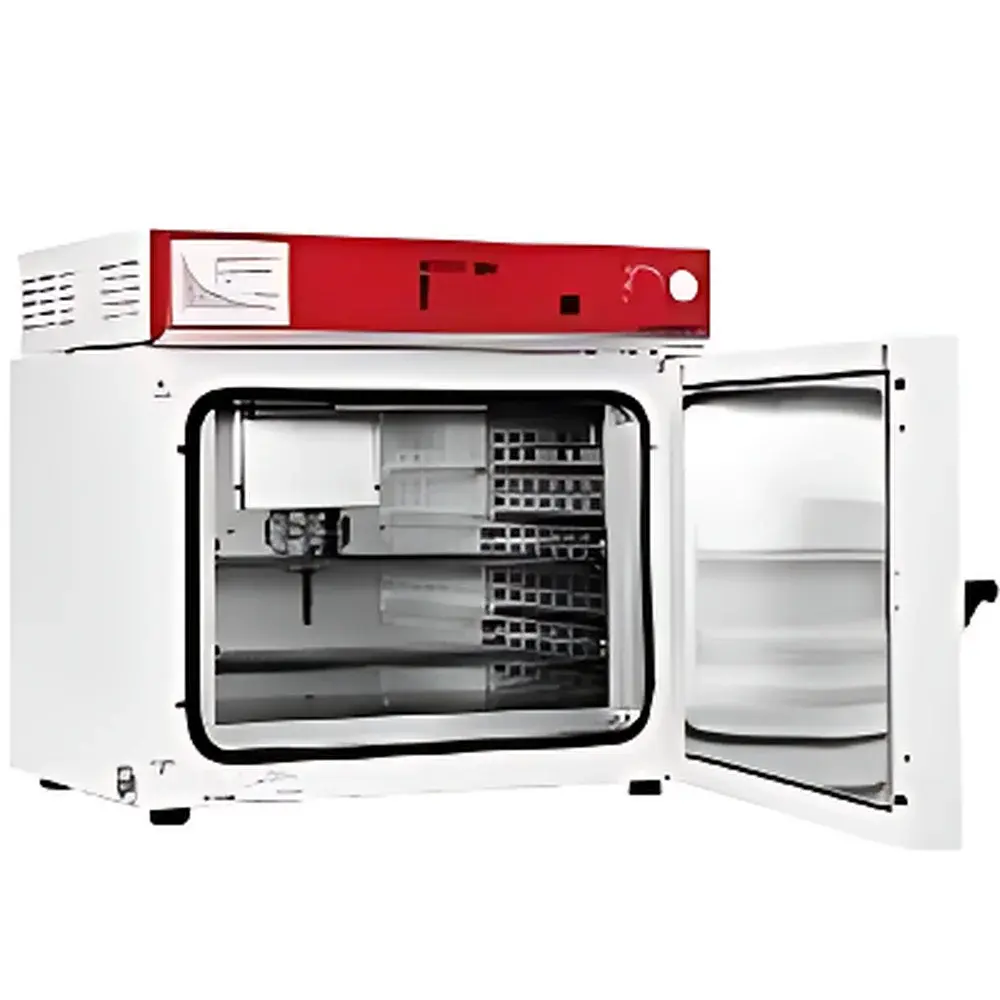
BINDER FDL Series Solvent-Safe Drying Ovens
| Brand | BINDER |
|---|---|
| Origin | Germany |
| Model | FDL |
| Internal Volume | 115 L |
| Temperature Range | Ambient +10 °C to 300 °C |
| Temperature Uniformity at 150 °C | ±2.5 K |
| Temperature Fluctuation | ±0.8 K |
| Heating Time to 150 °C | 20 min 30 sec |
| Recovery Time after 30-sec Door Opening at 150 °C | 12 min |
| Rated Power (230 V) | 2.9 kW |
| Net Weight (empty) | 90 kg |
| Max. Total Load | 60 kg |
| Max. Load per Shelf | 30 kg |
| Standard Shelves | 2 (up to 5 optional) |
| Fresh Air Filter Class | M6 |
| Door Seal Material (standard) | FKM (solvent-resistant, ≤200 °C) |
| Optional Seal | Silicone (solvent-limited, ≤300 °C) |
| Safety Compliance | EN 1539:2010-08 |
| Independent Temperature Safety Device | DIN 12880 Class 2 |
| Controller | Programmable with Interval & Real-time Scheduling |
| Interface | RS 422 |
Overview
The BINDER FDL Series Solvent-Safe Drying Ovens are precision-engineered laboratory ovens designed for the controlled thermal treatment of solvent-containing samples in quality control, R&D, and production environments. Based on convection heating with symmetrical airflow distribution and a silicon-free, particle-controlled interior chamber, the FDL series complies fully with EN 1539:2010-08 — the European standard governing safety requirements for industrial drying and baking ovens used with flammable substances. Its architecture integrates passive explosion protection principles, including forced ventilation, temperature-limited operation, and automatic heating cutoff upon fresh air supply interruption. The oven operates across a wide temperature range from ambient +10 °C up to 300 °C, enabling applications from low-temperature curing to high-temperature polymer crosslinking and solvent evaporation under reproducible conditions.
Key Features
- APTL.line™ preheating chamber technology ensures uniform heat distribution and minimizes thermal gradients across the working volume
- Silicon-free stainless steel interior chamber (electropolished finish) prevents contamination of sensitive coatings, adhesives, and pharmaceutical formulations
- Symmetrical dual-airflow system with rear-mounted fan and front-bottom air intake guarantees consistent temperature homogeneity (±2.5 K at 150 °C) and rapid recovery (<12 min after 30-sec door opening)
- Integrated fresh air monitoring with audible and visual alarm; automatic heater shutdown if airflow falls below threshold
- Replaceable M6-class particulate filter ensures continuous supply of clean, particle-reduced ambient air — critical for ISO 14644-compliant cleanroom-adjacent operations
- Dual-stage independent temperature safety device (DIN 12880 Class 2) provides hardware-level overtemperature protection separate from the main controller
- Standard FKM door gasket rated for continuous use up to 200 °C and resistant to common organic solvents (e.g., acetone, toluene, xylene); optional silicone gasket available for extended 300 °C operation where solvent compatibility permits
- RS 422 interface enables integration into centralized lab automation systems for remote parameter logging, event tracking, and audit-ready data export
Sample Compatibility & Compliance
The FDL series is validated for drying, curing, and conditioning of solvent-based paints, lacquers, inks, adhesives, and composite prepregs. Its EN 1539 certification confirms conformity with structural integrity, ventilation rate, temperature limitation, and ignition source mitigation requirements for Class II A1/B1 equipment handling volatile organic compounds (VOCs). The oven supports GLP and GMP-aligned workflows through configurable alarm logging, user-accessible calibration records, and traceable parameter history. While not intrinsically rated for Zone 1 hazardous areas, its design satisfies the functional safety prerequisites for installation in ventilated laboratories handling Class I flammable liquids per NFPA 30 and ATEX Directive 2014/34/EU Annex I Group II applications.
Software & Data Management
The programmable controller supports both interval-based and real-time scheduling, allowing multi-step drying profiles (e.g., ramp-hold-cool sequences) with up to 16 segments per program. All operational events — including door openings, temperature deviations, fresh air alarms, and safety device triggers — are timestamped and stored in non-volatile memory. Data export via RS 422 supports CSV-formatted logs compatible with LIMS and electronic lab notebook (ELN) platforms. Audit trail functionality meets FDA 21 CFR Part 11 requirements when deployed with appropriate system access controls and electronic signature protocols.
Applications
- Automotive and aerospace paint shop QC: film thickness stabilization and solvent residue quantification prior to gloss measurement
- Coating formulation development: optimization of cure kinetics under controlled ventilation and thermal ramping
- Pharmaceutical excipient drying: moisture removal from solvent-cast films without silicon leaching or particulate generation
- Electronics manufacturing: pre-bake of photoresist-coated wafers and conformal coating validation
- Academic materials science labs: thermal aging studies of polymer blends and nanocomposites under inert or ventilated atmospheres
FAQ
Is the FDL oven suitable for drying samples containing chlorinated solvents such as chloroform or methylene chloride?
Yes — the FKM gasket and stainless steel chamber are chemically resistant to most chlorinated hydrocarbons; however, prolonged exposure above 150 °C may accelerate degradation. Consult the BINDER Chemical Resistance Guide before extended use.
Can the oven be operated in a nitrogen-purged environment?
No — the FDL series relies on active fresh air exchange for safety compliance and thermal stability. Nitrogen purging voids EN 1539 certification and disables the fresh air monitoring system.
What maintenance intervals are recommended for the M6 filter and temperature sensors?
The M6 filter should be replaced every 6 months under continuous operation; temperature sensor verification is recommended annually using NIST-traceable reference standards.
Does the RS 422 interface support Modbus RTU protocol?
No — the native protocol is BINDER’s proprietary ASCII command set; third-party integration requires middleware translation or OEM-provided drivers.
Is calibration documentation provided with shipment?
Yes — each unit ships with a factory calibration certificate covering chamber temperature uniformity, deviation, and fluctuation at 100 °C, 150 °C, and 250 °C, traceable to DAkkS-accredited standards.



