
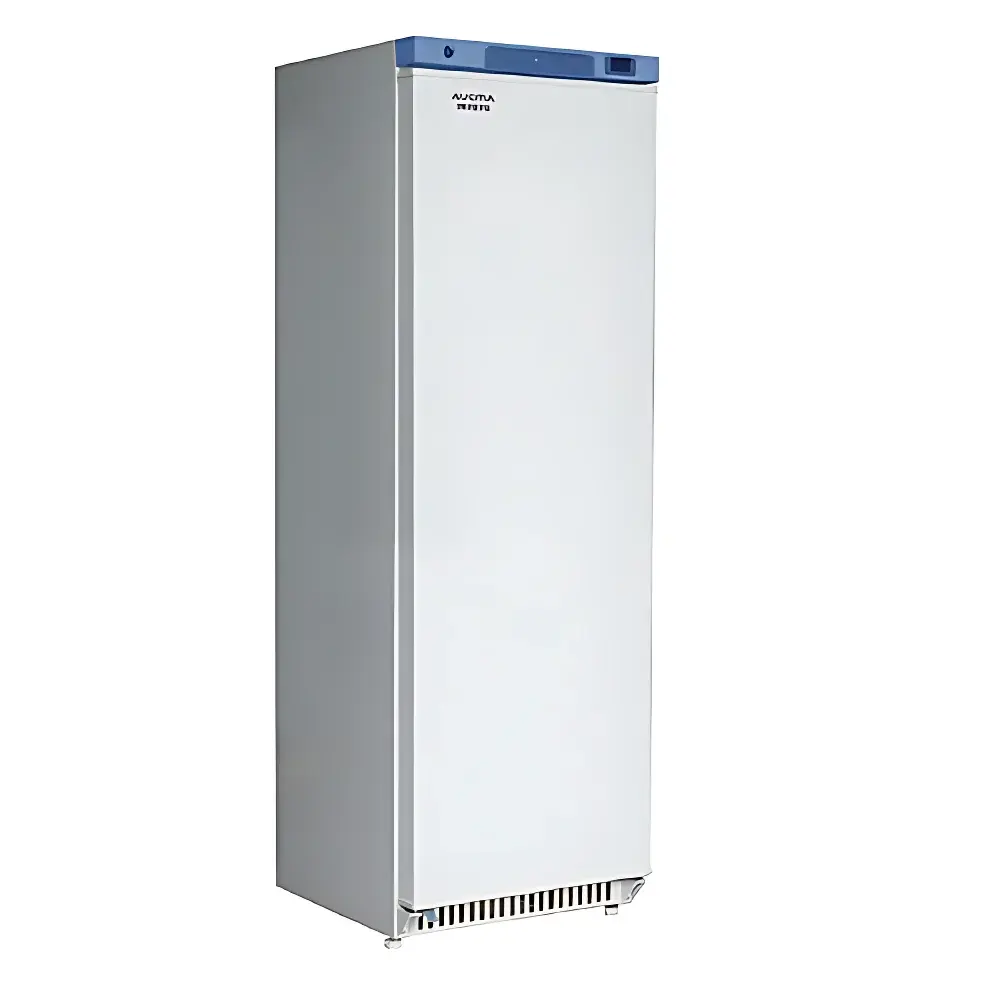
AUCMA DW Series Ultra-Low Temperature Freezers
| Key | Brand: AUCMA |
|---|---|
| Model Series | DW |
| Temperature Ranges | −25 °C to −60 °C |
| Voltage/Frequency | 220 V / 50 Hz |
| Insulation | High-density polyurethane foam with microcellular foaming technology |
| Refrigerant | Non-CFC, non-HCFC eco-friendly refrigerant |
| Compressor | Industrial-grade hermetic compressor |
| Control System | Microprocessor-based digital temperature controller with dual-stage alarm logic |
| Compliance | Designed for GLP-compliant laboratory environments |
Overview
The AUCMA DW Series Ultra-Low Temperature Freezers are engineered for reliable, long-term storage of biologics, clinical specimens, cell lines, vaccines, and nucleic acid samples in research laboratories, biobanks, clinical diagnostics centers, and pharmaceutical quality control facilities. These freezers operate on a cascade refrigeration principle—employing two independent refrigeration circuits (typically R404A/R23 or equivalent low-GWP blends) to achieve stable, uniform temperatures across three distinct operating ranges: −25 °C, −40 °C, and −60 °C. The system architecture prioritizes thermal stability, minimizing temperature fluctuation (< ±2 °C at setpoint under standard load conditions) and ensuring sample integrity during extended storage cycles. Cabinet design follows ISO 13732-1 ergonomic guidelines for door operation and interior accessibility, while structural rigidity supports stacking configurations where permitted by local building codes.
Key Features
- Precision Digital Temperature Control: Microprocessor-based controller with high-resolution LED display; adjustable setpoints in 0.1 °C increments across the full operational range (−10 °C to −60 °C depending on model).
- Dual-Stage Alarm System: Independent monitoring of chamber temperature and sensor integrity; configurable audible (piezo buzzer) and visual (LED flash) alerts for high/low temperature deviation and sensor failure.
- Robust Thermal Insulation: 100–120 mm thick polyurethane insulation with closed-cell microfoam structure (density ≥ 40 kg/m³), achieving effective thermal resistance (R-value > 3.5 m²·K/W) and minimizing heat ingress during power interruption.
- Eco-Compliant Refrigeration: Uses zero-ozone-depletion-potential (ODP = 0) and low-global-warming-potential (GWP < 10) refrigerants; fully compliant with EU F-Gas Regulation (EU No 517/2014) and China’s HCFC Phase-Out Management Plan.
- Industrial-Grade Components: Hermetically sealed compressors with high COP (coefficient of performance); low-noise axial fans with IP54-rated motors; reinforced stainless-steel evaporator coils resistant to condensate corrosion.
- Operational Safeguards: Built-in compressor protection including delayed startup (≥ 3 min), minimum off-cycle interval (≥ 3 min), and keypad lockout to prevent unauthorized parameter changes.
Sample Compatibility & Compliance
The DW Series accommodates standard cryogenic storage configurations—including stacked cryoboxes (e.g., 10 × 10 format), rack-mounted vial trays, and modular aluminum canisters—without compromising airflow uniformity. Interior dimensions are optimized to maintain laminar air distribution from rear-mounted evaporator panels, ensuring ≤1.5 °C vertical temperature gradient under static load (per ASTM F2697-22 Annex A3). Units meet IEC 61000-4 electromagnetic compatibility standards and conform to GB/T 20154–2014 (Chinese national standard for ultra-low temperature freezers). While not certified to UL 471 or EN 60335-2-24 out-of-the-box, models are designed to support third-party safety certification upon request. Documentation packages include factory calibration reports traceable to NIM (National Institute of Metrology, China) standards.
Software & Data Management
These freezers operate as standalone instruments with no embedded network interface or cloud connectivity. Temperature data is displayed locally and may be manually logged per institutional GLP requirements. Optional external USB data loggers (e.g., HOBO UX100 series) can be integrated via probe ports located behind the rear panel. All models support 21 CFR Part 11–compatible audit trails when paired with validated third-party environmental monitoring systems (EMS), provided timestamped records are generated externally and stored in secure, access-controlled repositories. Firmware updates are performed exclusively via physical service technician intervention using proprietary diagnostic tools.
Applications
- Long-term preservation of primary human tissues and PBMCs at −80 °C-equivalent stability (validated for ≤5-year viability at −60 °C with appropriate cryoprotectants)
- Storage of mRNA vaccine intermediates requiring strict cold-chain adherence between −25 °C and −40 °C
- Biobank specimen archiving per ISBER Best Practices (2022) for temperature uniformity and alarm response time
- QC stability testing of reference standards per ICH Q5C guidelines
- Backup storage for −80 °C freezer failures in academic core facilities
FAQ
What is the typical recovery time after door opening?
Recovery to ±2 °C of setpoint typically requires 8–12 minutes following a 30-second door opening under ambient 25 °C conditions (tested per ISO 23993:2022 Annex B).
Are these units suitable for GMP-regulated environments?
They provide foundational thermal performance required for GMP Annex 1 cold storage zones; however, formal qualification (IQ/OQ/PQ) must be conducted per site-specific protocols and supported by documented calibration and preventive maintenance schedules.
Can internal shelves be reconfigured?
Yes—most DW-W and DW-L variants feature adjustable stainless-steel shelving with standardized mounting rails, allowing customization for oversized containers or custom racks.
Is remote monitoring possible?
Not natively; integration with facility-wide BMS or EMS requires analog voltage output modules (available as field-installable accessories) or third-party contact-closure relay interfaces.
What maintenance intervals are recommended?
Compressor oil inspection every 24 months; condenser coil cleaning every 6 months in dust-prone environments; door gasket integrity verification quarterly per ISO 15197:2013 guidance.





