
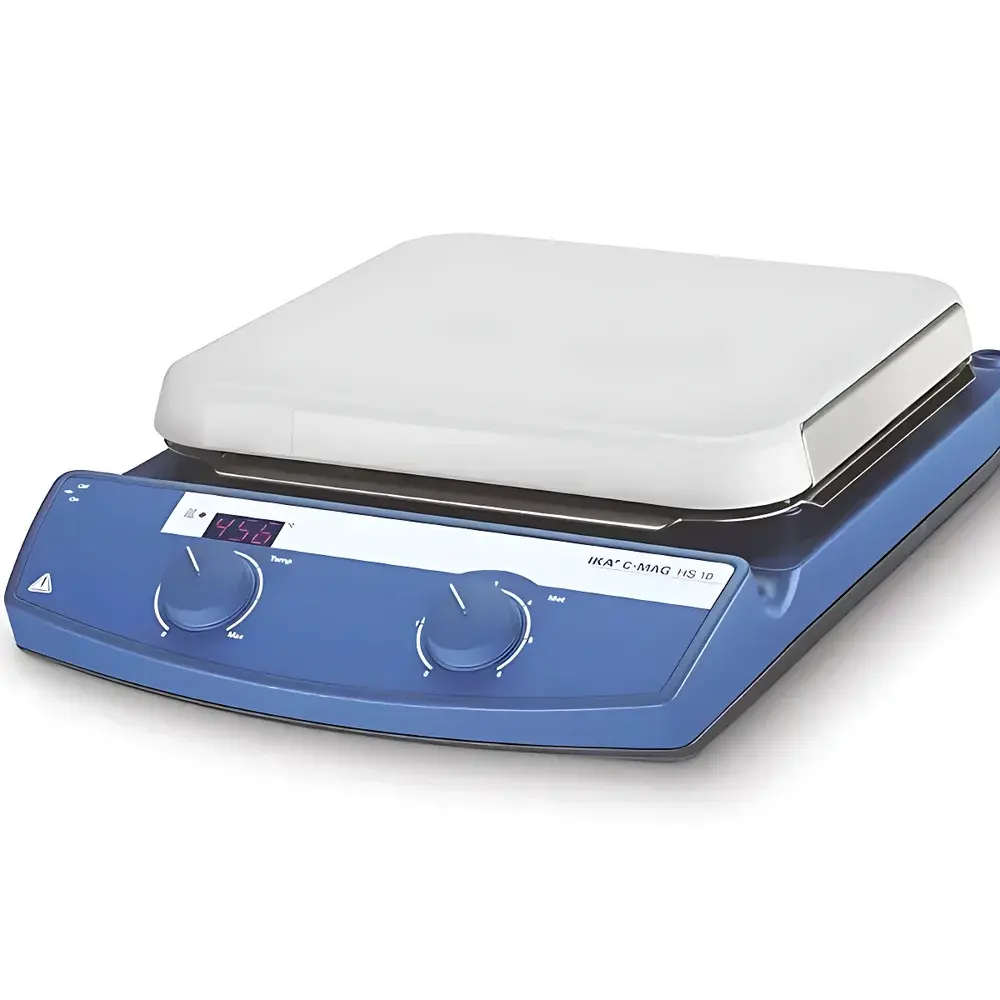
IKA C-MAG HS 10 Magnetic Stirrer with Hotplate
| Brand | IKA |
|---|---|
| Origin | Germany |
| Model | C-MAG HS 10 |
| Stirring Positions | 1 |
| Max. Stirring Volume (H₂O) | 15 L |
| Motor Output Power | 1.5 W |
| Rotation Direction | Counter-Clockwise |
| Speed Control | Analog Dial (0–6) |
| Speed Range | 100–1500 rpm |
| Max. Stir Bar Length | 80 mm |
| Heating Power Output | 1500 W |
| Heating Temperature Range | 50–500 °C |
| Heating Rate | 5 K/min |
| Temperature Setting Accuracy | ±5 K |
| External Temperature Sensor Interface | ETS-D5 |
| Over-Temperature Safety Cut-Off | 550 °C |
| Plate Material | Ceramic |
| Plate Dimensions | 260 × 260 mm |
| Overall Dimensions | 300 × 105 × 415 mm |
| Weight | 6 kg |
| Ambient Operating Temperature | 5–40 °C |
| Relative Humidity Limit | 80 % |
| Protection Class | IP21 (per DIN EN 60529) |
| Voltage | 230 V AC |
| Frequency | 50/60 Hz |
| Total Input Power | 1520 W |
Overview
The IKA C-MAG HS 10 is a high-performance magnetic stirrer and hotplate combination designed for demanding laboratory applications requiring precise thermal control and robust mechanical stirring. Engineered for reproducibility and long-term stability, it operates on the principle of electromagnetic induction to rotate magnetic stir bars within vessels while simultaneously heating the sample via a ceramic-coated aluminum heating plate. Its dual-function architecture supports both temperature-sensitive reactions and high-viscosity mixing tasks—common in synthetic chemistry, materials science, and quality control laboratories. The device integrates analog speed regulation with digital temperature feedback capability (when paired with optional ETS-D5 sensor), enabling users to maintain consistent process conditions across repeated experiments under GLP-compliant workflows.
Key Features
- Single-position design optimized for large-volume applications—supports up to 15 L of aqueous solution or equivalent viscosity media
- Ceramic-coated heating plate (260 × 260 mm) offering exceptional chemical resistance, thermal uniformity, and mechanical durability
- Microprocessor-controlled motor and heater subsystems ensure stable rotational speed and accurate thermal setpoint maintenance
- Elevated control panel minimizes risk of liquid ingress during operation and improves ergonomics for parameter readout and adjustment
- Integrated safety circuitry includes fixed overtemperature cutoff at 550 °C and visual thermal warning indicator (blinking LED during active heating)
- Analog speed dial (0–6 scale) coupled with 100–1500 rpm operating range delivers fine-grained control for low-shear or high-torque mixing scenarios
- Compatible with IKA’s ETS-D5 external contact temperature sensor for closed-loop solution temperature monitoring and regulation (optional accessory)
Sample Compatibility & Compliance
The C-MAG HS 10 accommodates standard round-bottom flasks, beakers, and reaction vessels ranging from 50 mL to 20 L capacity. Its strong magnetic coupling system prevents “jumping” of stir bars—even with viscous solutions or asymmetric vessel geometries—provided stir bar length does not exceed 80 mm. The ceramic surface resists corrosion from common solvents (e.g., acetone, ethanol, dilute acids/bases) and withstands thermal shock during rapid heating or cooling cycles. The unit complies with DIN EN 60529 (IP21 ingress protection), IEC 61010-1 (safety requirements for electrical equipment), and meets CE marking directives for laboratory instrumentation. While not intrinsically rated for hazardous area use, its design supports integration into ISO/IEC 17025-accredited testing environments when operated per manufacturer guidelines.
Software & Data Management
The C-MAG HS 10 operates as a standalone instrument without embedded firmware-based data logging or USB connectivity. However, its analog interface supports seamless integration with external data acquisition systems via optional analog output modules (e.g., IKA RH basic controller). When used with the ETS-D5 sensor, real-time temperature feedback enables manual recording or connection to third-party chart recorders or SCADA platforms. For regulated environments governed by FDA 21 CFR Part 11 or EU Annex 11, users may implement procedural controls—including logbook entries, calibration verification records, and periodic performance checks—to satisfy audit trail requirements. Routine calibration of speed and temperature functions is recommended per ISO/IEC 17025 Clause 6.5.
Applications
- Synthesis and purification protocols requiring simultaneous heating and agitation (e.g., esterification, polymerization, crystallization)
- Preparation of homogeneous suspensions, emulsions, and colloidal dispersions in pharmaceutical development
- Dissolution testing and buffer equilibration in QC/QA laboratories
- Sample digestion and extraction procedures in environmental and food safety analysis
- Calibration and validation of thermocouples and RTDs using traceable reference standards
- Teaching laboratory demonstrations of kinetic studies, phase transitions, and heat transfer phenomena
FAQ
Is the C-MAG HS 10 suitable for use with corrosive solvents?
Yes—the fully sealed ceramic plate surface provides broad resistance to organic solvents, mild acids, and alkaline solutions. Avoid prolonged exposure to hydrofluoric acid or molten alkali metals.
Can the unit maintain precise solution temperature without an external probe?
No. The built-in heater temperature reading reflects plate surface temperature only. For accurate solution temperature control, the ETS-D5 contact sensor must be connected and immersed in the sample.
What is the maximum allowable ambient humidity for continuous operation?
The device is rated for operation at ≤80% relative humidity (non-condensing), per IEC 61010-1 environmental classification.
Does the C-MAG HS 10 support clockwise rotation?
No—it rotates exclusively counter-clockwise, which is standard for IKA magnetic stirrers and compatible with most commercially available stir bars.
How often should speed and temperature calibration be performed?
Annual calibration is recommended; more frequent verification (e.g., quarterly) is advised in GxP-regulated settings or after mechanical impact or extended high-temperature cycling.



