
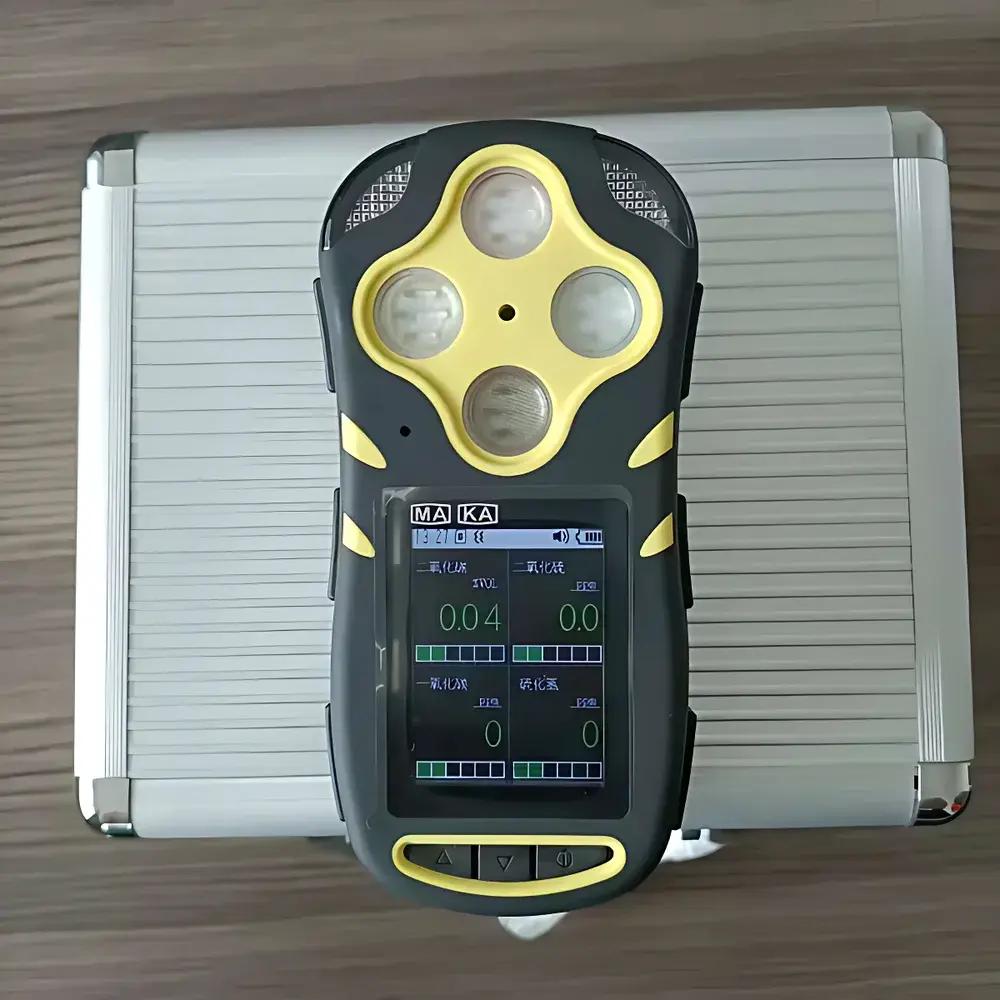
CD4(B) Multi-Gas Detector for CO₂, CO, H₂S, and SO₂
| Origin | Beijing, China |
|---|---|
| Manufacturer Type | Authorized Distributor |
| Origin Category | Domestic (China) |
| Model | CD4(B) |
| Pricing | Available Upon Request |
| Detection Gases | CO₂, CO, H₂S, SO₂ |
| Detection Principles | Non-Dispersive Infrared (NDIR) for CO₂ |
| Measurement Ranges | CO: 0–1000 ppm |
| SO₂ | 0.0–100.0 ppm |
| H₂S | 0.0–100.0 ppm |
| CO₂ | 0.00–5.00% vol |
| Accuracy | CO: ±2 ppm (0–20 ppm), ±4 ppm (20–100 ppm), ±5% FS (100–500 ppm), ±6% FS (500–1000 ppm) |
| SO₂ | ±5.0 ppm (0–50 ppm), ±10% FS (50–100 ppm) |
| H₂S | ±3 ppm (0–49 ppm), ±10% FS (50–100 ppm) |
| CO₂ | ±0.10% (0–0.50%), ±(0.05% + 5% of reading) (0.50–5.00%) |
| Alarm Accuracy | CO: ±1 ppm at 25 ppm |
| SO₂ | ±0.2 ppm at 10 ppm |
| H₂S | ±1 ppm at 10 ppm |
| CO₂ | ±0.05% at 1.00% |
| Response Time (200 mL/min) | ≤45 s (CO, SO₂, H₂S), ≤60 s (CO₂) |
| Audible Alarm | ≥75 dB(A) at 1 m |
| Visual Alarm | Blue LED strobe visible ≥20 m in darkness |
| Vibration Alert | Integrated haptic feedback |
| Display | 2.4″ TFT color LCD with bilingual (English/Chinese) UI |
| Data Logging | Optional internal storage with configurable interval |
| Interface | USB 2.0 for data export and firmware update |
| Battery | Rechargeable Li-ion, 7.2 V nominal, ≤120 mA avg. current draw |
| Runtime | >10 h continuous operation |
| Enclosure | ABS+PC dual-material impact- and ESD-resistant housing |
| Dimensions & Weight | 135 × 60 × 20 mm / 200 g |
| Environmental Rating | IP55 |
| Hazardous Area Certification | Exib I Mb (for use in coal mine methane environments) |
| Operating Temp. | −20 °C to +55 °C |
| Operating Humidity | 0–95% RH non-condensing |
| Sensor Lifespan | CO₂: >5 years |
| CO/H₂S/SO₂ | >2 years each |
| Regulatory Compliance | MA (Mine Safety Mark), CNEx explosion-proof certification, CNAS-accredited test reports |
Overview
The CD4(B) Multi-Gas Detector is a compact, intrinsically safe portable instrument engineered for simultaneous real-time monitoring of four critical toxic and asphyxiant gases: carbon dioxide (CO₂), carbon monoxide (CO), hydrogen sulfide (H₂S), and sulfur dioxide (SO₂). Designed specifically for demanding industrial and underground mining applications—particularly coal mine ventilation safety assessment—the device integrates dual-sensing modalities: non-dispersive infrared (NDIR) spectroscopy for high-stability CO₂ quantification, and precision potentiostatic electrochemical cells for selective, low-range detection of CO, H₂S, and SO₂. Its architecture adheres to the functional safety requirements of IEC 61508 SIL 2 and operational constraints defined in GB 3836.4–2021 (Explosion-Proof Electrical Apparatus – Intrinsically Safe “i” Protection). The detector operates continuously under variable environmental loads, delivering metrologically traceable measurements across its full dynamic range while maintaining compliance with Chinese national standards for mine safety instrumentation (AQ 6205–2019, AQ 6207–2019).
Key Features
- Intrinsically safe design certified to Exib I Mb, enabling deployment in Zone 0/10 methane-rich underground coal mine environments.
- Bilingual (English/Chinese) TFT color display with intuitive menu navigation, supporting rapid operator onboarding and cross-regional field use.
- Triple-alert system: audible alarm (≥75 dB[A] at 1 m), high-intensity visual strobe (blue LED, ≥20 m visibility in darkness), and tactile vibration feedback—ensuring alert redundancy under high-noise or low-visibility conditions.
- Configurable dual-stage alarm thresholds: primary (pre-alarm) and secondary (critical) levels independently adjustable across the entire measurement span for each gas.
- Self-diagnostic startup sequence verifying battery status, sensor integrity, acoustic/optical output functionality, and baseline zero stability prior to deployment.
- Robust mechanical construction: shock-absorbing ABS/PC hybrid housing rated IP55 for dust ingress resistance and limited water jet protection.
- Extended operational endurance: >10 hours of continuous monitoring on a single charge, optimized for multi-shift field surveys without mid-cycle recharging.
Sample Compatibility & Compliance
The CD4(B) is validated for direct ambient air sampling at standard flow rate (200 mL/min) without external dilution or conditioning. It meets the physical and performance criteria specified in China’s mandatory mine safety product certification framework, including the Mine Safety Approval Mark (MA) and CNEx explosion-proof certification (Certificate No. CNEx20.1234X). Sensor calibration traceability aligns with JJG 968–2021 (Calibration Regulations for Electrochemical Gas Detectors) and JJG 693–2011 (Calibration Regulations for NDIR Gas Analyzers). Device firmware and hardware design support audit-ready operation per GB/T 27025–2019 (General Requirements for Competence of Testing and Calibration Laboratories), with built-in timestamped event logging for GLP-aligned recordkeeping.
Software & Data Management
Data acquisition and reporting are supported via optional USB 2.0 interface, enabling secure transfer of time-stamped concentration logs, alarm events, and system diagnostics to host PCs running Windows-based configuration software. Internal memory (optional configuration) stores up to 100,000 records with user-defined sampling intervals (1 s to 24 h). All stored datasets include UTC timestamps, gas-specific channel identifiers, battery voltage, and diagnostic flags. Firmware updates preserve calibration coefficients and user settings, ensuring metrological continuity during maintenance cycles. Exported CSV files are compatible with common industrial analytics platforms (e.g., LabVIEW, MATLAB, Excel) for trend analysis, exposure dose calculation (per GBZ/T 188–2014), and regulatory reporting.
Applications
- Coal mine shaft and roadway atmospheric monitoring for CH₄ displacement risk assessment and ventilation efficiency verification.
- Confined space entry pre-screening in petrochemical, wastewater treatment, and utility tunnel environments.
- Emergency response triage where rapid identification of CO/H₂S co-exposure informs respiratory protection selection.
- Industrial hygiene surveys tracking cumulative 8-hour TWA exposures against GBZ 2.1–2019 occupational exposure limits.
- Post-incident forensic gas mapping following fire, chemical spill, or geothermal venting events.
FAQ
What certifications does the CD4(B) hold for use in hazardous locations?
It carries the Exib I Mb intrinsic safety certification (CNEx) and the China National Mine Safety Mark (MA), permitting operation in coal mine Class I explosive atmospheres containing methane-air mixtures.
Can the alarm thresholds be customized for site-specific exposure limits?
Yes—both primary and secondary alarm points for each gas are fully programmable across their respective measurement ranges using the onboard keypad or PC configuration tool.
How often must the sensors be calibrated?
Electrochemical sensors require bump testing before each shift and full calibration every 30 days or after exposure to extreme concentrations; NDIR CO₂ sensor calibration interval is extended to 6 months under stable operating conditions.
Is the device suitable for outdoor use in extreme temperatures?
It operates reliably from −20 °C to +55 °C and tolerates 0–95% RH (non-condensing), making it appropriate for unsheltered field deployments across most climatic zones in Asia and Eastern Europe.
Does the CD4(B) support data export in formats compliant with regulatory submissions?
Yes—CSV exports include ISO 8601 timestamps, gas identifiers, concentration values, units, and diagnostic metadata, satisfying documentation requirements under GB/T 27025–2019 and internal QA/QC protocols.
Related Products







