
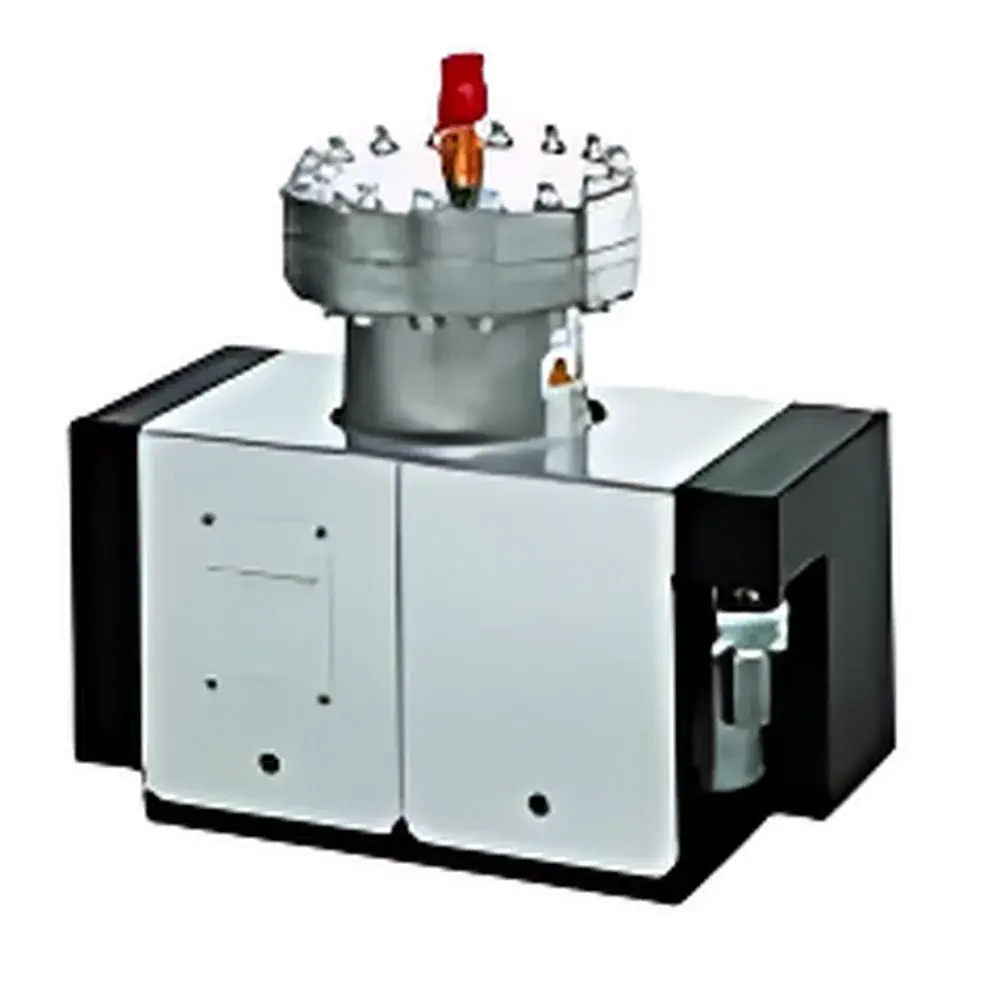
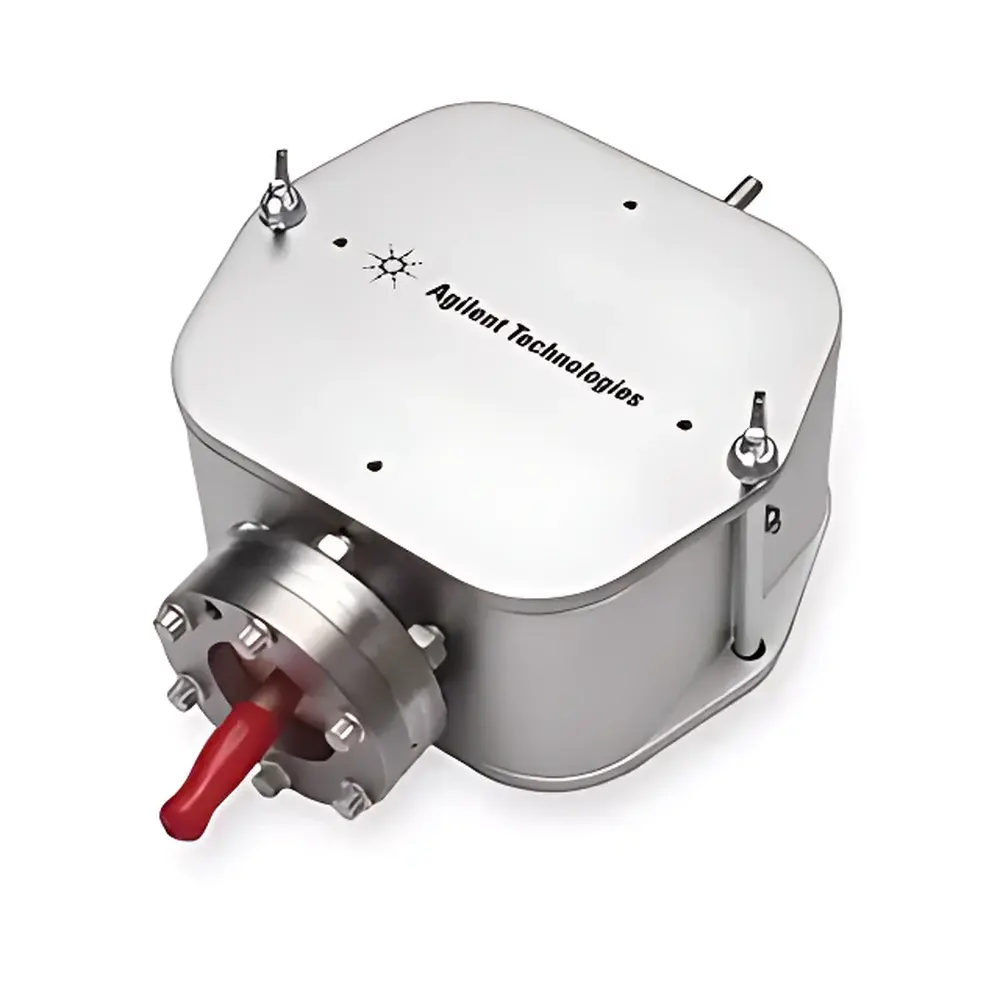
VacIon Ultra-High Vacuum Ion Pump System by Agilent Technologies
| Brand | Agilent Technologies |
|---|---|
| Origin | Italy |
| Manufacturer Type | Original Equipment Manufacturer (OEM) |
| Origin Category | Imported |
| Model | VacIon |
| Pump Type | Oil-Free Ion Pump |
| Pumping Speed | 1000 L/s |
| Ultimate Pressure | ≤ 5 × 10⁻² mbar |
| Weight | 265 kg |
| Electrical Power Consumption | 0 W (No Motor, No Moving Parts) |
Overview
The VacIon Ultra-High Vacuum (UHV) Ion Pump System by Agilent Technologies—originally developed by Varian and now part of Agilent’s advanced vacuum portfolio—is a magnetically confined, sputter-ion based vacuum pumping solution engineered for continuous, vibration-free operation in demanding UHV (≤10⁻⁷ mbar) and extreme high vacuum (XHV, ≤10⁻¹⁰ mbar) environments. Unlike turbomolecular or cryogenic pumps, the VacIon system operates without mechanical motion, oil, or consumables: it relies on ionization of residual gas molecules under high-voltage DC fields (typically ±3–7 kV), followed by momentum transfer and burial into chemically active cathode surfaces (titanium and tantalum). This principle enables stable, ultra-clean vacuum conditions essential for surface science, electron microscopy, particle accelerators, synchrotron beamlines, and quantum measurement systems where hydrocarbon contamination, magnetic interference, or mechanical micro-vibrations must be eliminated.
Key Features
- Oil-free, dry, and maintenance-free operation with zero moving parts—eliminates vibration, particulate generation, and hydrocarbon backstreaming.
- High pumping speed of 1000 L/s for nitrogen-equivalent gases; optimized cathode geometry and magnetic field configuration ensure balanced performance across reactive (N₂, O₂, H₂) and inert (Ar, He) species.
- Ultra-low leakage current (<1 nA typical at operating voltage), enabling precise, drift-free pressure monitoring when paired with compatible ion gauge controllers.
- Low intrinsic magnetic field design (<0.5 mT at 10 cm distance) minimizes perturbation to electron beams, spin-polarized measurements, and SQUID-based detectors.
- Pre-baked and valve-sealed at >400 °C under vacuum—ensures factory-certified cleanliness and outgassing stability prior to installation.
- Modular ConFlat (CF) flange interface (non-rotational CF150 or CF200 standard), with optional dual-end, side-port, or multi-hole configurations for flexible integration into complex vacuum manifolds.
- Customizable high-voltage feedthroughs (Fischer, King, DESY, Varian, Safeconn standards), external heating jackets (for active bake-out), magnetic shielding, and integrated optical baffles for photon-sensitive applications.
Sample Compatibility & Compliance
The VacIon pump is compatible with all common UHV/XHV chamber materials—including stainless steel 316L, aluminum alloys, and ceramic insulators—and supports long-term operation under bake-out temperatures up to 400 °C. It complies with international vacuum engineering standards including ISO 27893 (vacuum pump safety), ASTM E576 (vacuum system cleanliness verification), and ISO 10110-7 (optical component vacuum compatibility). When integrated into regulated environments (e.g., medical device manufacturing or pharmaceutical analytical instrumentation), the system supports GLP/GMP audit trails via optional digital controller logging and meets electromagnetic compatibility requirements per EN 61326-1. Its zero-power consumption during steady-state operation aligns with energy-efficient laboratory infrastructure mandates.
Software & Data Management
While the VacIon pump itself is a passive, analog device requiring no embedded firmware, it is fully compatible with Agilent’s VACUUBRAND VACUU*VIEW and Agilent Vacuum Control Suite (AVCS) software platforms. These tools enable remote monitoring of high-voltage status, leakage current trends, and real-time pressure correlation via connected Bayard–Alpert or cold cathode gauges. All controller logs are timestamped and exportable in CSV/Excel format. For FDA-regulated applications, AVCS supports 21 CFR Part 11-compliant user access control, electronic signatures, and immutable audit trails—ensuring full traceability from pump activation through system validation.
Applications
- Scanning Electron Microscopy (SEM) and Transmission Electron Microscopy (TEM) column vacuum maintenance
- Surface analysis techniques including XPS (X-ray Photoelectron Spectroscopy), AES (Auger Electron Spectroscopy), and LEED (Low-Energy Electron Diffraction)
- Ultra-high vacuum chambers for atomic physics experiments, cold atom traps, and quantum computing testbeds
- Medical cyclotron beamline vacuum systems and radioisotope production modules
- Space simulation chambers and satellite component testing facilities
- Residual gas analyzers (RGAs) and mass spectrometer ion sources requiring stable, contaminant-free base pressure
FAQ
Does the VacIon pump require a backing pump?
Yes—ion pumps cannot start from atmosphere. A roughing pump (e.g., diaphragm or scroll pump) must first reduce chamber pressure to ≤1 × 10⁻² mbar before high-voltage activation.
Can the VacIon pump handle noble gases like helium or argon?
Standard three-electrode VacIon units provide limited pumping speed for noble gases; optional inert-gas-optimized cathodes (e.g., tantalum-titanium hybrid) are available for enhanced Ar/He capture.
What is the expected lifetime under continuous UHV operation?
With proper pre-bake and clean installation, service life exceeds 10 years or 100,000 hours—limited only by cathode sputter erosion, which is negligible below 10⁻⁸ mbar.
Is magnetic shielding included as standard?
No—low-field design is inherent, but supplemental mu-metal shielding is offered as an optional accessory for ultra-sensitive magnetic applications.
How is vacuum integrity verified before shipment?
Each unit undergoes helium leak testing to ≤1 × 10⁻¹¹ mbar·L/s, followed by 48-hour bake-out at 400 °C and pressure hold validation at ≤5 × 10⁻² mbar under sealed conditions.



