
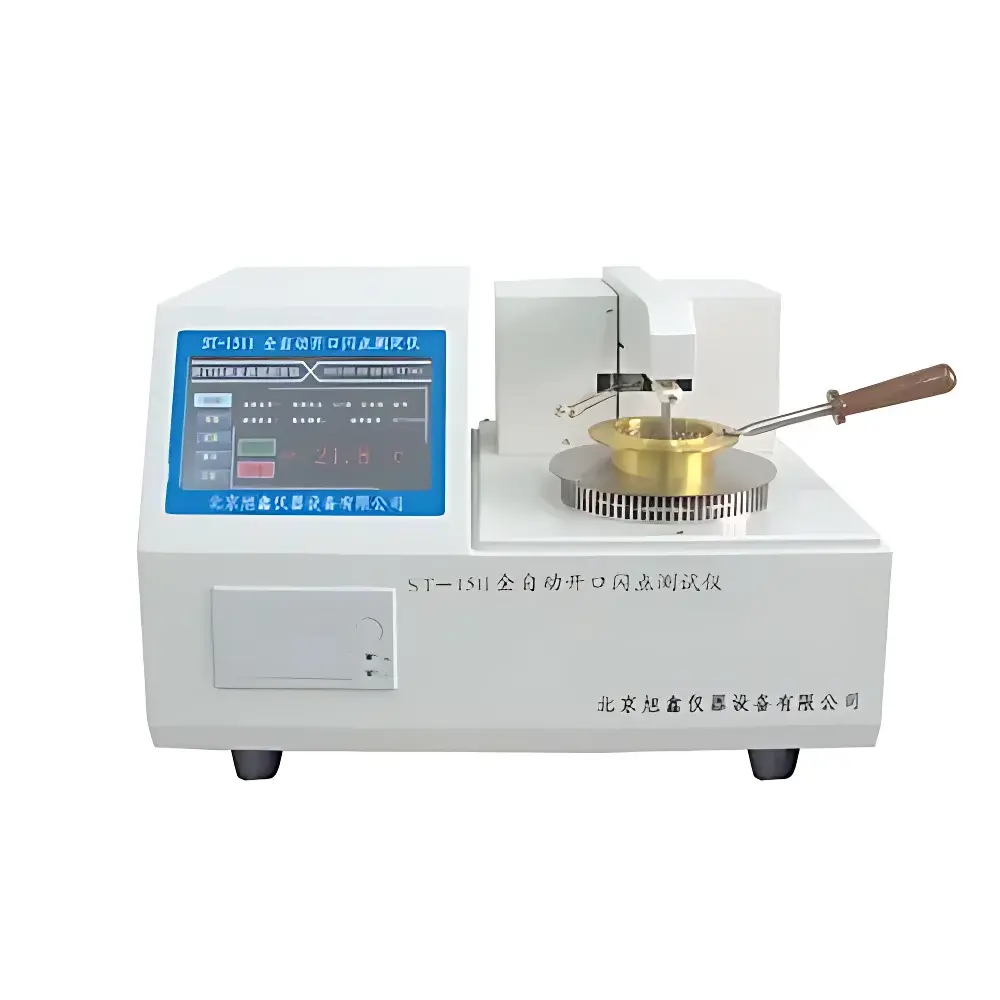
Xuxin ST-1511 Automatic Cleveland Open-Cup Flash Point Tester
| Brand | Xuxin Instrument |
|---|---|
| Origin | Beijing, China |
| Manufacturer Type | Direct Manufacturer |
| Country of Origin | China |
| Model | ST-151511 |
| Detection Method | Cleveland Open-Cup (COC) |
| Operation Mode | Fully Automatic |
| Temperature Range | Ambient to 400 °C |
| Ignition Methods | Intelligent Electric Ignition (standard), Gas Ignition (optional) |
| Repeatability | Compliant with GB/T 3536–2008 and ASTM D92 |
| Applicable Standards | GB/T 3536, GB/T 267, ASTM D92 |
| Accuracy | ±2 °C |
| Resolution | 0.1 °C |
| Display | Color LCD Touchscreen |
| Data Storage | 2000 test records with timestamp |
| Cooling | Integrated high-efficiency forced-air cooling |
| Power Consumption | ≤550 W |
| Dimensions | 430 × 280 × 285 mm |
| Weight | 16.5 kg |
| Environmental Operating Conditions | 5–45 °C, 10–80% RH |
| Power Supply | 220 V ±10%, 50 Hz |
Overview
The Xuxin ST-1511 Automatic Cleveland Open-Cup Flash Point Tester is a precision-engineered instrument designed for the standardized determination of flash point temperatures of petroleum products, lubricants, bituminous materials, and other combustible liquids using the Cleveland Open-Cup (COC) method. Based on the fundamental principle of thermal equilibrium and vapor-phase ignition threshold detection, the instrument heats a standardized open test cup at a controlled rate while periodically introducing an ignition source across the sample surface. The flash point is defined as the lowest temperature at which vapors above the specimen ignite momentarily when exposed to a flame or electric spark under prescribed atmospheric conditions. This method is thermodynamically distinct from closed-cup techniques and is specified for materials with higher volatility thresholds and elevated boiling ranges—particularly relevant for heavy fuel oils, residual fuels, and asphaltic binders. The ST-1511 implements full automation of the entire ASTM D92 / GB/T 3536 protocol—including ramped heating, timed ignition cycles, automatic sweep motion, real-time vapor detection, audible/visual alarm triggering upon flash occurrence, post-test forced-air cooling, and result validation against ambient pressure compensation.
Key Features
- Fully automated Cleveland Open-Cup testing sequence compliant with ASTM D92, GB/T 3536–2008, and GB/T 267—eliminating manual intervention in heating, ignition timing, sweep actuation, and endpoint detection.
- Intelligent dual-mode ignition system: standard electric arc ignition with adjustable energy output; optional gas flame ignition (LPG/propane) for legacy method alignment or regulatory cross-validation.
- High-resolution temperature control with 0.1 °C resolution and ±2 °C accuracy across ambient to 400 °C range, calibrated per ISO/IEC 17025 traceable procedures.
- Integrated atmospheric pressure sensor enabling real-time barometric correction of flash point values—critical for laboratories operating at non-standard elevations or variable weather conditions.
- Color TFT touchscreen interface supporting both English and Chinese language modes, with intuitive workflow navigation and context-sensitive soft keys.
- Onboard thermal printer with offline printing capability and embedded timestamping; stores up to 2000 test records with full metadata (date/time, operator ID, method, ambient pressure, raw temperature curve).
- Self-diagnostic subsystem continuously monitors mechanical actuators (lift rod, sweep arm), ignition circuit integrity, cup positioning, and thermal sensor linearity—triggering fault codes and audible alerts upon deviation.
- Forced-air cooling module reduces cooldown time between tests by >60% versus passive dissipation, enhancing throughput in high-volume QC environments.
Sample Compatibility & Compliance
The ST-1511 accommodates standard Cleveland open test cups conforming to ASTM D92 Annex A1 and GB/T 3536–2008 dimensional specifications (63.5 mm inner diameter, 47 mm depth). It is validated for use with crude oils, diesel fuels, heating oils, lubricating base stocks, bitumen emulsions, and industrial solvents exhibiting initial boiling points above 175 °C. All operational parameters—including heating rate (5–6 °C/min during final approach), ignition interval (every 2 °C per GB/T 3536), and sweep duration—are programmable within regulatory boundaries. The instrument meets electromagnetic compatibility (EMC) requirements per IEC 61326-1 and safety standards per IEC 61010-1. Its firmware architecture supports audit-ready operation under GLP and GMP frameworks, including user access levels, electronic signature prompts, and immutable test log export (CSV/USB).
Software & Data Management
The embedded mini-OS provides deterministic real-time control without external PC dependency. Test data—including raw temperature vs. time profiles, ignition event timestamps, pressure-corrected flash point values, and diagnostic logs—are stored in non-volatile memory with cyclic overwrite protection. USB port enables secure export of encrypted CSV files compatible with LIMS platforms (e.g., LabWare, Thermo SampleManager) and statistical process control (SPC) tools. Optional firmware upgrade path supports future integration with enterprise MES systems via Modbus TCP or OPC UA protocols. Data integrity safeguards include write-once logging, SHA-256 hash verification of stored records, and configurable auto-backup intervals—ensuring compliance with FDA 21 CFR Part 11 requirements for electronic records and signatures when deployed with approved authentication modules.
Applications
This instrument serves critical quality assurance functions across upstream, midstream, and downstream petroleum operations. In refinery QC labs, it verifies flash point conformity of bunker fuels prior to marine shipment—ensuring compliance with IMO MARPOL Annex VI and ISO 8217 specifications. Power generation facilities rely on ST-1511 data to assess insulating oil degradation in transformers (per IEEE C57.106). Asphalt producers use it to monitor binder volatility during hot-mix production, directly correlating with field compaction behavior and VOC emissions. Independent testing laboratories deploy the system for third-party certification under CNAS (China National Accreditation Service) or UKAS scopes, where documented method equivalence between ASTM D92 and GB/T 3536 is routinely audited. Academic research groups apply it in combustion kinetics studies involving bio-derived heavy fractions and synthetic hydrocarbon blends.
FAQ
What standards does the ST-1511 fully support out-of-the-box?
ASTM D92, GB/T 3536–2008, and GB/T 267—with preloaded method templates, default ramp rates, and ignition schedules aligned to each standard’s procedural clauses.
Can the instrument operate without continuous PC connectivity?
Yes. All control logic, data acquisition, storage, and reporting are handled internally via the embedded ARM-based controller and real-time OS.
Is pressure compensation mandatory for valid results?
Per ASTM D92 Section 7.2.3 and GB/T 3536–2008 Clause 8.3, atmospheric pressure correction is required for flash point values above 150 °C; the ST-1511 performs this automatically using its integrated barometric sensor.
How is calibration traceability maintained?
The unit ships with a NIM (National Institute of Metrology, China)-traceable calibration certificate for temperature and pressure sensors; annual recalibration services are available through Xuxin’s ISO/IEC 17025-accredited service centers.
Does the system support multi-user role-based access control?
Yes—administrator, technician, and viewer roles can be assigned with password protection; all operator actions are logged with timestamps and user IDs in the audit trail.
Related Products







