
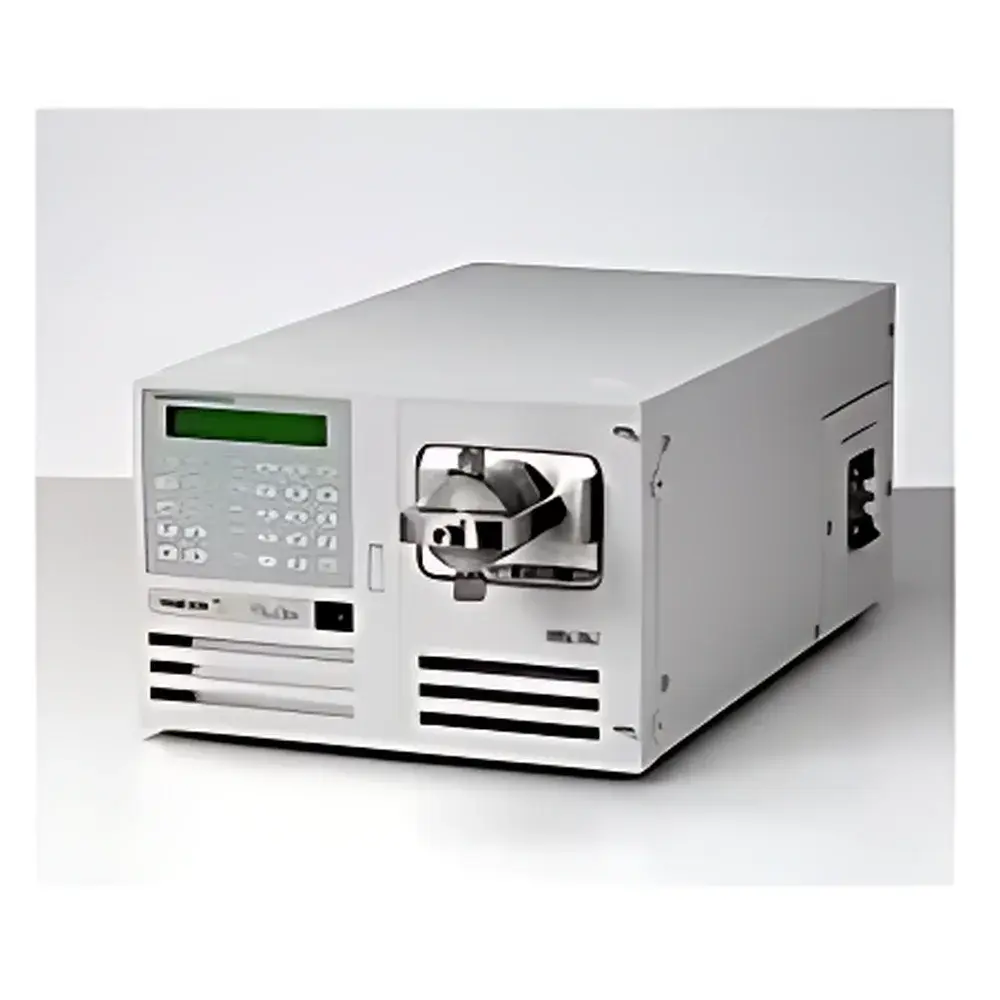
Agilent 218 Purification System
| Brand | Agilent Technologies |
|---|---|
| Origin | Germany |
| Manufacturer Type | Original Equipment Manufacturer (OEM) |
| Import Status | Imported |
| Model | 218 |
| Instrument Type | UHPLC–Online SPE Coupled Purification System |
| Flow Rate Range | Up to 200 mL/min (configurable via interchangeable pump heads: 25, 100, or 200 mL/min) |
| Maximum Pressure Rating | 400 bar |
| Sample Injection Volume | 0.1–10 mL (manual or via Agilent 410 Autosampler) |
| Column Compatibility | Analytical to semi-preparative (up to 50 mm ID, including 1" and 2" i.d. columns) |
| Temperature Control | Ambient to 60 °C (optional column heater module) |
| Wavelength Range | 190–800 nm (dual-wavelength UV-Vis detection) |
| Data Acquisition Rate | Up to 100 Hz |
Overview
The Agilent 218 Purification System is a purpose-engineered binary gradient liquid chromatography platform designed for scalable method development and robust fraction collection in analytical-to-semi-preparative purification workflows. Built upon Agilent’s proven high-pressure fluidic architecture, the system integrates UHPLC-grade pumping precision with online solid-phase extraction (SPE) coupling capability—enabling automated sample cleanup, enrichment, and targeted compound isolation without manual cartridge handling. Its core measurement principle relies on pressure-driven solvent delivery, UV-Vis absorbance detection at two independently programmable wavelengths, and real-time peak-triggered fraction collection based on optical signal thresholds or time windows. The system is optimized for laboratories transitioning from analytical HPLC method development to gram-scale purification, supporting seamless scale-up from 2.1 mm to 50 mm internal diameter columns—including industry-standard 1-inch and 2-inch preparative formats.
Key Features
- Modular high-pressure binary pump with field-replaceable pump heads—supporting three flow rate configurations (25, 100, or 200 mL/min) while maintaining ≤0.2% RSD flow precision and ≤0.15% gradient composition accuracy across the full range.
- Agilent 325 UV-Vis Dual-Wavelength Detector featuring a proprietary dual-pathlength flow cell (10 mm + 100 mm), delivering an extended linear dynamic range of 0.005 mAU to 80 AU—40× greater than conventional single-path detectors—enabling quantitative tracking of both trace impurities and major components in the same run.
- Flexible injection options: manual loop injection (0.1–10 mL) or automated sampling via the Agilent 410 Autosampler with 120-position vial capacity and integrated needle wash station.
- Intelligent fraction collection driven by real-time UV signal processing—supporting time-based, peak-threshold, or derivative-triggered collection logic with sub-second actuation latency and programmable delay compensation.
- Rugged stainless-steel fluidic path rated to 400 bar, compatible with aggressive solvents (e.g., THF, DCM, DMF) and high-salt mobile phases commonly used in peptide and natural product purification.
Sample Compatibility & Compliance
The Agilent 218 Purification System accommodates diverse sample matrices including synthetic intermediates, pharmaceutical actives, natural product extracts, peptides, oligonucleotides, and polymer fractions. Its modular design supports reversed-phase, normal-phase, ion-exchange, and hydrophilic interaction liquid chromatography (HILIC) separations. All hardware and software components comply with ISO 9001 manufacturing standards. When operated with OpenLab CDS software configured for audit trail, electronic signatures, and user role management, the system meets FDA 21 CFR Part 11 requirements for regulated environments. It also supports GLP/GMP documentation workflows, including instrument qualification (IQ/OQ/PQ) templates and raw data integrity per ALCOA+ principles.
Software & Data Management
Control and data acquisition are fully integrated within Agilent OpenLab CDS (ChemStation Edition), a validated chromatography data system widely adopted in QC, R&D, and regulatory laboratories. The software provides intuitive method building for gradient programming, detector wavelength selection, fraction collection logic definition, and post-run purity analysis. All acquisition parameters, sequence logs, and raw chromatograms are stored in a secure, timestamped database with immutable audit trails. Raw data files (.D format) retain full detector spectral fidelity and are exportable in open formats (e.g., .csv, .mzML) for third-party processing. Remote monitoring and email/SMS alerts for run completion or error conditions are supported via OpenLab Enterprise Server deployment.
Applications
- Method development and direct scale-up from analytical to semi-preparative conditions—reducing method transfer risk and accelerating lead compound isolation.
- Purification of synthetic APIs under cGMP pilot-scale workflows, including removal of genotoxic impurities and residual catalysts.
- Isolation of bioactive constituents from complex botanical or microbial extracts for structural elucidation (NMR, MS).
- Desalting and buffer exchange of peptides and oligonucleotides prior to lyophilization or formulation studies.
- Preparative chiral separations using polysaccharide-based columns, leveraging precise gradient control for enantiomer resolution.
FAQ
What column dimensions and chemistries are supported?
The system supports columns from 2.1 mm to 50 mm internal diameter, including standard stainless-steel and PEEK-lined semi-preparative columns. Compatible chemistries include C18, phenyl-hexyl, cyano, silica, diol, and chiral stationary phases.
Can the system be integrated into an existing OpenLab CDS network?
Yes—it operates as a native instrument driver within OpenLab CDS v2.5 or later and supports centralized method library management, shared sequence queues, and cross-instrument reporting.
Is online SPE functionality built-in or requires additional modules?
Online SPE coupling is enabled via optional valve modules (e.g., Agilent 218 Valve Kit) and dedicated method templates in OpenLab CDS; no external switching hardware is required.
What validation documentation is provided?
Agilent supplies factory test reports, IQ/OQ protocols compliant with ASTM E2500 and USP , and electronic signature configuration guides for Part 11 compliance.
Does the system support temperature-controlled fraction collection?
While the column compartment offers ambient-to-60 °C heating, ambient-temperature fraction collection is standard; low-temperature collection requires external chilled fraction collectors interfaced via digital I/O.





