
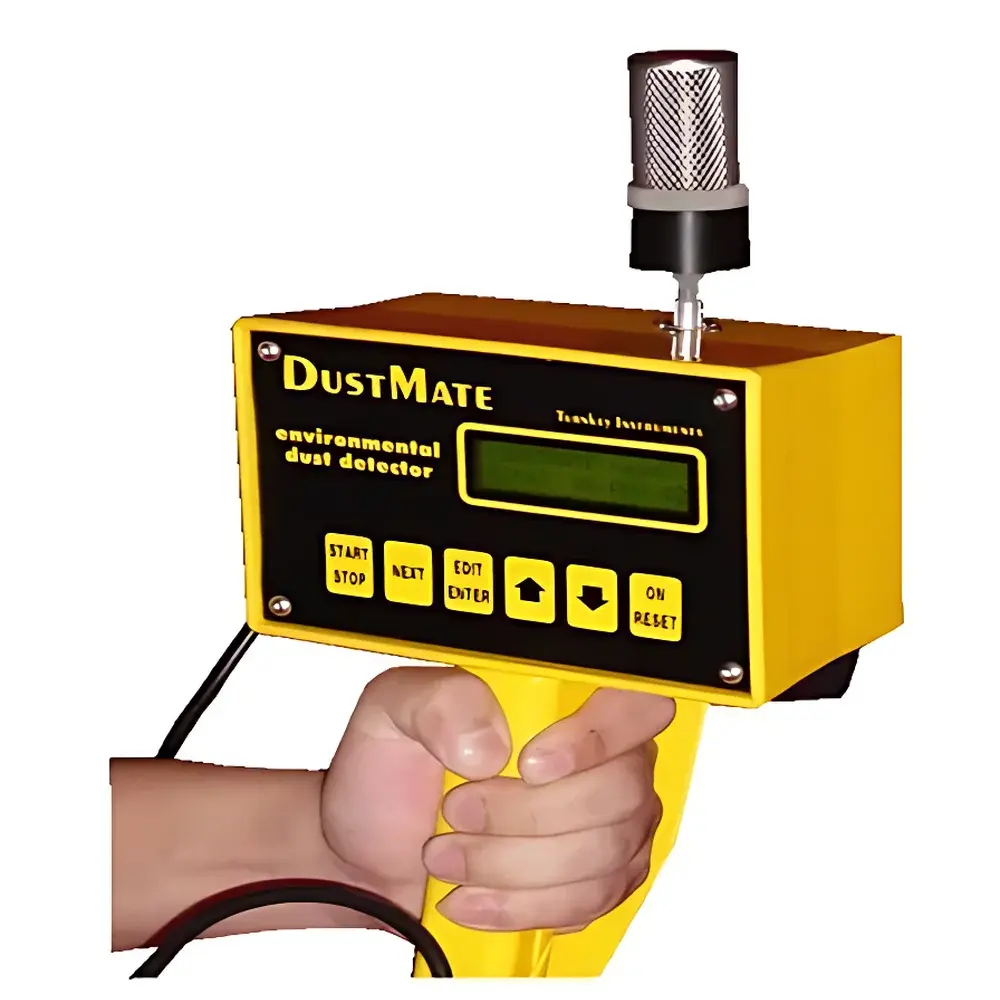
Dustmate Handheld Atmospheric Particulate Matter Monitor
| Origin | UK |
|---|---|
| Manufacturer Type | Authorized Distributor |
| Origin Category | Imported |
| Model | Dustmate |
| Measurement Principle | Laser Light Scattering |
| Measurable Parameters | TSP, PM1.0, PM2.5, PM10 |
| Measurement Range | 0–6000 µg/m³ |
| Cut-Point Diameter (Da₅₀) | (10 ± 0.5) µm |
| Geometric Standard Deviation (σg) | 1.5 ± 0.15 |
| Detectable Particle Size Range | 0.5–15 µm |
| Channel Configuration | 3-channel size-resolved counting |
| Sampling Flow Rate | 500 mL/min |
| Resolution | 1 µg/m³ |
| Repeatability | RSD < 5% |
| Overall Uncertainty | ≤ 25% (vs. gravimetric reference method) |
| Operating Environment | −5 to +40 °C, 0–100% RH (non-condensing) |
| Dimensions | 160 × 100 × 90 mm |
| Weight | 0.6 kg (instrument only) |
| Power Supply | Rechargeable 6 V DC / 1.2 Ah battery |
| AC adapter | 220 V, 50–60 Hz |
| Interface | RS-232 serial port |
| Calibration Standard | Whatman GF/A 25 mm circular filter |
Overview
The Dustmate Handheld Atmospheric Particulate Matter Monitor is a portable, real-time optical aerosol measurement instrument engineered for field-deployable quantification of inhalable airborne particulate mass concentrations. Based on the physical principle of laser light scattering—where incident monochromatic light interacts with suspended particles and generates angularly resolved scattered intensity—the Dustmate enables simultaneous estimation of total suspended particulates (TSP), thoracic (PM₁₀), fine (PM₂.₅), and ultrafine (PM₁.₀) fractions. Its design adheres to the foundational metrological framework outlined in WS/T 206–2001, the Chinese health industry standard for PM₁₀ determination by light scattering, while maintaining compatibility with internationally recognized aerosol sampling conventions—including ISO 7708:1995 (airborne particles definitions) and EN 481:1993 (inhalable, thoracic, and respirable convention). The instrument operates via isokinetic aspiration into an optimized optical sensing chamber, where particle-laden air passes through a focused laser beam; the resulting scatter signal is processed using multi-angle detection logic to assign particles to one of three discrete aerodynamic size bins. This approach delivers rapid, on-site concentration readouts without requiring laboratory-based gravimetric analysis.
Key Features
- Three-channel real-time particle sizing: Discriminates particles across 0.5–15 µm aerodynamic diameter range with Da₅₀ = (10 ± 0.5) µm and σg = 1.5 ± 0.15, satisfying regulatory definitions for TSP, PM₁₀, PM₂.₅, and PM₁.₀.
- High-resolution mass concentration output: 1 µg/m³ resolution across full 0–6000 µg/m³ dynamic range, with repeatability expressed as relative standard deviation < 5% under controlled test conditions.
- Field-optimized ergonomics: Compact housing (160 × 100 × 90 mm), lightweight construction (0.6 kg), integrated rechargeable 6 V / 1.2 Ah battery, and intuitive three-button interface enable extended battery-powered operation in occupational and ambient monitoring scenarios.
- Optical chamber architecture: Sealed, laminar-flow sampling path minimizes wall losses and particle bounce effects; calibrated inlet geometry ensures representative aspiration at 500 mL/min flow rate.
- RS-232 serial interface: Enables direct connection to laptops or data loggers for time-stamped data acquisition, firmware updates, and remote configuration.
- Ruggedized transport case: Includes all essential accessories—sampling head, filter holder, GF/A calibration filters, hex key, AC adapter, and user documentation—in a shock-absorbing, dust-resistant enclosure.
Sample Compatibility & Compliance
The Dustmate is validated for use with ambient air, indoor workplace atmospheres, vehicle cabins, HVAC ducts, and industrial emission plumes where particulate loading remains within its operational envelope. It complies with WS/T 206–2001 for PM₁₀ light-scattering methodology and aligns with ISO/IEC 17025 traceability expectations when used with NIST-traceable filter standards (e.g., Whatman GF/A 25 mm circles). While not certified for regulatory compliance reporting under EPA Method PS-1 or EN 12341, it serves as a qualified screening tool for preliminary assessment, trend analysis, and exposure mapping in occupational hygiene (per OSHA Technical Manual Chapter 2) and environmental site characterization. Its cut-point performance meets the geometric criteria specified in ISO/CEN TR 19852 for PM₁₀ samplers, supporting comparative interpretation against reference gravimetric datasets.
Software & Data Management
Optional AirQ desktop software provides comprehensive post-acquisition functionality: time-synchronized data import via RS-232, automated generation of Excel-compatible spreadsheets (.csv), overlayable temporal concentration plots (PM₁.₀, PM₂.₅, PM₁₀, TSP), and configurable alarm thresholds. Audit trails include operator ID, location tags, calibration timestamps, and instrument serial number metadata. Software-generated reports support GLP-aligned documentation requirements—including electronic signature fields and revision-controlled templates—though full 21 CFR Part 11 compliance requires supplementary IT infrastructure controls (e.g., domain authentication, encrypted storage, and access logs).
Applications
- Occupational health surveillance: Real-time assessment of worker exposure during grinding, sanding, demolition, and powder handling operations.
- Indoor air quality (IAQ) audits: Monitoring HVAC filtration efficiency, occupancy-related resuspension events, and cooking or cleaning emissions.
- Environmental baseline studies: Mobile mapping of urban PM gradients, roadside pollution hotspots, and construction site fugitive dust dispersion.
- Industrial process control: Verification of baghouse or electrostatic precipitator performance in cement, mining, and metallurgical facilities.
- Educational and research fieldwork: Teaching aerosol physics principles, validating dispersion models, and supporting citizen science initiatives with standardized instrumentation.
FAQ
What particle size fractions does the Dustmate report?
It provides concurrent real-time mass concentration outputs for TSP, PM₁₀, PM₂.₅, and PM₁.₀ based on its three-channel optical classification algorithm.
Is the instrument suitable for outdoor ambient monitoring?
Yes—its operating temperature range (−5 to +40 °C) and humidity tolerance (0–100% RH, non-condensing) support deployment in unsheltered environments, though prolonged rain exposure should be avoided.
How is the Dustmate calibrated?
Factory calibration uses gravimetrically characterized aerosols and Whatman GF/A 25 mm reference filters; users may perform field verification using the included calibration kit and follow WS/T 206–2001 procedural guidelines.
Does the device meet ISO or EU regulatory requirements for official reporting?
No—it is intended for indicative measurement and exposure screening; definitive compliance reporting requires reference-grade beta attenuation or tapered element oscillating microbalance (TEOM) systems accredited under EN 12341 or EPA equivalency protocols.
Can data be exported for statistical analysis?
Yes—AirQ software exports timestamped, parameter-tagged datasets in CSV format compatible with MATLAB, R, Python pandas, and commercial statistical packages.







