
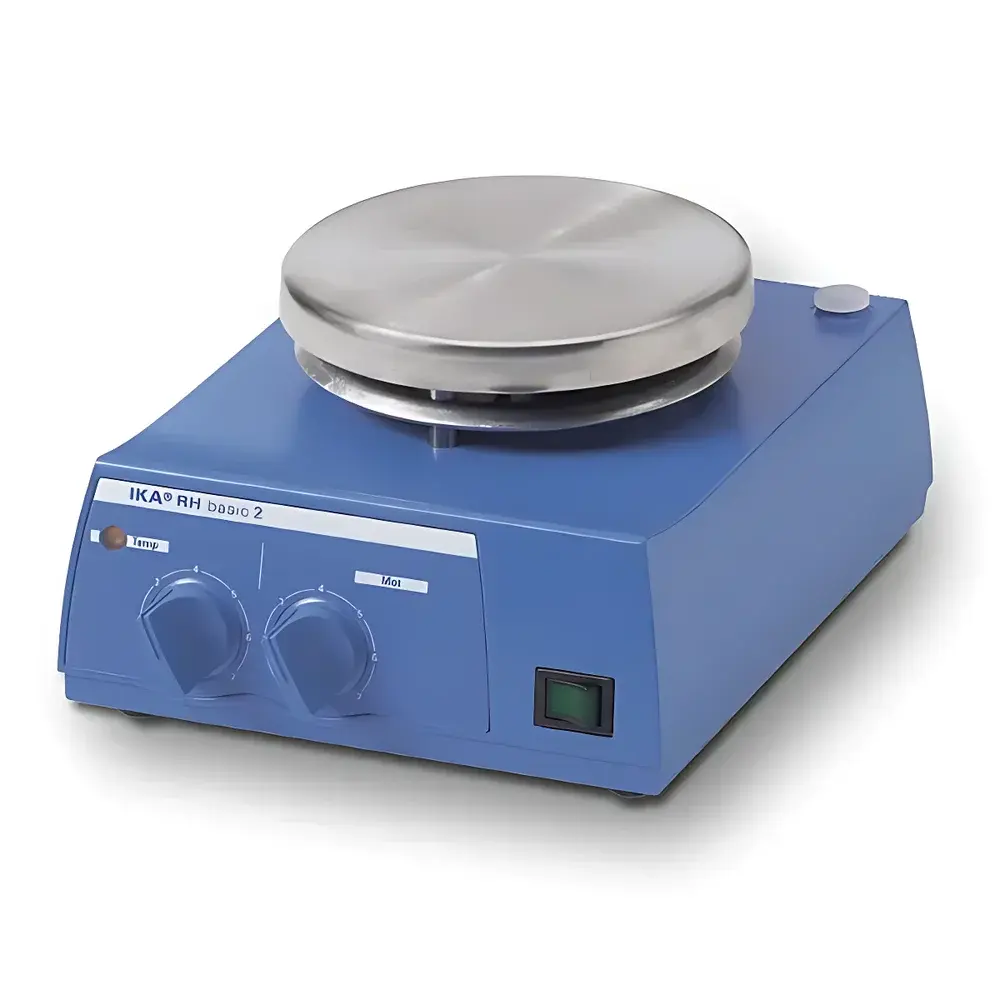
IKA RH basic 2 Magnetic Stirrer
| Brand | IKA |
|---|---|
| Origin | Germany |
| Model | RH basic 2 |
| Instrument Type | Magnetic Stirrer |
| Maximum Stirring Volume (H₂O) | 10 L |
| Speed Range | 100 – 2000 rpm |
| Heating Temperature Range | Ambient to 320 °C |
| Fixed Safety Cut-off Temperature | 400 °C |
| Heating Power | 400 W |
| Motor Output Power | 2 W |
| Plate Material | Stainless Steel 1.4301 |
| Plate Diameter | Ø 125 mm |
| Dimensions (W × D × H) | 168 × 105 × 220 mm |
| Weight | 2.4 kg |
| Protection Class | IP21 (per DIN EN 60529) |
| Operating Voltage | 220–240 V, 50/60 Hz |
| Total Input Power | 415 W |
| Permissible Ambient Temperature | 5–40 °C |
| Max. Relative Humidity | 80 % |
Overview
The IKA RH basic 2 Magnetic Stirrer is a compact, entry-level benchtop instrument engineered for reliable and repeatable mixing of liquid samples in academic, quality control, and routine laboratory environments. It operates on the principle of magnetic coupling: a rotating permanent magnet beneath the stainless-steel heating plate induces synchronous rotation of a magnetic stir bar immersed in the sample vessel. This contactless drive mechanism eliminates mechanical wear, ensures leak-free operation, and supports continuous stirring under sealed or inert-atmosphere conditions. Integrated resistive heating provides precise thermal control across a wide range—from ambient temperature up to 320 °C—making the RH basic 2 suitable for applications requiring simultaneous heating and agitation, such as dissolution testing, buffer preparation, reagent synthesis, and pre-analytical sample conditioning. Its fixed safety cut-off at 400 °C complies with IEC 61000-4-2 and EN 61010-1 requirements for laboratory electrical equipment, preventing thermal runaway during unattended operation.
Key Features
- Stainless steel heating plate (material grade 1.4301) offering corrosion resistance, thermal stability, and easy cleaning
- Two-knob analog control system: dedicated dials for speed (0–6 scale, corresponding to 100–2000 rpm) and heating temperature (1–6 scale, covering ambient to 320 °C)
- Low-maintenance brushless DC motor delivering consistent torque output up to 2 W, optimized for loads up to 10 L of water-equivalent viscosity
- Compact footprint (168 × 105 × 220 mm) and lightweight design (2.4 kg) enabling flexible placement on fume hoods, laminar flow cabinets, or shared lab benches
- IP21 ingress protection rating per DIN EN 60529, safeguarding internal electronics against vertically falling drips and solid objects ≥12.5 mm
- Compliance with EN 61010-1:2013 for electrical safety in laboratory equipment, including overtemperature protection, grounding continuity, and dielectric strength verification
Sample Compatibility & Compliance
The RH basic 2 accommodates standard glassware—including beakers, Erlenmeyer flasks, and round-bottom flasks—up to 10 L volume when used with appropriately sized stir bars (e.g., 40–60 mm PTFE-coated bars). Its non-inductive plate surface ensures uniform heat distribution and avoids localized hot spots that could compromise sample integrity. While not designed for viscous non-Newtonian fluids (e.g., polymer melts or pastes), it performs robustly with aqueous solutions, organic solvents, dilute suspensions, and low-viscosity buffers. The device meets essential regulatory expectations for general-purpose lab instrumentation: it carries CE marking, conforms to RoHS Directive 2011/65/EU, and supports GLP-aligned workflows through stable, reproducible operational parameters. Though it lacks digital logging or audit trail functionality, its analog interface enables straightforward SOP execution in non-GxP environments where manual recording suffices.
Software & Data Management
The RH basic 2 is a standalone analog instrument without embedded microprocessor control, software connectivity, or data export capabilities. All settings are adjusted manually via calibrated rotary dials, ensuring operational simplicity and immunity to firmware-related failures or cybersecurity vulnerabilities. This architecture aligns with ISO/IEC 17025:2017 Clause 6.4.7, which permits use of non-automated equipment provided performance characteristics (e.g., speed accuracy, temperature stability) are verified during periodic calibration. Users may document operating conditions—such as dial positions, elapsed time, and observed sample behavior—in paper-based or electronic lab notebooks (ELN) compliant with 21 CFR Part 11 if configured with appropriate signature controls. No drivers, APIs, or proprietary software are required or supported.
Applications
- Routine dissolution and homogenization of reagents, standards, and calibration solutions in analytical chemistry labs
- Preparation of culture media and buffer stocks in microbiology and molecular biology workflows
- Controlled heating/stirring during titration setup, pH adjustment, or precipitation reactions
- Supporting ASTM D1298 (density of crude oil) and USP (dissolution apparatus verification) auxiliary procedures
- Use in teaching laboratories for demonstrating fluid dynamics, heat transfer, and stoichiometric mixing principles
FAQ
Is the RH basic 2 compatible with 115 V or 100 V power supplies?
Yes—optional voltage configurations (115 V and 100 V) are available upon request; standard units ship with 220–240 V, 50/60 Hz input.
Does the unit include a stir bar?
No—the RH basic 2 is supplied without magnetic stir bars; users must select appropriate size and coating (e.g., PTFE or glass-coated) based on chemical compatibility and vessel geometry.
Can the safety cut-off temperature be adjusted?
No—the 400 °C thermal cut-off is fixed and non-configurable, per EN 61010-1 safety requirements for Class II laboratory equipment.
What is the recommended calibration frequency?
IKA recommends annual verification of speed and plate temperature accuracy using traceable reference instruments, particularly when used in regulated environments.
Is the stainless steel plate chemically resistant to strong acids or bases?
Grade 1.4301 (AISI 304) stainless steel offers good resistance to mild acids and alkalis but is not suitable for prolonged exposure to halide-containing or highly oxidizing media (e.g., aqua regia, hot concentrated HNO₃).



