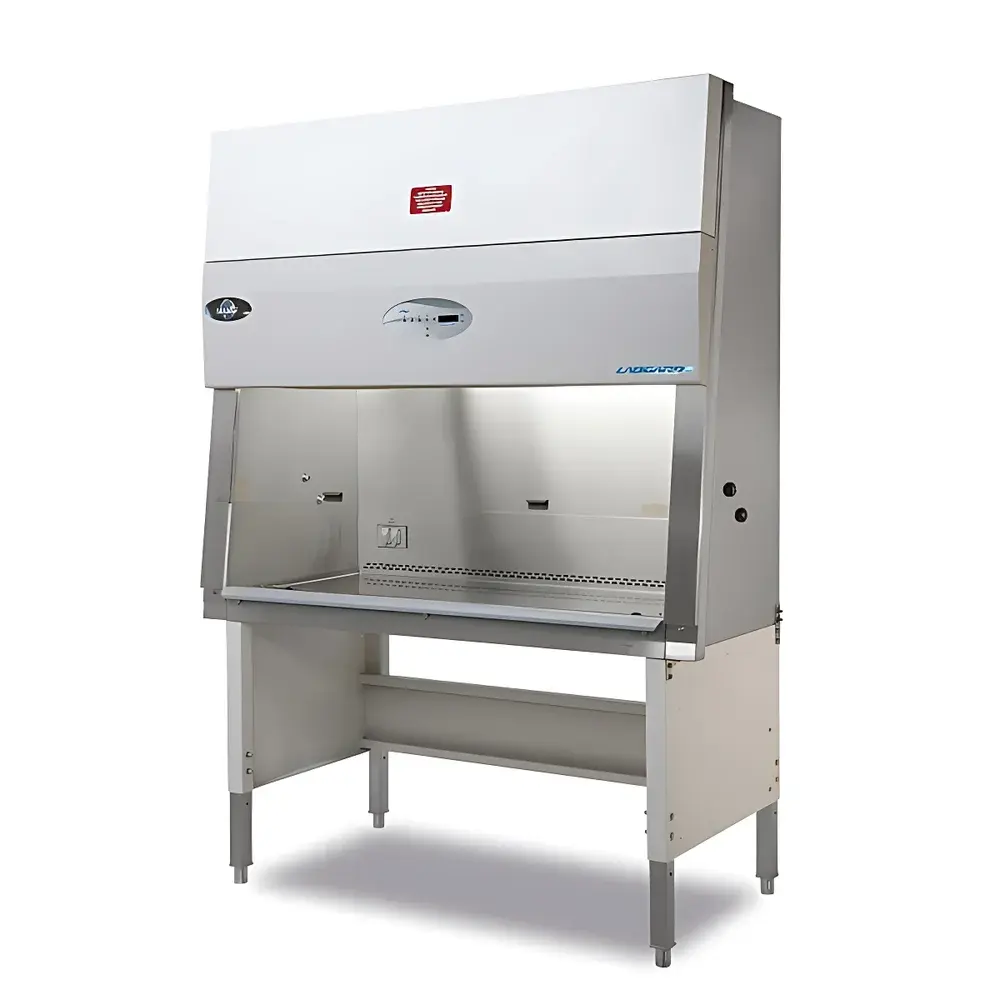
Nuaire LabGard NU-543 Series Class II A2 Biological Safety Cabinet
| Brand | Nuaire |
|---|---|
| Origin | USA |
| Manufacturer Status | Authorized Distributor |
| Origin Category | Imported |
| Model | NU-543-300S / 400S / 500S / 600S |
| Instrument Type | Class II A2 Biological Safety Cabinet |
| External Dimensions (L×W×H, mm) | 1057 / 1362 / 1669 / 1972 × 799 × 1572 |
| Internal Dimensions (L×W×H, mm) | 873 / 1178 / 1483 / 1788 × 654 × 724 |
| Filter Efficiency | ≥99.995% at 0.3 µm |
Overview
The Nuaire LabGard NU-543 Series is a certified Class II, Type A2 biological safety cabinet engineered for precision containment of low- to moderate-risk biological agents in research, clinical, and pharmaceutical laboratories. It operates on the principle of inward airflow (for personnel protection), downward laminar airflow (for product protection), and recirculated air (70%) combined with exhaust air (30%) through dual HEPA filtration—ensuring simultaneous protection of operator, sample, and environment. Designed and manufactured in the United States, the NU-543 complies with NSF/ANSI 49–2022, EN 12469:2000, and ISO 14644-1 Class 5 (ISO Class 5) cleanroom performance standards. Its structural integrity, aerodynamic stability, and validated airflow dynamics make it suitable for applications involving BSL-2 organisms, cell culture work, microbiological assays, and sterile compounding where volatile chemicals are absent or used only in trace quantities.
Key Features
- Full-welded, seamless 304 stainless steel chassis minimizes vibration transmission and acoustic resonance—achieving operational noise levels ≤55 dBA at 1 m, among the quietest in its class.
- HEPEX™ Zero-Leak Airflow System: Eliminates direct impingement on HEPA filter media and applies electrostatic pre-charging to suppress particle re-entrainment; ensures uniform face velocity (0.50 ± 0.05 m/s) and consistent downflow velocity (0.33 ± 0.03 m/s) across the work surface.
- True laminar, unidirectional airflow generated by a brushless DC motor-driven centrifugal blower with real-time speed modulation—maintaining stable inflow and downflow profiles under variable sash positions and filter loading conditions.
- One-piece monocoque interior construction with radius-curved corners and fully accessible front service panel—enabling full front-side maintenance without disassembly of structural components.
- Ergonomic sash design with counterbalanced vertical lift mechanism and integrated sash stop positions (e.g., 200 mm working height); sash window composed of tempered, low-iron glass for optical clarity and UV resistance.
- Integrated airflow monitoring system with audible/visual alarms for inflow velocity deviation (>±10%), filter saturation, and loss of blower power—meeting NSF 49 requirements for continuous performance verification.
Sample Compatibility & Compliance
The NU-543 series accommodates standard laboratory workflows including tissue culture, transfection, plasmid preparation, and microbial isolation. It supports use with open vessels (e.g., Petri dishes, flasks, multiwell plates), pipetting stations, and small-scale centrifuges (up to 15 mL rotor capacity). The cabinet is not intended for use with volatile radioactive materials, high-vapor-pressure solvents (e.g., ether, benzene), or cytotoxic drug compounding unless validated per USP and supplemental engineering controls. All models are certified to NSF/ANSI 49–2022 Annex D for personnel, product, and environmental protection, and undergo third-party certification including smoke pattern testing, tracer gas containment validation (SF₆), and filter leak scanning (DOP/PAO at 0.3 µm). Documentation includes full traceability to ISO/IEC 17025-accredited test reports.
Software & Data Management
While the NU-543 operates as a hardware-certified mechanical system without embedded microprocessor-based control software, it integrates seamlessly with laboratory infrastructure via analog and digital I/O interfaces. Optional RS-485 Modbus RTU output enables connection to building management systems (BMS) or centralized lab monitoring platforms for real-time logging of sash position, inflow velocity, and alarm status. All units include a permanent, laser-etched serial plate and comprehensive compliance documentation—including factory calibration certificates, airflow validation summaries, and filter integrity test records—archivable for GLP/GMP audit trails. Firmware-free architecture eliminates cybersecurity vulnerabilities and ensures long-term operational consistency across regulatory inspection cycles.
Applications
- Cell culture maintenance and passaging under BSL-2 containment conditions
- Preparation of sterile reagents, media, and buffers for molecular biology workflows
- Handling of recombinant DNA constructs and viral vectors in academic and biotech R&D labs
- Microbiological analysis including colony isolation, antibiotic susceptibility testing, and fungal culture
- Support of CLIA-certified clinical microbiology laboratories requiring NSF 49-compliant primary containment
- Integration into cleanroom suites (ISO Class 5–7) as a localized critical process barrier
FAQ
What biosafety level does the NU-543 support?
The NU-543 is certified for BSL-2 applications and may be used for certain BSL-1 and BSL-2+ procedures when risk assessments confirm compatibility with the A2 configuration.
Can the NU-543 be used with volatile organic compounds (VOCs)?
Only trace amounts of low-hazard VOCs (e.g., ethanol, isopropanol) are permitted; prolonged or high-concentration exposure to corrosive or highly volatile solvents voids certification and compromises filter integrity.
How often must the supply and exhaust HEPA filters be replaced?
Filter replacement intervals depend on usage intensity and ambient particulate load; typical service life ranges from 3–7 years, verified via in-situ filter integrity testing prior to replacement.
Is third-party recertification required after relocation or filter change?
Yes—per NSF/ANSI 49, all cabinets must undergo full performance recertification by an accredited technician following any filter replacement, major component service, or physical relocation.
Does the NU-543 meet FDA 21 CFR Part 11 requirements?
As a non-software-based device, the NU-543 does not fall under Part 11 scope; however, its audit-ready documentation package supports electronic record retention in compliant LIMS or QMS environments.
Related Products