
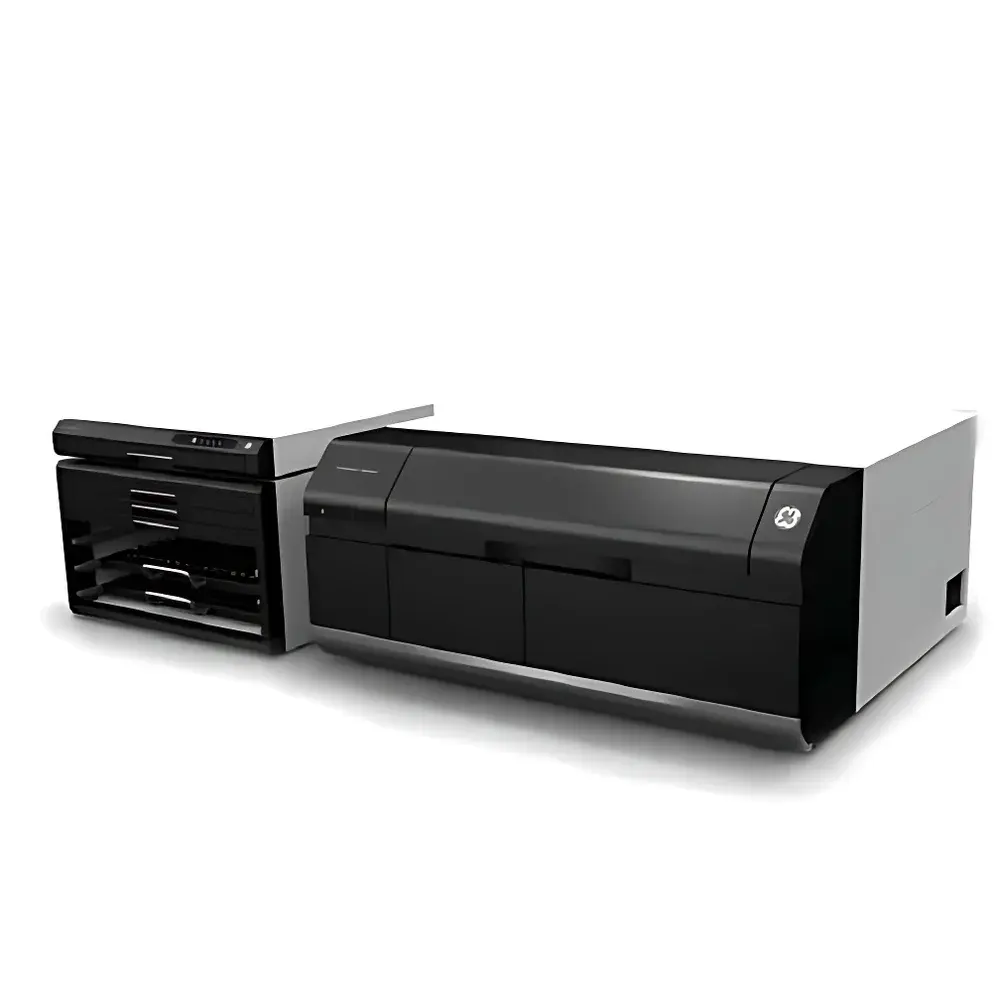
Cytiva Amersham Typhoon RGB and Typhoon 5 Multimodal Laser Scanning Imaging Systems
| Brand | Cytiva |
|---|---|
| Origin | Japan |
| Model | Amersham Typhoon RGB |
| Imaging Modes | Multicolor Fluorescence (RGB), Dual-Channel Near-Infrared (NIR), Phosphor Imaging, Optical Density (OD) |
| Pixel Resolution | Down to 10 µm |
| Scan Area | Up to 40 × 46 cm (Typhoon 5/RGB) |
| Dynamic Range | >5 orders of magnitude |
| Detection Sensitivity | As low as 3 pg protein (fluorescently labeled) |
| Laser Configuration | 5-laser platform (Typhoon 5) |
| Detector Type | High-gain Photomultiplier Tubes (PMTs) |
| Upgrade Path | Field-upgradable across models |
Overview
The Cytiva Amersham Typhoon RGB and Typhoon 5 are high-performance, multimodal laser scanning imaging systems engineered for quantitative molecular detection across life science research laboratories. Based on confocal laser scanning architecture with precisely aligned excitation lasers and spectrally resolved PMT detection, these instruments enable simultaneous or sequential acquisition of multiple signal modalities—including visible-light RGB fluorescence, dual-channel near-infrared (NIR) fluorescence (700 nm and 800 nm bands), phosphor storage imaging (PSI), and optical density (OD) of stained gels and blots. Unlike CCD-based gel doc systems, the Typhoon platform employs point-scanning optics with galvanometric mirrors and high-quantum-efficiency PMTs, delivering superior signal-to-noise ratio, exceptional linearity, and intrinsic pixel-level calibration—critical for reproducible quantitation in publications and regulatory submissions.
Key Features
- Multimodal Detection Architecture: Integrated laser excitation sources (405 nm, 488 nm, 532 nm, 635 nm, and 685 nm on Typhoon 5; configurable subsets on other models) coupled with motorized filter wheels and selectable PMT gain settings enable precise spectral separation and minimal crosstalk between fluorophores.
- Sub-10 µm Spatial Resolution: Achieved via high-precision XYZ motorized stage control and diffraction-limited laser spot focusing, enabling clear resolution of closely spaced protein bands in SDS-PAGE, fine histological features in tissue sections, and individual colonies in colony arrays.
- Quantitative Linearity Over 5+ Orders of Magnitude: Calibrated PMT response and proprietary image acquisition algorithms ensure accurate relative and absolute quantitation without saturation or signal compression—validated per ISO/IEC 17025 traceable protocols for assay development and QC applications.
- Large-Area Scanning Capability: 40 × 46 cm scan bed accommodates up to twenty 10 × 8 cm western blots or two full-size 20 × 20 cm 2D gels in a single pass; supports standard multiwell plates (6–1536-well), glass slides, and flexible film formats.
- Modular & Future-Proof Design: Hardware components—including lasers, filters, detectors, and sample holders—are independently serviceable and upgradeable in situ. A Typhoon IP system can be expanded to RGB or NIR capability via certified field installation kits, preserving capital investment over time.
Sample Compatibility & Compliance
The Typhoon platform is validated for use with a broad range of sample substrates and labeling chemistries: polyacrylamide and agarose gels, nitrocellulose and PVDF membranes, glass and polymer-coated slides, formalin-fixed paraffin-embedded (FFPE) tissue sections, live-cell monolayers in chambered coverslips, and microtiter plates. It supports common fluorescent dyes (Cy2/Cy3/Cy5/Cy7, Alexa Fluor series, IRDye 680/800, SYPRO Ruby, Deep Purple), radioisotopes (32P, 33P, 125I), and chromogenic stains (Coomassie, silver, Ponceau S). All Typhoon models comply with IEC 61010-1 safety standards for laboratory equipment and meet electromagnetic compatibility (EMC) requirements per EN 61326-1. Data integrity features—including audit-trail-enabled acquisition software, user-access controls, and electronic signature support—align with FDA 21 CFR Part 11 and EU Annex 11 expectations for GLP/GMP environments.
Software & Data Management
Image acquisition and analysis are managed through Cytiva’s ImageQuant TL software—a Windows-based application supporting automated protocol execution, batch processing, background subtraction, band/spot volume integration, and multiplex ratio calculations. Raw data (.gel/.tl files) are stored in vendor-neutral TIFF format with embedded metadata (laser power, PMT voltage, exposure time, filter ID, calibration coefficients). The software includes built-in tools for normalization against internal standards, statistical comparison across replicates, and export to Excel, GraphPad Prism, or third-party platforms via XML or CSV. Optional integration with LIMS systems is available via HL7 or RESTful API extensions. All software updates undergo rigorous validation per Cytiva’s Quality Management System (ISO 9001 and ISO 13485 certified).
Applications
- Quantitative western blotting with multiplexed NIR detection for target and loading control on a single membrane
- Differential expression profiling in 2D electrophoresis using fluorescent saturation dyes
- Phosphoproteomics and radiolabeled nucleic acid hybridization (e.g., Northern/Southern blots)
- High-content screening of cellular responses in multiwell plates using fluorescent viability or apoptosis markers
- Digital pathology workflows including whole-slide fluorescence imaging of immunofluorescent tissue sections
- Validation of CRISPR editing efficiency via T7E1 or Surveyor assays on stained gels
FAQ
Can the Typhoon RGB be upgraded to Typhoon 5 functionality?
Yes—hardware upgrades (additional lasers, detector modules, and filter sets) and corresponding software licenses can be installed post-purchase by Cytiva-certified field service engineers.
Is phosphor imaging compatible with fluorescence detection on the same sample?
No—phosphor imaging requires separate exposure after radioactive decay or phosphor plate stimulation; however, the same physical sample holder accommodates both modalities sequentially.
What file formats does ImageQuant TL export for downstream analysis?
TIFF (with metadata), PNG, JPEG, PDF, Excel (.xlsx), and delimited text (CSV/TSV); raw quantitation tables support direct import into R, Python (pandas), or commercial bioinformatics suites.
Does the system support GxP-compliant workflows?
Yes—audit trail logging, electronic signatures, role-based access control, and 21 CFR Part 11–compliant configuration management are enabled via optional software modules validated per Cytiva’s QMS.
How is calibration maintained across instrument lifetime?
Cytiva provides annual performance verification services including laser power measurement, PMT linearity testing, spatial uniformity mapping, and dynamic range validation using NIST-traceable reference standards.




