
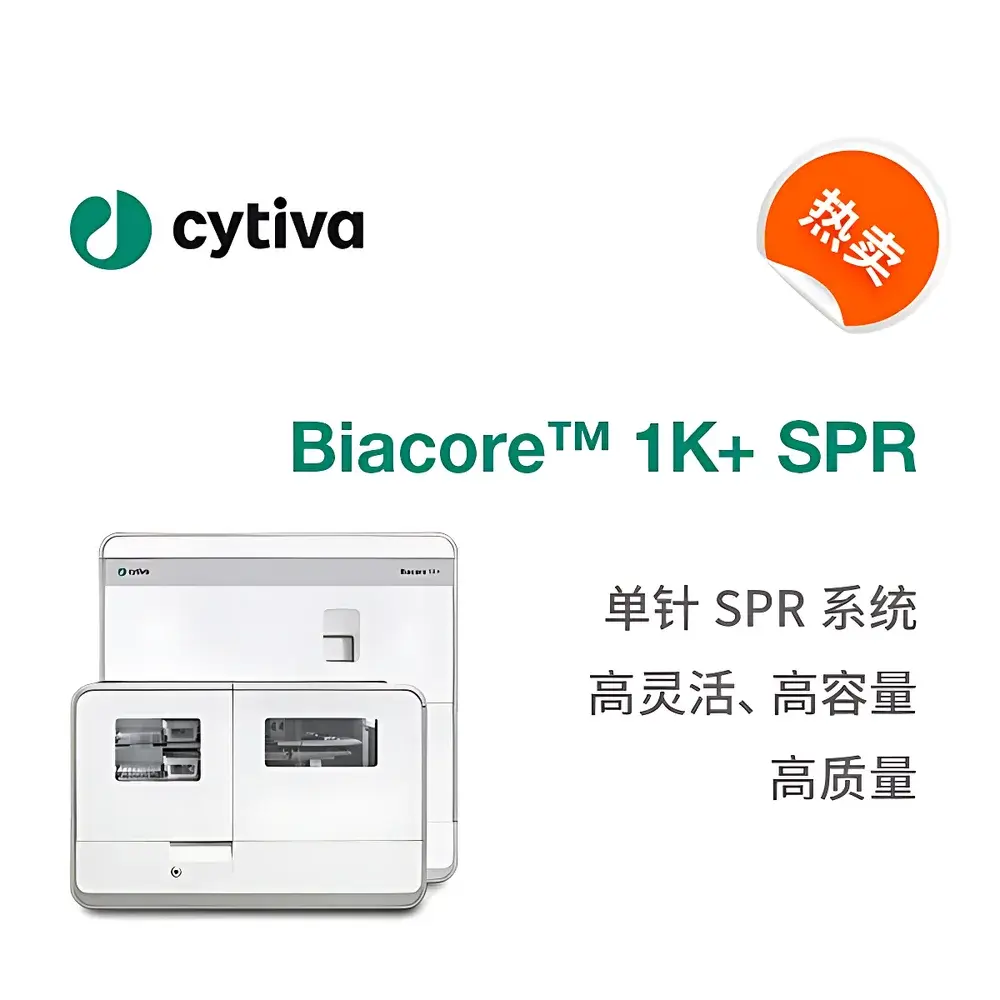
Cytiva Biacore 1K+ Surface Plasmon Resonance (SPR) Molecular Interaction Analysis System
| Brand | Cytiva |
|---|---|
| Origin | Sweden |
| Model | Biacore 1K+ SPR System |
| Channel Configuration | Single-needle, 6-flow cell architecture |
| Sample Capacity | Dual 96-well microplate support + dual reagent racks |
| Buffer Selection | Integrated automated buffer selector |
| Temperature Control | Precise thermostatic sample compartment |
| Software Platform | Biacore Insight™ with FDA 21 CFR Part 11-compliant audit trail and GLP/GMP-ready data management |
Overview
The Cytiva Biacore 1K+ Surface Plasmon Resonance (SPR) Molecular Interaction Analysis System is a high-fidelity, single-needle biosensor platform engineered for label-free, real-time quantification of biomolecular interactions. Leveraging the physical principle of surface plasmon resonance—where changes in refractive index at a gold sensor surface are optically detected upon ligand-analyte binding—the system delivers kinetic rate constants (ka, kd), equilibrium dissociation constants (KD), and active concentration measurements with high reproducibility across laboratories. Designed as an evolution of the Biacore 1-series architecture, the 1K+ integrates a robust fluidic path with six independently addressable flow cells, enabling both parallel and serial sample routing without hardware modification. Its core purpose is to support early- to mid-stage biopharmaceutical development—including antibody screening, epitope binning, affinity maturation, and QC release testing—while maintaining full traceability and regulatory compliance.
Key Features
- Six-flow-cell sensor chip architecture supporting independent, paired, or sequential (up to six-in-series) analyte injections—enabling enhanced signal-to-noise ratio and reduced analyte consumption per interaction cycle.
- Single-needle autosampler compatible with two standard 96-well microplates and two reagent racks, allowing unattended operation for up to 192 samples per run sequence.
- Integrated automated buffer selector with programmable valve sequencing, minimizing carryover and enabling rapid buffer-switching for regeneration, reference subtraction, and multi-condition screening.
- Precisely controlled thermostatic sample compartment (4–40 °C adjustable) ensuring thermal stability during extended kinetic runs and temperature-dependent binding assessments.
- Preconfigured method templates and interactive run setup in Biacore Insight™ software reduce method development time while preserving experimental rigor and parameter transparency.
- Modular inlet tools—including low-volume capillary probes and high-precision syringe-driven injection modules—optimized for precious samples (e.g., membrane proteins, low-yield mAbs) and viscous formulations.
Sample Compatibility & Compliance
The Biacore 1K+ accommodates a broad range of biomolecular analytes including monoclonal antibodies, antibody fragments (Fab, scFv), peptides, small molecules (<500 Da), nucleic acids, carbohydrates, and immobilized membrane proteins (via liposome or nanodisc coupling). Sensor chip surfaces (CM5, SA, NTA, C1, etc.) support covalent, streptavidin-biotin, Ni-NTA, or hydrophobic immobilization strategies. The system complies with ISO/IEC 17025 requirements for testing laboratories and supports GLP and GMP workflows through full electronic records, user access controls, and 21 CFR Part 11–compliant audit trails. All raw sensorgrams, processed fits, and metadata are stored in a secure, version-controlled database with immutable timestamps and operator attribution.
Software & Data Management
Biacore Insight™ software provides end-to-end data handling—from instrument control and real-time monitoring to global fitting, heterogeneity modeling, and batch reporting. It includes built-in quality metrics (e.g., bulk refractive index shift correction, double-referencing, R2 confidence intervals), customizable report templates aligned with ICH Q5E and USP guidelines, and export options compliant with CDISC SEND and SDTM standards. Data integrity safeguards include role-based permissions, electronic signatures, and automated backup to network-attached storage or validated cloud repositories. Optional integration with LIMS and ELN platforms is supported via RESTful API and vendor-certified middleware.
Applications
- Kinetic characterization of therapeutic antibodies and Fc-fusion proteins under physiologically relevant conditions (pH, ionic strength, temperature).
- Epitope binning and mapping using competition assays with orthogonal immobilization and capture strategies.
- Concentration analysis of active protein content in crude lysates, purified batches, or formulated drug products—without calibration curves.
- High-throughput primary screening of fragment libraries or engineered variants with multiplexed regeneration protocols.
- Stability assessment via thermal denaturation profiling and binding resilience under accelerated stress conditions.
- Regulatory submission support with fully documented SOPs, validation reports (IQ/OQ/PQ), and change control documentation per Cytiva’s CCN service.
FAQ
Can the Biacore 1K+ perform simultaneous multi-analyte detection?
No—it operates sequentially via a single optical detection path; however, six flow cells allow multiplexed experimental design (e.g., reference subtraction, duplicate ligands, or condition gradients) within one run.
Is sensor chip reuse supported?
Yes—regeneration protocols are method-defined and chip-specific; CM5 chips typically sustain >50 cycles with proper optimization, while SA and NTA chips support reversible capture with minimal degradation.
Does the system meet FDA requirements for regulated environments?
Yes—Biacore Insight™ is validated for 21 CFR Part 11 compliance, including electronic signatures, audit trail review, and data archival features required for IND, BLA, and MAA submissions.
How does the 1K+ differ from the Biacore 8K series?
The 1K+ prioritizes flexibility, cost-per-run efficiency, and ease of method transfer in discovery and process development labs; the 8K offers higher throughput via 8-channel parallel detection and advanced automation for late-stage QC and comparability studies.
What service and support options are available?
OptiRun™ lifecycle support includes preventive maintenance, remote diagnostics, application troubleshooting, and customizable training—aligned with ISO 9001-certified service delivery and SLA-backed response times.






