
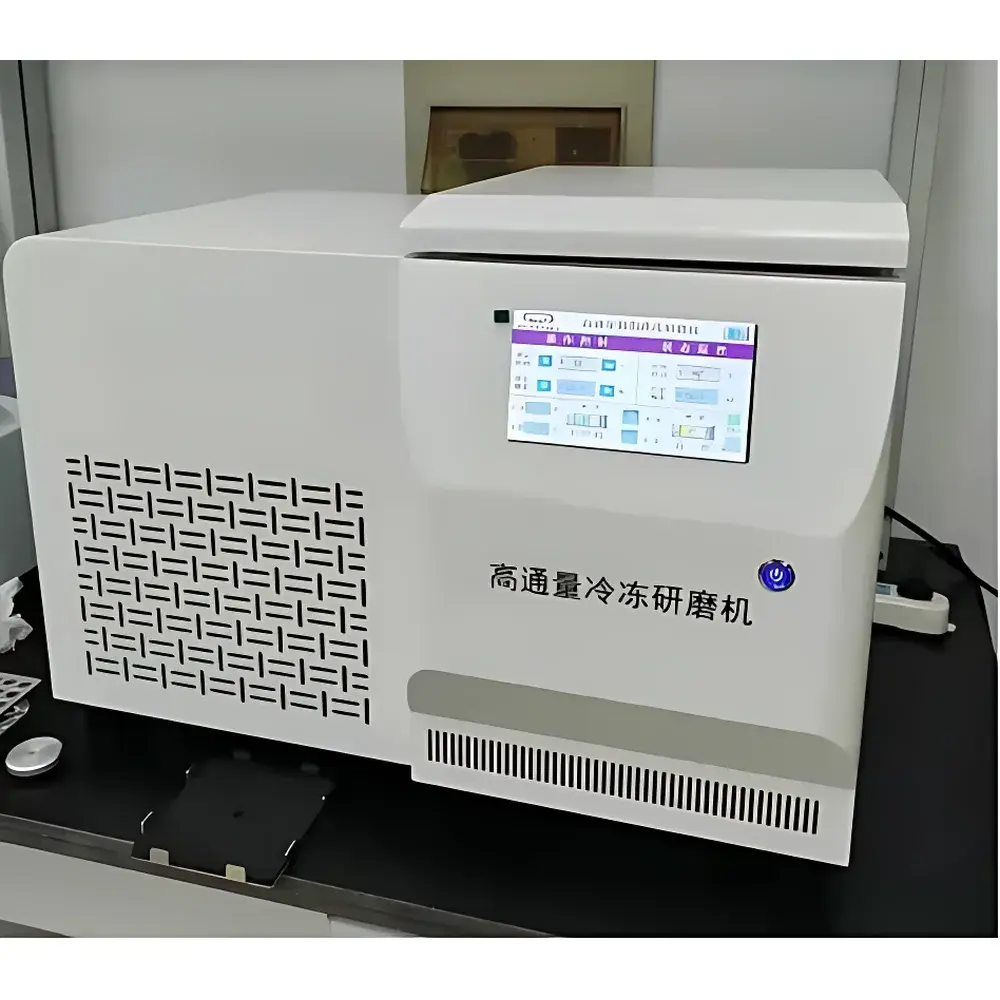
DYYB TG-48LD High-Throughput Cryogenic Multi-Sample Tissue Grinder
| Brand | DYYB |
|---|---|
| Origin | Shanghai, China |
| Model | TG-48LD |
| Cooling Chamber Temperature Range | −50 °C to +45 °C (±0.5 °C accuracy) |
| Sample Capacity | 48 × 0.2–0.5 mL tubes |
| Vibration Frequency | 0–70 Hz (0–2100 rpm) |
| Vertical Stroke | 34 mm |
| Noise Level | <50 dB(A) |
| Power Supply | 220 V / 50 Hz |
| Protection Rating | IP30 |
| Maximum Grinding Time | 9999 min |
| Minimum Grinding Time | 10 s |
| Acceleration/Deceleration Time | ≤2 s |
| Final Particle Size | <5 µm |
| Compatible Bead Materials | Zirconia, Stainless Steel, Tungsten Carbide, Agate, Quartz, Ceramic |
| Bead Diameter Range | 0.1–30 mm |
| Touchscreen Interface | 7-inch capacitive LCD with microprocessor control |
| Data Storage | 10 pre-programmed protocols (e.g., “Liver”, “Bone”, “Fungal Mycelium”, “Plant Leaf”) |
| Safety Features | Electromagnetic lid lock, auto-centering clamping, full-tube containment during operation |
Overview
The DYYB TG-48LD High-Throughput Cryogenic Multi-Sample Tissue Grinder is an engineered solution for mechanical lysis of biological and non-biological samples under controlled thermal conditions. It operates on the principle of high-frequency vertical oscillation—generating kinetic energy via rapid reciprocating motion of grinding beads within sealed sample tubes. This mechanism induces simultaneous impact, shear, and friction forces, enabling efficient cell wall disruption, organelle release, and macromolecular extraction without enzymatic or chemical bias. Unlike rotor-stator homogenizers or probe sonicators, the TG-48LD eliminates heat accumulation through cryogenic compatibility—allowing direct immersion of aluminum adapters in liquid nitrogen prior to loading onto the platform. Its architecture supports reproducible, scalable, and contamination-controlled processing across diverse matrices including fibrous plant tissues, lipid-rich animal organs, microbial biomass, polymeric materials, and volatile geological samples.
Key Features
- Cryogenic-ready design: Aluminum adapters withstand −80 °C pre-cooling; integrated cooling chamber maintains setpoint from −50 °C to +45 °C with ±0.5 °C stability—critical for preserving labile RNA, phosphoproteins, and metabolites.
- High-throughput parallel processing: Simultaneous grinding of up to 48 samples (0.2–0.5 mL format) in ≤2 minutes, with programmable cycle repetition to minimize inter-operator variability.
- Zero-cross-contamination workflow: Fully enclosed tube system with disposable consumables (tubes + beads); electromagnetic lid interlock prevents operation unless fully secured.
- Precision parameter control: 7-inch touchscreen interface enables granular adjustment of frequency (0–70 Hz), duration (10 s–9999 min), and multi-step cycling—validated for consistent bead velocity profiles across all positions.
- Acoustically optimized operation: Noise emission <50 dB(A) ensures compatibility with shared laboratory environments, including adjacent PCR prep rooms or imaging suites.
- Material-flexible grinding: Supports dry, wet, and cryo-milling modes; compatible with bead sets ranging from 0.1 mm quartz for nucleic acid shearing to 30 mm tungsten carbide for tough bone or polymer fragments.
Sample Compatibility & Compliance
The TG-48LD accommodates heterogeneous sample types requiring mechanical disruption without thermal degradation: mammalian tissues (liver, brain, kidney), fibrous botanicals (roots, stems, seeds), microbial pellets (bacteria, yeast, filamentous fungi), forensic specimens (hair, nail), pharmaceutical excipients, coal derivatives, and synthetic polymers (PE, PS, PET). All protocols adhere to ISO 17025-aligned sample integrity requirements—tubes remain sealed throughout processing, eliminating aerosol generation and cross-sample transfer. The system meets GLP documentation standards via timestamped protocol storage (10 user-defined methods), audit-trail-capable parameter logging, and hardware-level safety interlocks compliant with IEC 61000-6-2 (EMC) and IEC 61010-1 (electrical safety). While not FDA 21 CFR Part 11–certified out-of-box, its deterministic operation and traceable parameter history support validation for regulated workflows under internal SOPs.
Software & Data Management
The embedded microcontroller firmware provides non-volatile storage for ten experiment templates, each configurable with frequency ramping, dwell time, pause intervals, and repeat cycles. Preloaded profiles include “Animal Organ”, “Bone & Cartilage”, “Fungal Hyphae”, “Leaf Tissue”, and “Polymer Pellet”—optimized for common bead-to-sample mass ratios and kinetic energy thresholds. Real-time status display shows elapsed time, current frequency, chamber temperature, and lid-lock state. Data export is not supported via USB or network interface; however, all parameters are retained across power cycles and accessible via front-panel navigation. For integration into LIMS or ELN systems, users may manually record protocol IDs and timestamps per batch—consistent with ISO/IEC 17025 clause 7.7 on result reporting traceability.
Applications
- Genomic DNA isolation from formalin-fixed paraffin-embedded (FFPE) tissue sections where protease digestion alone yields fragmented yields.
- RNA extraction from RNase-rich tissues (e.g., pancreas, spleen) under sub-zero conditions to suppress endogenous nuclease activity.
- Proteome-wide preparation of membrane protein complexes from brain synaptosomes using cryo-milled detergent-resistant microdomains.
- Homogenization of mycotoxin-contaminated grain samples for HPLC-MS quantification, ensuring representative particle size distribution (<5 µm) prior to extraction.
- Preparation of nanocomposite polymer blends (e.g., PLA/graphene oxide) requiring uniform dispersion without thermal degradation.
- Forensic toxicology workflows involving hair shaft pulverization for segmental drug analysis—preserving longitudinal concentration gradients.
FAQ
What sample volumes does the TG-48LD support?
The standard configuration accommodates 48 × 0.2–0.5 mL microcentrifuge tubes. Optional adapters enable 2 mL, 7–15 mL, 25 mL, and 50 mL formats—each validated for mechanical stability at maximum operational frequency.
Can the instrument operate without cryogenic cooling?
Yes. The system functions effectively at ambient temperature for robust samples (e.g., dried plant material, bacterial pellets); however, cryogenic mode is recommended for thermolabile targets such as native enzymes or intact ribonucleoprotein particles.
How is bead contamination prevented between runs?
Disposable beads and single-use tubes eliminate carryover risk. Reusable beads require validated cleaning protocols (e.g., 70% ethanol soak + centrifugal wash) and must be inspected for surface pitting prior to reuse.
Is method transfer possible between TG-48LD units?
Yes—provided identical bead composition, size, mass ratio, and adapter geometry are maintained. Inter-unit reproducibility has been verified within ±3% CV for A260/A280 ratios in liver RNA preps across three independently calibrated instruments.
What maintenance is required?
Biannual inspection of drive shaft coupling integrity, annual recalibration of temperature sensor against NIST-traceable reference, and routine visual check of electromagnetic lock actuation force—documented per ISO/IEC 17025 clause 6.4.1.



