
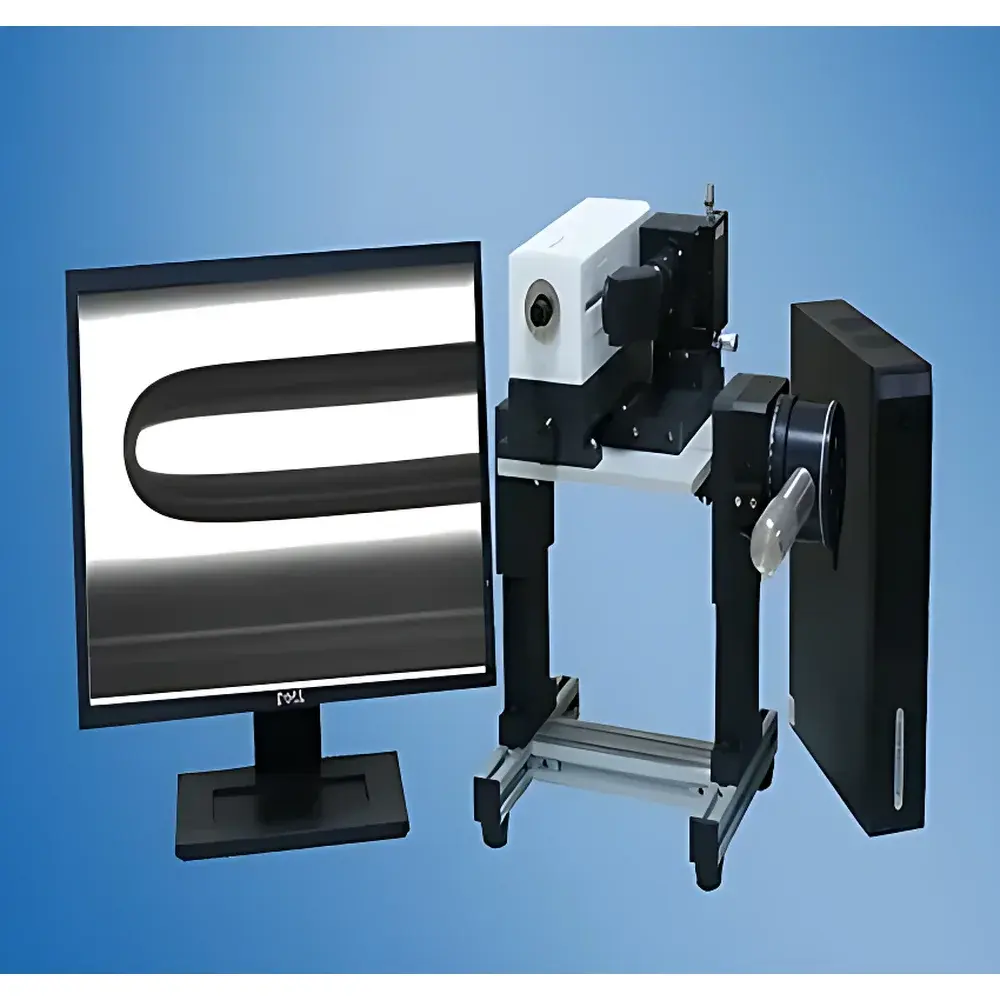
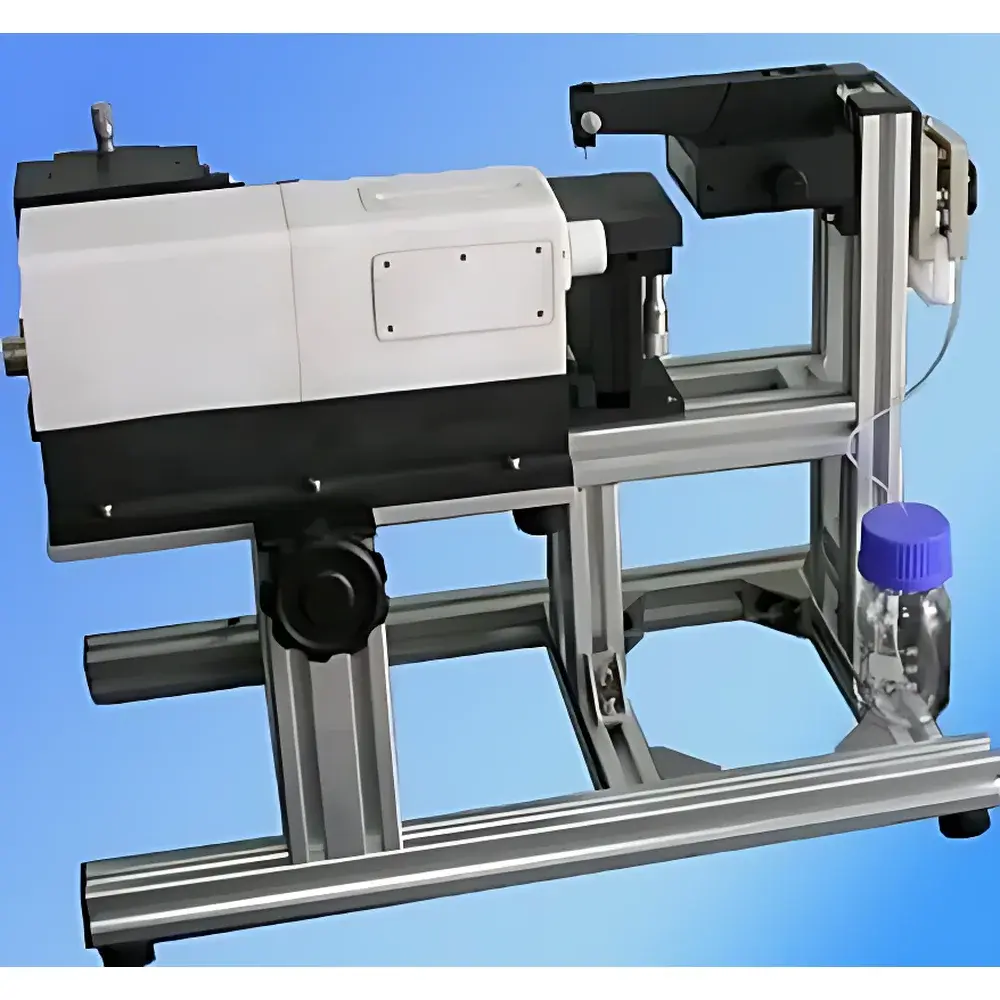
JJ2000BM Rotating Drop Interfacial Tensiometer & Contact Angle Analyzer
| [Origin | Beijing, China |
|---|---|
| Manufacturer Type | Authorized Distributor |
| Origin Category | Domestic (PRC) |
| Model | JJ2000BM |
| Measurement Range | 1×10⁻⁵–100 mN/m |
| Resolution | 0.001 mm (optical readout) |
| Accuracy | ±0.1% (rotational speed), ±0.1 °C (temperature) |
| Temperature Control Range | RT+5 °C to 80 °C (internal heating) or ambient to 100 °C (external bath) |
| Rotation Speed | 1000–10,000 rpm |
| Video Resolution | 768×576 pixels |
| Frame Rate | 30 fps |
| Interfaces | RS-232, RCA video] |
Overview
The JJ2000BM Rotating Drop Interfacial Tensiometer & Contact Angle Analyzer is a dual-function laboratory instrument engineered for high-precision measurement of ultra-low interfacial tension (IFT) and dynamic contact angle under controlled rotational and thermal conditions. It operates on the rotating drop principle—a well-established method in colloid and interface science—where a denser droplet of one liquid is suspended within a less-dense continuous phase inside a horizontally rotating quartz capillary tube. Under centrifugal force, the droplet deforms into a prolate spheroid; its shape is captured via high-resolution video imaging and analyzed using axisymmetric drop shape analysis (ADSA) algorithms to determine interfacial tension with sub-micron spatial resolution. Simultaneously, the system supports static and dynamic contact angle measurements on solid substrates by imaging sessile or captive drops under identical optical and environmental conditions. This integrated architecture enables correlative analysis of wettability and interfacial energetics—critical for reservoir engineering, formulation science, and surface functionalization studies.
Key Features
- Dual-mode operation: simultaneous or independent measurement of interfacial tension (1×10⁻⁵–100 mN/m) and contact angle (0–180°) using a shared optical path and synchronized video acquisition.
- Precision motorized rotation stage with closed-loop speed control (1000–10,000 rpm, ±0.1% accuracy) and real-time PC-based parameter adjustment via RS-232 interface.
- Integrated thermostatic control: internal Peltier-heated quartz cell (RT+5 °C to 80 °C) or compatibility with external circulating baths (up to 100 °C), with digital temperature feedback (±0.1 °C stability).
- High-fidelity video system: 768×576 pixel resolution at 30 fps, capturing droplet morphology in standard BMP format for offline validation and archival compliance.
- Optical calibration traceability: dual-calibrated quartz capillaries (2 mm and 4 mm inner diameter) with certified dimensional tolerances; pixel-to-length conversion verified using micrometer-scale reference standards.
- Windows-based control software with intuitive GUI, real-time droplet contour fitting, automated baseline detection, and export-ready data tables (CSV, TXT) compatible with LIMS and statistical analysis platforms.
Sample Compatibility & Compliance
The JJ2000BM accommodates a broad range of sample systems including aqueous/non-aqueous surfactant solutions, polymer blends, crude oil–brine–surfactant microemulsions, and functionalized solid surfaces (e.g., silanized glass, oxidized silicon wafers, coated metals). Its design conforms to ASTM D971 (Standard Test Method for Interfacial Tension of Oil Against Water by the Ring Method—adapted for rotating drop validation), ISO 1409 (Plastics—Determination of Interfacial Tension), and supports GLP-compliant workflows through timestamped image logging, operator ID tagging, and audit-trail-enabled parameter history. While not FDA 21 CFR Part 11-certified out-of-the-box, the software architecture permits integration with validated electronic lab notebook (ELN) systems for regulated environments requiring full data integrity and change control.
Software & Data Management
The native Windows application provides real-time visualization of droplet deformation, automatic edge detection using Canny–Sobel hybrid filtering, and iterative ADSA fitting based on Young–Laplace equation solutions. All raw images are stored as uncompressed BMP files with embedded metadata (timestamp, RPM, temperature, user ID, capillary ID). Processed results include interfacial tension (mN/m), contact angle (°), droplet volume (nL), aspect ratio, and curvature radius—exportable in ASCII format for traceability. Batch processing mode allows sequential analysis of multi-condition experiments (e.g., temperature ramps or concentration gradients), while built-in statistical tools compute mean, SD, and CV across replicate runs. Data files adhere to IUPAC-recommended nomenclature and units, facilitating cross-platform interoperability with MATLAB, Python (SciPy/Pandas), and commercial rheology or surface science suites.
Applications
- Enhanced Oil Recovery (EOR): Quantification of ultra-low IFT (<10⁻³ mN/m) between reservoir oil and novel surfactant/polymer formulations during core flooding simulation and screening of chemical flooding candidates.
- Formulation Development: Stability assessment of emulsions, microemulsions, and Pickering systems via interfacial rheology proxies and contact angle hysteresis analysis on model substrates.
- Coating & Adhesion Science: Correlation of substrate surface energy (via contact angle) with interfacial tension to predict wetting behavior, spreading coefficient, and adhesion thermodynamics.
- Pharmaceutical & Agrochemical Research: Characterization of surfactant-mediated solubilization, droplet coalescence kinetics, and solid–liquid interaction in suspension concentrates and nanoemulsion delivery systems.
- Academic Interface Physics: Experimental validation of theoretical models for droplet deformation in shear-dominated flows, Marangoni effects, and surfactant adsorption kinetics at fluid interfaces.
FAQ
What is the minimum measurable interfacial tension value supported by the JJ2000BM?
The instrument achieves reliable quantification down to 1×10⁻⁵ mN/m under optimized conditions (high-speed rotation, low-density contrast, clean quartz surfaces, and vibration-isolated mounting).
Can the system measure contact angle on rough or heterogeneous surfaces?
Yes—the video-based analysis supports both static and advancing/receding angle protocols; however, interpretation requires complementary surface topography data (e.g., from AFM or profilometry) for rigorous wettability modeling.
Is external temperature control required for measurements above 80 °C?
Yes. The built-in heater is rated to 80 °C; for higher temperatures, an external thermostatted bath with precision flow control must be connected via the provided thermal coupling ports.
How is calibration performed for interfacial tension measurements?
Calibration uses certified reference liquids (e.g., pure water/air, diiodomethane/water) and geometric verification of capillary dimensions; no user-performed force calibration is needed due to the shape-based first-principles calculation method.
Does the software support automated reporting for regulatory submissions?
The base software generates structured data logs suitable for internal QA/QC; for formal regulatory use (e.g., USP , ISO/IEC 17025), integration with validated ELN or LIMS platforms is recommended to meet ALCOA+ data integrity requirements.



