
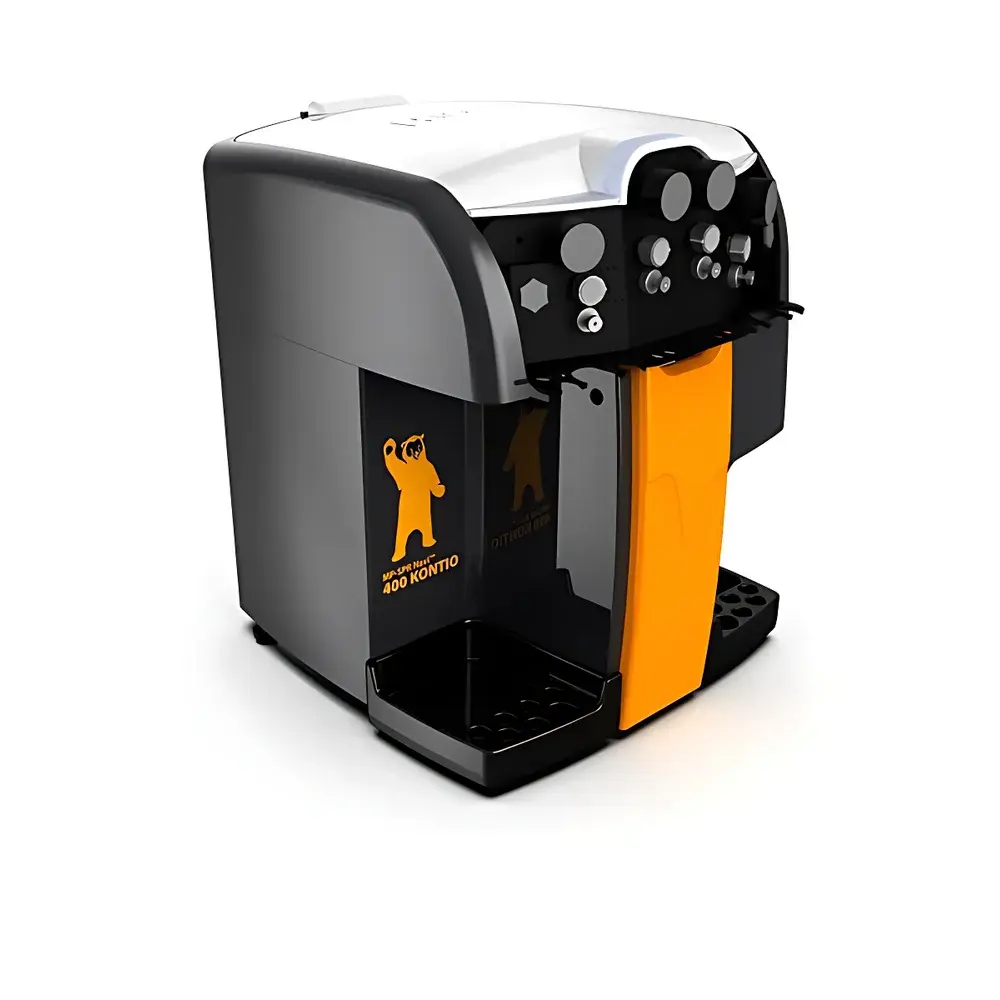
Bionavis MP-SPR Navi 400 KONTIO Multi-Parameter Surface Plasmon Resonance Analyzer
| Brand | Bionavis |
|---|---|
| Origin | Finland |
| Model | MP-SPR Navi 400 KONTIO |
| Sample Volume | 250 µL |
| Injection Volume | 50 µL |
| Analysis Time | 5–10 min |
| Temperature Control Range | 15–45 °C |
| Angular Measurement Range | 40–78° |
| Angular Resolution | 0.001° |
| Flow Rate | 10–400 µL/min |
| Laser Wavelengths | 670 nm (standard), optional dual-wavelength (670 nm + 785 nm) |
| Refractive Index Range | 1.00–1.40 (bulk), extendable for high-RI materials (e.g., diamond-like carbon, n ≈ 2.7) |
| Thickness Measurement Range | Å to µm (material-dependent) |
| Kinetic Constants | kₐ = 10³–10⁸ M⁻¹s⁻¹, k = 10⁻⁷–0.1 s⁻¹, K = 10⁻¹²–10⁻³ M |
| Sensitivity | 1 µRIU, 1 pg/mm² (protein coverage) |
| Minimum Detectable Mass | 2 Da (gas phase), <100 Da (liquid phase) |
| Short-term Noise | 0.3 µRIU, Baseline Drift: <1 µRIU/min |
| Flow Channels | 4 (PDMS microfluidic cell) |
| Detection Modes | Angle-scan (full SPR curve) and fixed-angle (kinetic mode, up to 1 ms sampling) |
Overview
The Bionavis MP-SPR Navi 400 KONTIO is a high-precision, label-free multi-parameter surface plasmon resonance (MP-SPR) analyzer engineered for real-time, quantitative molecular interaction analysis across diverse physical states—solid, liquid, and gas. Unlike conventional single-angle or wavelength-modulated SPR systems, the MP-SPR Navi 400 KONTIO implements true angular interrogation using a rotating laser and high-resolution detector, enabling acquisition of full SPR curves over an exceptionally broad angular range (40°–78°) with sub-millidegree resolution (0.001°). This architecture delivers simultaneous, independent measurement of multiple optical parameters—including resonance angle, full width at half maximum (FWHM), and intensity—as well as derived metrics such as refractive index (RI), layer thickness, and complex dielectric function. Its ability to operate without index-matching oil and support interchangeable sensor chips (Au, Ag, SiO₂, TiO₂, functionalized surfaces) ensures experimental flexibility while eliminating contamination risks associated with traditional prism-coupled SPR. The system is validated for use under GLP-compliant workflows and supports audit-trail-enabled data acquisition in accordance with FDA 21 CFR Part 11 requirements when deployed with TraceDrawer™ or LayerSolver™ analysis modules.
Key Features
- Four-channel PDMS microfluidic flow cell (1 µL/channel), compatible with parallel or serial assay configurations
- Dual-mode operation: angle-scan mode (full SPR curve acquisition in <2 s) and fixed-angle kinetic mode (1 ms temporal resolution)
- Integrated dual-peristaltic pump system (2 pumps × 2 channels), enabling precise, pulse-free fluid delivery across 10–400 µL/min
- Multi-wavelength capability: standard 670 nm laser; optional L-option adds 785 nm for simultaneous RI and thickness determination
- Extended refractive index detection range (1.00–1.40 bulk; validated up to n ≈ 2.7 for inorganic thin films)
- Temperature-controlled sample environment (15–45 °C) with ±0.1 °C stability, critical for thermosensitive biomolecular assays
- Modular flow cell design: quick-release mechanism enables tool-free replacement of PDMS, PEEK (SPR305-MS), electrochemical (SPR321-EC), gas-phase (SPR310-GS), or ultrafast kinetic (SPR302-LS) cells
- No gold-coated prisms required; proprietary matched-index prism with removable adhesive interface allows rapid sensor exchange and post-assay ex situ characterization
Sample Compatibility & Compliance
The MP-SPR Navi 400 KONTIO accommodates native, undiluted biological samples—including whole serum, urine, saliva, and live-cell suspensions—without signal suppression or matrix interference, enabled by its PureKinetics™ algorithm that dynamically compensates for bulk RI shifts induced by buffer composition (e.g., ≤5% DMSO). It complies with ISO/IEC 17025 principles for analytical instrument validation and supports traceable calibration via certified RI standards. For regulated environments, the system integrates seamlessly with electronic lab notebooks (ELNs) and LIMS platforms. All firmware and software components are designed to meet ICH-GCP, USP , and ASTM E2500-22 guidelines for analytical instrument qualification (AIQ). Sensor surfaces are available in Au, Ag, Cu, Pt, SiO₂, Al₂O₃, TiO₂, and chemically functionalized variants (CMD, Ni²⁺, Protein A, streptavidin, thiol-reactive monolayers), supporting covalent immobilization, affinity capture, or passive adsorption strategies per ISO 10993-5 cytotoxicity screening protocols.
Software & Data Management
The MP-SPR Navi™ Control and DataViewer software suite provides unrestricted local installation, real-time visualization, and export-ready data formatting (CSV, Excel, HDF5). Raw angular scan data are stored with full metadata—including timestamp, temperature, flow rate, and user-defined annotation—ensuring FAIR (Findable, Accessible, Interoperable, Reusable) data stewardship. Optional TraceDrawer™ performs global fitting of association/dissociation kinetics under heterogeneous binding models (1:1, bivalent analyte, conformational change), while LayerSolver™ enables quantitative modeling of multilayer architectures (e.g., polymer brushes, lipid bilayers, nanoparticle monolayers) using Fresnel-based optical simulations. Both tools generate PDF reports compliant with ALCOA+ (Attributable, Legible, Contemporaneous, Original, Accurate, Complete, Consistent, Enduring, Available) data integrity criteria. Software updates are delivered via secure HTTPS channel with SHA-256 signature verification.
Applications
- Pharmaceutical Development: Quantification of antibody-antigen affinity (KD down to pM), epitope binning, FcγR binding profiling, and cell membrane receptor internalization kinetics in real time
- Nanomaterial Characterization: In situ monitoring of nanoparticle self-assembly, protein corona formation, ligand density mapping, and release kinetics from polymeric carriers
- Electrochemical Integration: Synchronized MP-SPR/electrochemistry (EIS, amperometry, potentiometry) for label-free detection of redox-coupled binding events on conductive substrates
- Functional Coating Optimization: Thickness and RI quantification of anti-fouling, pH-responsive, antimicrobial, or anti-reflective thin films (3–100 nm) on flexible or rigid substrates
- Biosensor Development: Rational design and iterative testing of recognition layers on glass, polymer, silicon, or nanomaterial transducers for point-of-care diagnostics
- Gas-Phase Sensing: Real-time hydrogen detection (2 Da) on Pd-functionalized surfaces and volatile organic compound (VOC) screening in breath-mimetic matrices
FAQ
Can the MP-SPR Navi 400 KONTIO measure interactions in undiluted human serum?
Yes—PureKinetics™ correction eliminates bulk RI artifacts caused by serum matrix, enabling direct kinetic analysis without sample dilution or pre-clearing.
Is the system compatible with electrochemical workstations?
Yes—dedicated SPR321-EC flow cells integrate with standard potentiostats for simultaneous optical and electrochemical readout.
What is the minimum detectable molecular weight in aqueous solution?
Small molecules below 100 Da (e.g., drug metabolites, peptides) are reliably detected due to sub-pg/mm² surface mass sensitivity and low-noise angular tracking.
Does the instrument require annual service contracts?
No—modular HPLC-grade fluidics and field-replaceable optical components eliminate mandatory maintenance contracts; optional extended warranty available.
Can I use custom sensor chips not listed in the catalog?
Yes—Bionavis offers custom sensor fabrication and surface chemistry development services under NDA, including lithographic patterning and SAM optimization.





