
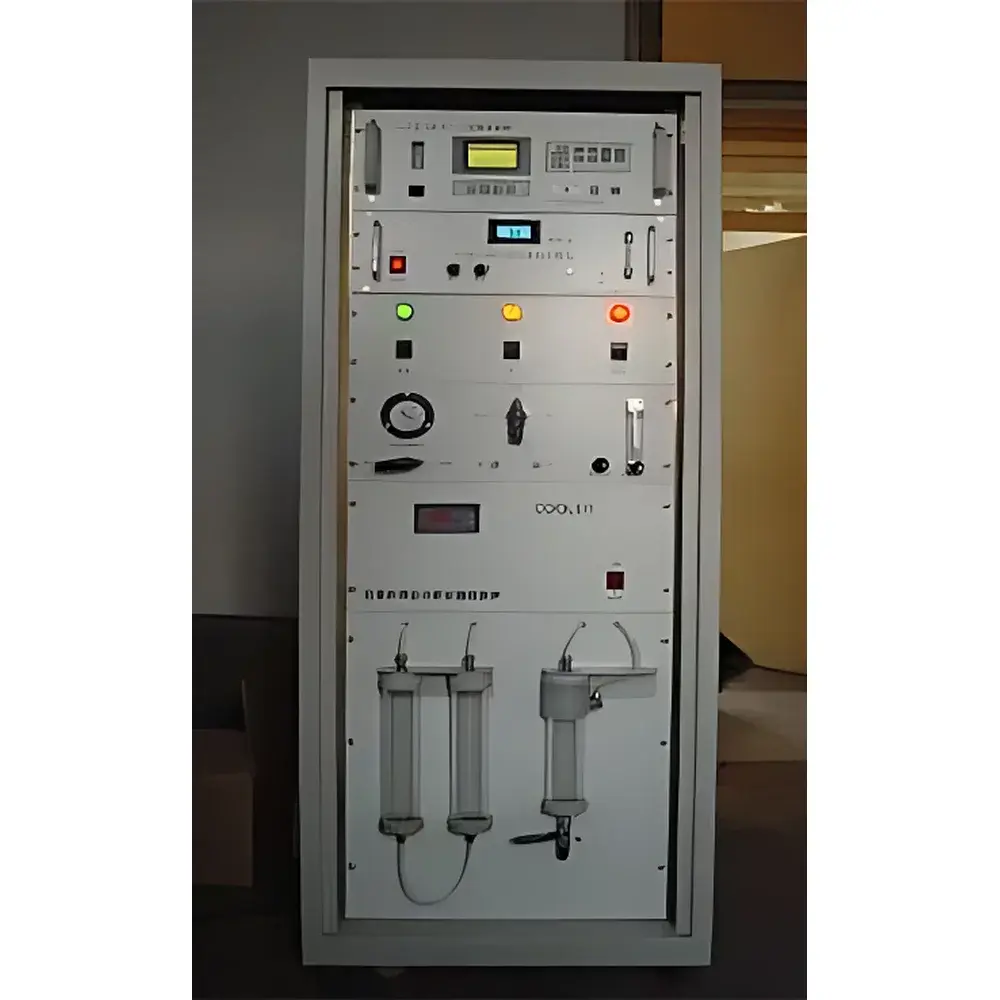
Hyundai HY-3000 Multi-Component Gas Analysis System
| Origin | Beijing, China |
|---|---|
| Manufacturer Type | Authorized Distributor |
| Product Origin | Domestic (PRC) |
| Model | HY-3000 |
| Instrument Type | Online Continuous Emission Monitoring System (CEMS) |
| Target Gases | CO, CO₂, CH₄, O₂, SO₂, H₂ |
| Response Time | ≤30 s |
| Zero Drift | ±2% FS / 48 h |
| Span Drift | ±2% FS / 48 h |
| Linearity Error | ±2% FS |
| O₂ Range Options | 0–2% or 0–25% vol |
| H₂ Range Options | 0–5% or 0–100% vol |
| CO Range | 0–5000 ppm (expandable) |
| CO₂/CH₄/SO₂ Ranges | 0–500 ppm / 0–500 ppm / 0–2000 ppm (all expandable) |
Overview
The Hyundai HY-3000 Multi-Component Gas Analysis System is an online, extractive continuous emission monitoring system engineered for real-time, simultaneous quantification of up to six key gaseous species in industrial process and flue gas streams. Based on dual-beam non-dispersive infrared (NDIR) spectroscopy for CO, CO₂, CH₄, and SO₂, coupled with paramagnetic detection for O₂ and thermal conductivity or electrochemical sensing for H₂ (configurable per application), the HY-3000 delivers stable, interference-resistant measurements under harsh ambient conditions. Designed specifically for integration into stack monitoring networks at cement kilns, sintering plants, coke ovens, waste incinerators, landfill biogas facilities, and ceramic firing lines, it meets the functional requirements of ISO 14064-1 verification pathways and supports compliance reporting under national emission standards aligned with EU IED (Industrial Emissions Directive) Annex V methodology frameworks.
Key Features
- Modular sensor architecture enabling field-selectable gas channel configuration — users specify required analytes (e.g., CO + CO₂ + O₂ only, or full six-gas suite) at order stage
- Integrated heated sample line (180 °C) and condensate removal unit to prevent water vapor interference and maintain dew point control upstream of optical cells
- Automatic zero/span calibration capability via integrated solenoid valves and certified calibration gas manifold (optional external cylinder interface)
- Robust 19-inch rack-mount enclosure rated IP54, conforming to IEC 61000-6-2 (immunity) and IEC 61000-6-4 (emission) standards
- Real-time diagnostics including optical path integrity monitoring, detector signal-to-noise ratio tracking, and pressure/temperature compensation logging
- Onboard data logger with 32 GB internal storage supporting 12-month buffer at 1-minute sampling intervals
Sample Compatibility & Compliance
The HY-3000 accepts raw, hot, humid, and particulate-laden sample gas streams typical of post-combustion zones—provided inlet temperature remains below 200 °C and particulate loading is <5 mg/Nm³ (achieved via standard cyclonic pre-filter). It complies with Chinese HJ 75-2017 and HJ 76-2017 technical specifications for CEMS performance evaluation, including mandatory 7-day stability testing, multi-point linearity verification, and interference testing against common cross-sensitivities (e.g., CO₂ on CO NDIR channels). While not certified to EN 15267 or US EPA PS-15 out-of-the-box, its measurement architecture is compatible with third-party validation protocols required for regulatory acceptance in export markets. All firmware and calibration records adhere to ALCOA+ principles (Attributable, Legible, Contemporaneous, Original, Accurate, Complete, Consistent, Enduring, Available) to support GLP/GMP-aligned quality systems.
Software & Data Management
HY-View™ embedded software provides intuitive web-based HMI accessible via Ethernet (HTTP/HTTPS) or optional 4G LTE modem. It supports configurable alarm thresholds (high/low, rate-of-change), automated report generation (daily summary, event-triggered logs), and secure data export in CSV and XML formats compliant with ISO 14040 LCA inventory templates. Audit trail functionality records all user actions—including parameter changes, calibration events, and maintenance interventions—with timestamps and operator ID. For enterprise integration, Modbus TCP and OPC UA (v1.04) server modules are available as factory-installed options, enabling direct connectivity to DCS, SCADA, or cloud-based environmental data platforms such as Siemens Desigo CC or Schneider EcoStruxure.
Applications
- Continuous monitoring of CO and O₂ in sinter plant exhaust for combustion efficiency optimization and carbon balance modeling
- Biogas composition analysis (CH₄/CO₂/H₂S/O₂) at landfill and anaerobic digestion facilities to inform upgrading system control logic
- SO₂ and CO co-monitoring in municipal solid waste incinerator flue ducts for desulfurization reagent dosing feedback
- Process safety interlock support via rapid H₂ detection in reducing atmospheres of ceramic roller kilns and metallurgical annealing lines
- Stack-level greenhouse gas (GHG) reporting per ISO 14064-3, with traceable chain-of-custody for CO₂-equivalent mass flow calculations
FAQ
Is the HY-3000 certified to EN 15267 or US EPA Performance Specification 15 (PS-15)?
No — it is type-approved under China’s HJ 75/76-2017 framework. Third-party certification to European or U.S. standards requires site-specific QAL2/QAL3 testing conducted by accredited laboratories.
Can the system operate unattended for extended periods?
Yes — with scheduled automatic zero/span checks (user-definable interval), the HY-3000 maintains valid operation for ≥30 days without manual intervention, assuming stable supply gas pressure and ambient temperature within 0–40 °C.
What sample conditioning options are available beyond the standard heated line?
Optional add-ons include chilled mirror dew point analyzers, Teflon-lined stainless steel sample probes, and catalytic scrubbers for H₂S removal prior to NDIR cells.
Does the system support remote firmware updates?
Firmware updates must be performed locally via USB or Ethernet using Hyundai-signed binary packages; no over-the-air (OTA) update capability is implemented for cybersecurity compliance.
How is measurement uncertainty quantified for regulatory reporting?
Total expanded uncertainty (k=2) is calculated per GUM (JCGM 100:2008) incorporating repeatability, drift, linearity, and environmental influence factors — documented in the instrument’s Certificate of Conformance supplied with each unit.
Related Products







