
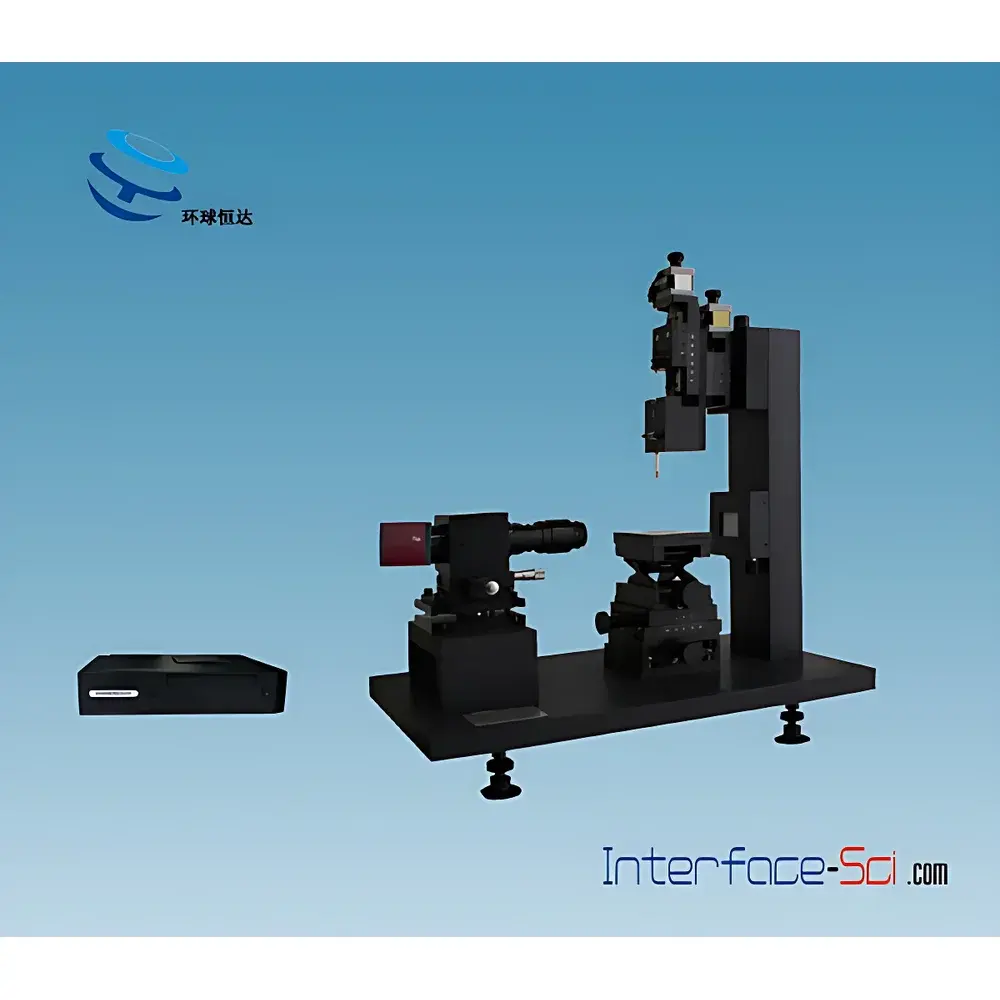
Interface SCI2000G High-Speed Video-Based Contact Angle Analyzer
| Brand | Interface |
|---|---|
| Origin | Beijing, China |
| Model | SCI2000G |
| Instrument Type | Benchtop Laboratory System |
| Contact Angle Range | 0–180° |
| Contact Angle Accuracy | ±0.1° |
| Sample Stage Dimensions | 120 × 100 mm |
| Minimum Image Resolution | 1280 × 1024 pixels |
| Surface/Interfacial Tension Range | 5.0–2000 mN/m |
| Imaging Speed (Standard) | 25 fps |
| Measurement Methods | Sessile Drop, Pendant Drop, Captive Bubble, Tilting Plate |
| Software Compliance | ASTM D724, ASTM D5946, ISO 15989 |
Overview
The Interface SCI2000G High-Speed Video-Based Contact Angle Analyzer is an engineered optical system designed for quantitative characterization of solid–liquid–gas interfacial behavior under static and dynamic conditions. It operates on the principle of high-resolution digital image capture and pixel-based geometric analysis of liquid droplet profiles, enabling precise determination of contact angles via multiple validated fitting algorithms—including Young–Laplace equation-based pendant drop analysis for surface and interfacial tension. The instrument supports both fundamental research and industrial quality control applications where surface wettability, interfacial energetics, and dynamic wetting kinetics are critical parameters. Its modular architecture accommodates variable environmental conditions—including temperature-controlled stages up to 400 °C—and integrates seamlessly with regulatory-compliant data management workflows required in GLP and GMP environments.
Key Features
- High-precision mechanical stage with manual five-axis positioning (X/Y/Z/tilt/rotation), featuring micrometer-grade resolution (0.1 mm linear, 0.01° angular) and dual-guide rail stability for repeatable sample alignment.
- Optimized optical train: industrial-grade continuous zoom lens (0.7–5.0× magnification), low-distortion optics, and adjustable LED cold-light contour illumination with parallel-beam collimation for sharp droplet edge definition.
- Modular imaging system: standard 25 fps USB 2.0 monochrome CCD (1280 × 1024 resolution); optional upgrade paths to 60–2000 fps high-speed cameras for transient wetting event capture.
- Multi-method fluid delivery: dual-mode syringe pump system (manual + programmable peristaltic or precision screw-driven injection), supporting 0.14–0.9 mm stainless steel and PTFE needles for diverse surface chemistries including superhydrophobic and viscous formulations.
- Comprehensive software suite with automated baseline detection, asymmetric droplet correction, curvature-based surface roughness compensation, and real-time video recording (AVI format) synchronized with metadata logging.
Sample Compatibility & Compliance
The SCI2000G accommodates a broad range of sample geometries and material classes—including rigid substrates (glass, silicon wafers, metals), flexible films, fibers, textiles, porous media, and compressed powders—within its 180 mm (W) × ∞ (L) × 60 mm (H) maximum loading envelope. Optional fixtures (e.g., fiber clamps, leaf holders) extend applicability to irregular or non-planar surfaces. All measurement protocols align with internationally recognized standards: ASTM D724 (paper wettability), ASTM D5946 (corona-treated polymer films), and ISO 15989 (water contact angle on treated plastic films). Data acquisition and storage support audit-trail functionality compliant with FDA 21 CFR Part 11 requirements when configured with user-access controls and electronic signature modules.
Software & Data Management
The proprietary analysis platform implements six distinct contact angle calculation methods (e.g., tangent, height-width, ellipse, circle, Young–Laplace, and automatic edge-detection algorithms), each selectable based on droplet symmetry, substrate heterogeneity, and experimental objective. Dynamic measurements—including advancing/receding angles, roll-off angles, and time-resolved contact angle evolution—are fully automatable with user-defined intervals down to 40 ms per frame. Surface free energy analysis employs twelve established theoretical models (Owen–Wendt–Rabel, Wu, van Oss–Chaudhury–Good, Neumann Equation of State, etc.) against an embedded database of 300+ reference liquids. All raw images, processed data, curve fits, and metadata are stored in a relational database with export capabilities to Excel, CSV, and annotated PNG/JPEG formats. Backup, compression, and version-controlled archiving ensure long-term data integrity.
Applications
This system serves cross-disciplinary laboratories engaged in surface science, materials engineering, and formulation development. Typical use cases include plasma treatment efficacy assessment on semiconductor wafers and display components; hydrophilicity/hydrophobicity mapping of HVAC heat exchanger foils and insulator ceramics; interfacial tension profiling of surfactant-laden formulations in agrochemicals, coatings, and pharmaceutical emulsions; surface energy quantification of biomaterials (e.g., contact lenses, bone scaffolds) for adhesion and biocompatibility screening; and dynamic wetting analysis of inkjet inks, conductive pastes, and battery electrolytes on functionalized electrodes. In R&D settings, it supports temperature-, time-, and concentration-dependent interfacial property studies across polymers, molten metals, crude oils, and colloidal dispersions.
FAQ
What measurement methods does the SCI2000G support?
Sessile drop (2- and 3-phase), pendant drop, captive bubble, and tilting plate methods—all implemented with corresponding analytical modules for contact angle and interfacial tension derivation.
Can the system measure surface free energy?
Yes—using twelve validated thermodynamic models against an integrated library of 300+ liquids, enabling analysis of both low-energy (e.g., PTFE) and high-energy (e.g., silica, alumina) surfaces.
Is the software compliant with regulatory data integrity requirements?
When deployed with role-based access control and electronic signature configuration, the software meets core elements of FDA 21 CFR Part 11 and EU Annex 11 for audit-ready documentation.
What is the maximum operating temperature of the heated stage?
The optional temperature-controlled stage supports operation from ambient up to 400 °C, enabling high-temperature wettability studies relevant to metallurgy and ceramic processing.
How is calibration performed for contact angle accuracy?
Calibration uses certified reference standards (e.g., NIST-traceable glass slides with defined contact angles) and internal geometric scaling verification via stage-mounted calibration grids.
Related Products



