
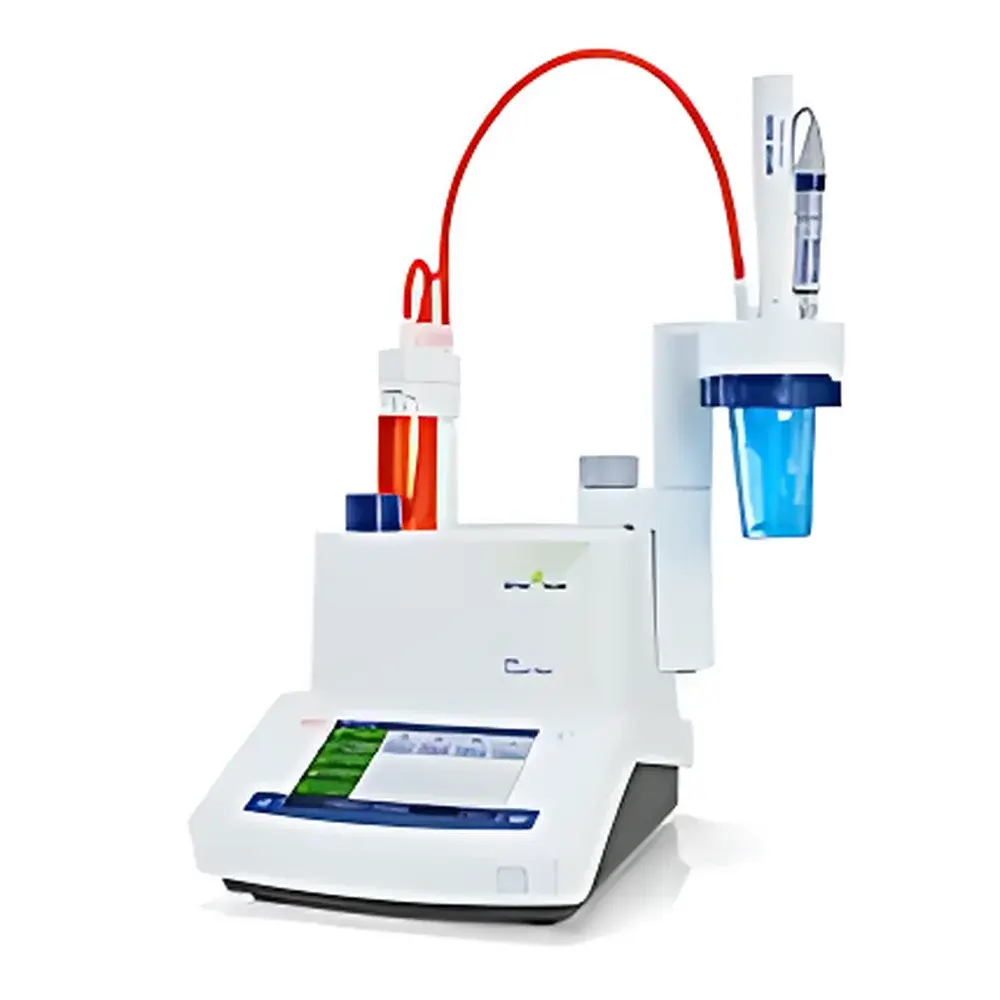
METTLER TOLEDO G10S Smart Compact Potentiometric Titrator
| Brand | METTLER TOLEDO |
|---|---|
| Origin | Switzerland |
| Model | G10S |
| Instrument Type | General-purpose Automatic Potentiometric Titrator |
| Application Scope | Universal |
| Built-in Pre-validated Methods | >20 |
| Touchscreen Interface | Color LCD with One Click™ UI |
| Language Support | English, Chinese, German, French, Spanish, Italian, Russian, Polish, Korean, Portuguese |
| Data Export Formats | CSV, PDF, XML |
| USB Peripheral Support | Printer (e.g., USB-P25), Flash Drive |
| Stirrer Type | Propeller Stirrer |
| Endpoint Detection | Yes |
| Titration Modes | Acid/Base, Redox, Precipitation (Cl⁻, Br⁻, etc.), Complexometric, Photometric |
| pH Measurement Capability | Yes |
| Predefined Calculation Templates | Yes |
| Learning Titration Function | Yes |
| Max Sample Capacity per Series | 120 |
| Part Number | 30267117 |
Overview
The METTLER TOLEDO G10S Smart Compact Potentiometric Titrator is an entry-level, benchtop automatic titrator engineered for precision, repeatability, and operational efficiency in routine electrochemical analysis. Based on potentiometric endpoint detection—measuring the potential difference between a reference electrode and an indicator electrode as titrant is incrementally added—the G10S delivers robust performance for acid-base, redox, precipitation (e.g., chloride and bromide determination), complexometric, and photometric titrations. Its compact footprint (290 × 320 × 420 mm) and intuitive architecture make it ideal for QC laboratories, teaching labs, and production environments where space, ease of use, and regulatory compliance are critical. Designed and manufactured in Switzerland, the instrument adheres to METTLER TOLEDO’s global quality standards and integrates seamlessly into workflows governed by Good Laboratory Practice (GLP) and ISO/IEC 17025 requirements.
Key Features
- One Click™ touchscreen interface with responsive 7-inch color display—enabling method launch, parameter adjustment, and result review with minimal user input
- RFID-enabled smart burette recognition: each METTLER TOLEDO Smart Burette contains an embedded chip storing reagent identity, concentration, expiry date, calibration history, and lot traceability—automatically loaded upon installation to prevent manual entry errors or use of expired titrants
- Integrated propeller stirrer with adjustable speed control ensures homogeneous mixing across diverse sample viscosities and volumes (1–250 mL)
- Onboard pH measurement capability with auto-calibration support for two-point pH standardization using NIST-traceable buffers
- Four customizable One Click™ shortcuts per user profile—accelerating access to frequently used methods, report templates, or instrument diagnostics
- Single-burette drive unit with high-precision stepper motor and glass syringe-type delivery system (typical resolution: 0.01 mL), supporting volumetric accuracy compliant with ASTM E2081 and ISO 8655-3
- Pre-loaded library of >20 METTLER TOLEDO-validated titration methods—including USP , AOAC 947.02, and EN ISO 9964-1—ready for immediate deployment without method development
Sample Compatibility & Compliance
The G10S accommodates liquid, semi-solid, and dissolved solid samples across a wide pH range (0–14) and temperature range (5–40 °C). It supports standard combination electrodes (e.g., pH, redox, ion-selective) and dedicated photometric sensors via its universal analog input port. All data acquisition, storage, and reporting functions comply with GLP principles: audit trails record user actions, method changes, calibration events, and result modifications with timestamps and operator IDs. Electronic signatures, secure user authentication (password-protected roles), and encrypted local database storage ensure alignment with FDA 21 CFR Part 11 expectations for regulated environments. Certificate of Conformance (CoC) and factory calibration documentation are supplied with each unit.
Software & Data Management
Data handling is fully configurable via the instrument’s embedded operating system—no external PC required for basic operation. Results and raw titration curves are stored internally (≥10,000 entries) and exportable in CSV (for spreadsheet analysis), PDF (for signed reports), or XML (for LIMS integration). USB host ports enable plug-and-play connection to METTLER TOLEDO USB-P25 thermal printers or generic USB printers—generating tamper-evident, timestamped hard copies with full method metadata and GLP header information. Optional connectivity to LabX® Lite software allows centralized method management, remote monitoring, and automated backup to network drives—supporting laboratory-wide standardization and digital transformation initiatives.
Applications
The G10S serves as a primary titration platform in pharmaceutical QC (e.g., assay of active ingredients, residual alkali in APIs), food & beverage testing (acidity in juices, salt content in dairy), water/wastewater analysis (alkalinity, chloride, hardness), and academic instruction (fundamental electrochemistry labs). Its validated methods cover pharmacopeial procedures including USP monographs for sodium bicarbonate, potassium permanganate assays, and iodometric determination of ascorbic acid. The learning titration mode supports student training by visualizing real-time potential vs. volume curves and guiding endpoint interpretation—reinforcing theoretical concepts through hands-on practice.
FAQ
Does the G10S support automatic sample handling?
Yes—when paired with the Rondolino automatic sampler (sold separately), the G10S can process up to 120 samples unattended per sequence, with integrated rinse, dosing, and electrode cleaning cycles.
Can I edit or create custom titration methods?
Yes—the modular Method Editor allows users to define titrant addition parameters, endpoint criteria (e.g., first/second derivative, fixed potential), calculation formulas, and report formatting—all without programming knowledge.
Is the G10S compatible with non-METTLER TOLEDO electrodes?
Yes—it accepts any standard BNC or DIN-compatible electrode with analog output; however, Smart Electrode recognition (e.g., QuickConnect) requires METTLER TOLEDO’s digital electrode series.
What data security features are included?
Role-based access control, electronic signature capture, immutable audit trail with operator ID and timestamp, and password-protected method editing ensure integrity and accountability per GLP and ISO/IEC 17025 Clause 7.10.
How is calibration verified and documented?
Built-in calibration verification routines generate printable reports showing electrode slope, offset, and asymmetry potential—traceable to internal reference standards and aligned with ISO 17025 clause 6.4.2 requirements for measurement equipment verification.





