
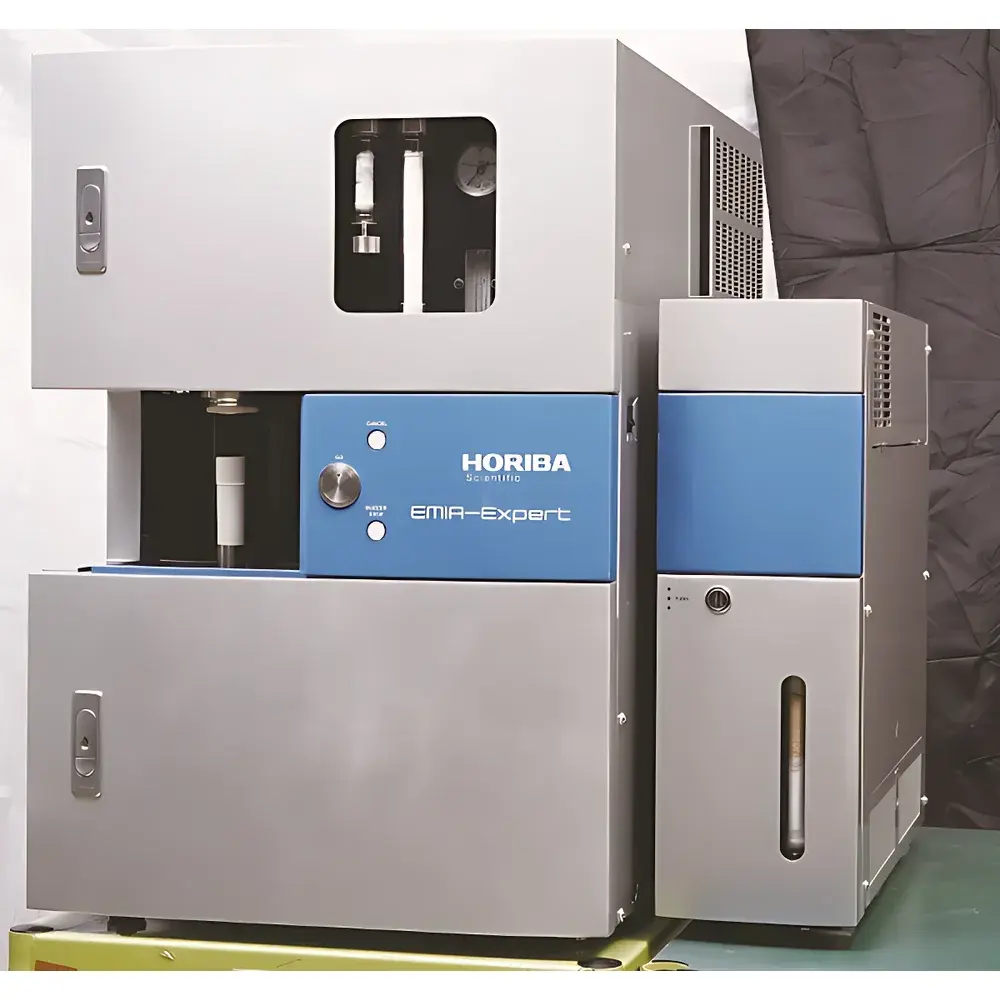
HORIBA EMIA-Expert Carbon and Sulfur Analyzer
| Brand | HORIBA |
|---|---|
| Origin | Japan |
| Manufacturer Type | Manufacturer |
| Origin Category | Imported |
| Model | EMIA-Expert |
| Pricing | Upon Request |
| Measurement Principle | Non-Dispersive Infrared (NDIR) Absorption |
| Heating System | High-Frequency Induction Furnace |
| Maintenance Interval | Up to 200 Analyses Without Service |
| Analysis Time | ≤70 Seconds per Sample |
| 清扫 Mechanism | Brushless Automatic Cleaning System |
Overview
The HORIBA EMIA-Expert Carbon and Sulfur Analyzer is a high-performance elemental combustion analyzer engineered for precise, reproducible quantification of total carbon (C) and total sulfur (S) in solid metallic, inorganic, and refractory materials. It operates on the fundamental principle of high-frequency induction combustion followed by non-dispersive infrared (NDIR) absorption spectroscopy — a method standardized under ASTM E1019, ISO 15350, and JIS G 1211. During analysis, a precisely weighed sample is combusted in an oxygen-rich atmosphere within a high-frequency induction furnace, converting carbon and sulfur into CO₂ and SO₂ gases, respectively. These gaseous oxides are then carried through a dust removal and moisture trapping system before entering dual NDIR detectors calibrated for independent, simultaneous measurement of each gas at specific absorption wavelengths (4.26 µm for CO₂, 7.35 µm for SO₂). The instrument’s optical path design, detector thermal stability, and gas flow control architecture ensure long-term baseline integrity and sub-ppm detection capability across dynamic concentration ranges.
Key Features
- High-frequency induction furnace with digitally regulated power delivery, enabling consistent, programmable combustion profiles for diverse sample matrices including steel, cast iron, ceramics, and carbides.
- Brushless automatic cleaning system eliminates mechanical wear and particulate carryover, supporting uninterrupted operation for up to 200 consecutive analyses without manual intervention or consumable replacement.
- Optimized gas handling train featuring dual-stage desiccant traps, catalytic oxidation of CO to CO₂, and sulfuric acid scrubbing for SO₃ removal — ensuring spectral purity and minimizing cross-interference.
- Integrated dual-channel NDIR detectors with temperature-stabilized reference cells and auto-zero compensation, delivering high linearity (R² > 0.9999) over five orders of magnitude (0.1 ppm – 10 wt%).
- Rugged, modular hardware architecture designed for laboratory environments compliant with IEC 61000-4 electromagnetic immunity standards and UL/CSA safety certification.
Sample Compatibility & Compliance
The EMIA-Expert accommodates sample masses from 0.1 g to 1.0 g in standard ceramic or graphite crucibles, supporting ferrous alloys, non-ferrous metals, ores, slags, catalysts, and geological specimens. Its combustion protocol meets the analytical requirements of ISO 4935 (steel), ASTM E1019 (general metals), and GB/T 20123 (Chinese national standard for C/S determination). Data acquisition and reporting comply with GLP and GMP documentation practices; audit trails, user authentication, and electronic signature support are available via optional software modules aligned with FDA 21 CFR Part 11 regulatory expectations.
Software & Data Management
HORIBA’s proprietary EMIA-Expert Control Software provides role-based access control, multi-level user permissions, and full traceability of all analytical events. The interface features three intelligent navigation modules: (1) Analysis Navigation guides users through method selection, calibration verification, and result validation via context-aware prompts tied to predefined sample types; (2) Maintenance Navigation delivers step-by-step textual instructions accompanied by embedded video demonstrations for routine tasks such as filter replacement, furnace inspection, and detector alignment; (3) Fault Diagnosis Navigation performs real-time subsystem diagnostics — identifying anomalies in gas flow, pressure differentials, detector output drift, or furnace temperature deviation — and recommends corrective actions based on internal logic trees. All raw spectra, calibration curves, and QC logs are stored in a secure SQLite database with export options to CSV, PDF, and LIMS-compatible XML formats.
Applications
The EMIA-Expert serves quality control laboratories in primary metal production, foundry operations, and advanced materials R&D. Typical use cases include monitoring carbon segregation in alloy steels, verifying sulfur content in ultra-low-sulfur pipeline steels (ASTM A106), certifying purity of silicon carbide abrasives, and validating carbon recovery in recycled aluminum feedstocks. Its rapid turnaround time (≤70 s/sample) and robustness against matrix-induced drift make it suitable for high-throughput QA/QC workflows where daily sample loads exceed 100 determinations. The system is also deployed in third-party testing labs accredited to ISO/IEC 17025, where documented method validation, uncertainty estimation, and inter-laboratory comparison data are routinely generated.
FAQ
What sample types are compatible with the EMIA-Expert?
Solid conductive and semi-conductive materials including ferrous/non-ferrous metals, alloys, ores, refractories, and ceramics — provided they are homogenous and free of volatile organic binders.
Does the system require external calibration gases?
No. Calibration is performed using certified reference materials (CRMs) traceable to NIST or equivalent national metrology institutes; gas-phase calibration is not required for routine operation.
Can the EMIA-Expert be integrated into a LIMS environment?
Yes. The software supports ASTM E1382-compliant data export protocols and offers optional OPC UA connectivity for direct integration with enterprise laboratory information management systems.
Is the brushless cleaning system field-serviceable?
The mechanism contains no user-replaceable brushes or moving parts subject to wear; maintenance is limited to periodic inspection and cleaning of the ceramic combustion tube and dust trap — typically every 500–1000 analyses.
What is the typical detection limit for sulfur in steel samples?
Under optimized conditions with 0.5 g sample mass and standard furnace configuration, the 3σ detection limit for sulfur is ≤0.3 ppm, consistent with ISO 15350 Annex B performance criteria.
Related Products




