
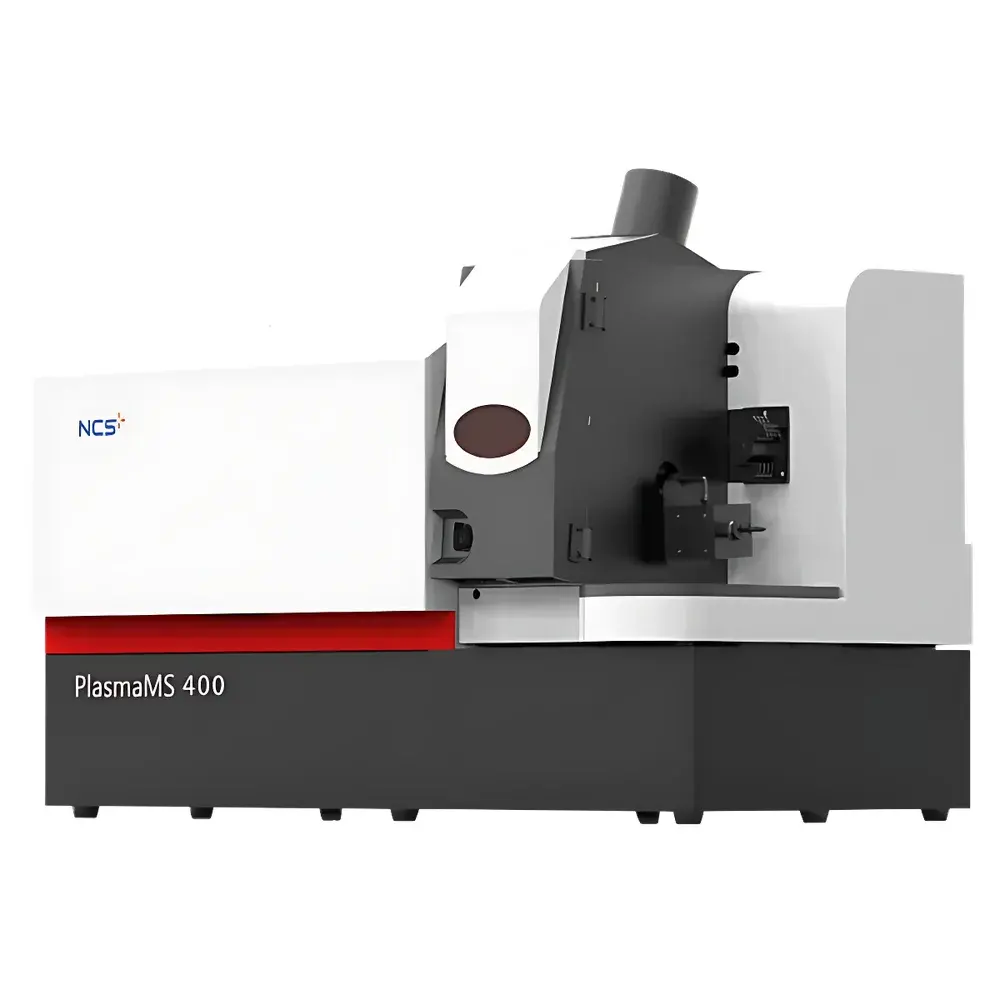
NCS PlasmaMS 400 Inductively Coupled Plasma Mass Spectrometer
| Brand | NCS |
|---|---|
| Origin | Jiangsu, China |
| Manufacturer Type | Direct Manufacturer |
| Product Origin | Domestic (China) |
| Model | PlasmaMS 400 |
| Instrument Type | Quadrupole ICP-MS |
| Application Environment | Laboratory |
| Mass Range (amu) | 2–260 |
| Resolution (Unit Mass Resolution, amu) | 0.3–1.0 (Continuously Adjustable) |
| Detection Limits (ng·L⁻¹) | Be ≤ 0.5 |
| Sensitivity (Mcps/mg·L⁻¹) | Li > 80 |
| Short-Term Stability (RSD) | ≤ 2% |
| Long-Term Stability (RSD) | ≤ 3% |
Overview
The NCS PlasmaMS 400 is a high-performance quadrupole inductively coupled plasma mass spectrometer (ICP-MS) engineered for precision elemental analysis across demanding laboratory environments. Utilizing robust RF-driven argon plasma ionization at ~7,000 K, the system generates analyte ions from liquid or laser-ablated solid samples, which are then mass-filtered and detected via electron-multiplier detection. Designed to address persistent analytical challenges—including polyatomic interferences, matrix-induced signal suppression, and memory effects—the PlasmaMS 400 integrates hardware-level innovations in ion optics, collision/reaction cell architecture, and sample introduction to deliver enhanced sensitivity, improved salt tolerance, and superior long-term reproducibility. Its mass range of 2–260 amu supports comprehensive analysis of light isotopes (e.g., 7Li, 9Be) through heavy actinides (e.g., 238U), making it suitable for ultra-trace quantification in regulatory, research, and industrial QA/QC workflows.
Key Features
- Optimized Ion Transmission System: A re-engineered ion lens stack increases overall ion transmission efficiency, achieving >400 Mcps/ppm sensitivity for 238U—enabling reliable detection of sub-pg/g analyte concentrations in complex digests.
- High-Matrix Tolerance Architecture: Patented high-salt resistant ion optics reduce space-charge distortion and oxide formation under elevated dissolved solids conditions; validated for uninterrupted operation with seawater (≥3.5% NaCl), soil extracts (≥10% TDS), and metal alloy digests.
- Multi-Gas Collision/Reaction Cell: A six-pole dynamic reaction cell supports He, H2, O2, and CH4 as reactive or non-reactive gases, enabling selective removal of ArO+, ArCl+, and other polyatomic interferences without compromising sensitivity.
- Low-Memory Sample Introduction: A compact cyclonic spray chamber with minimized internal volume (<1.2 mL) and inert surface coating reduces carryover between high-concentration and trace-level samples, yielding RSDs <1.5% for sequential analysis of ng/L–µg/L standards.
- Modular Hyphenation Interface: Standardized vacuum-compatible ports support seamless integration with HPLC (for speciation analysis), laser ablation systems (e.g., 193 nm ArF excimer LA-ICP-MS), and automated autosamplers compliant with ISO 17025 traceability requirements.
Sample Compatibility & Compliance
The PlasmaMS 400 accommodates aqueous solutions (0.1–5% HNO3), organic solvents (with oxygen addition), and solid micro-samples via laser ablation. It meets key international performance benchmarks including ASTM D5673 (water analysis), ISO 17294-2 (environmental waters), and USP (elemental impurities in pharmaceuticals). Instrument control firmware includes full audit trail logging per FDA 21 CFR Part 11, with electronic signatures, user role-based access, and data integrity safeguards aligned with GLP/GMP validation protocols. All calibration and QC data are timestamped and exportable in .csv and .xml formats compatible with LIMS integration.
Software & Data Management
Control and data reduction are performed using NCS MassSuite™ v4.x—a Windows-based platform supporting real-time mass calibration, interference correction algorithms (e.g., mathematical interference correction for 40Ar35Cl+ on 75As+), and isotope ratio calculation with internal standard normalization. The software provides automated QC pass/fail evaluation against pre-defined acceptance criteria (e.g., CRM recovery ±10%, blank <3× LOD), and generates PDF reports compliant with ISO/IEC 17025 Clause 7.8. Raw data files retain full metadata (tuning parameters, gas flows, dwell times) and support retrospective reprocessing without raw signal loss.
Applications
- Environmental Monitoring: Quantification of regulated metals (As, Cd, Pb, Hg, U) in drinking water (EPA Method 200.8), seawater (ISO 17294-2), soils (EPA 6020B), and airborne particulates (PM2.5/PM10 filters).
- Materials Science: Trace impurity profiling in high-purity metals (Fe, Ni, Co base alloys), semiconductor-grade Si wafers, and refractory ceramics—supporting ASTM E1479 and ISO 11885.
- Pharmaceutical & Food Safety: Elemental impurity testing per ICH Q3D guidelines; leachable metals from packaging (glass, polymer); nutrient and contaminant screening in infant formula, dietary supplements, and botanical extracts.
- Geochemical Research: Isotopic fingerprinting of Sr, Nd, Pb, and Hf in rock digests and zircon LA-ICP-MS dating, with mass bias correction via external standard bracketing.
FAQ
What regulatory standards does the PlasmaMS 400 support for pharmaceutical testing?
The system complies with ICH Q3D elemental impurity limits and supports USP , EP 2.4.20, and JP 6.07 methodologies—including method validation per ICH Q2(R2) for accuracy, precision, LOD/LOQ, and robustness.
Can the PlasmaMS 400 analyze seawater directly without dilution?
Yes—its high-salt ion optics and dynamic reaction cell enable direct analysis of un-diluted seawater with minimal signal drift (<2% RSD over 8 h), provided matrix-matched calibration and internal standardization (e.g., 115In) are applied.
Is the instrument compatible with third-party LIMS platforms?
All data exports (raw spectra, quantitation tables, QC logs) adhere to ASTM E1384 and ISO/IEC 11179 metadata standards, enabling bidirectional integration with major LIMS vendors via ODBC or RESTful API interfaces.
How is long-term stability verified during routine operation?
Built-in daily auto-tuning routines monitor mass calibration, sensitivity, oxide ratio (160Gd16O+/160Gd+), and doubly charged ion yield (138Ba2+/138Ba+)—triggering alerts if deviations exceed predefined thresholds per ISO/IEC 17025 Clause 7.7.






