
PTB-740SS Portable Suspended Solids (SS), Turbidity & Sludge Interface Analyzer
| Origin | UK |
|---|---|
| Manufacturer Type | Authorized Distributor |
| Origin Category | Imported |
| Model | PTB-740SS |
| Power Supply | Rechargeable Li-ion battery |
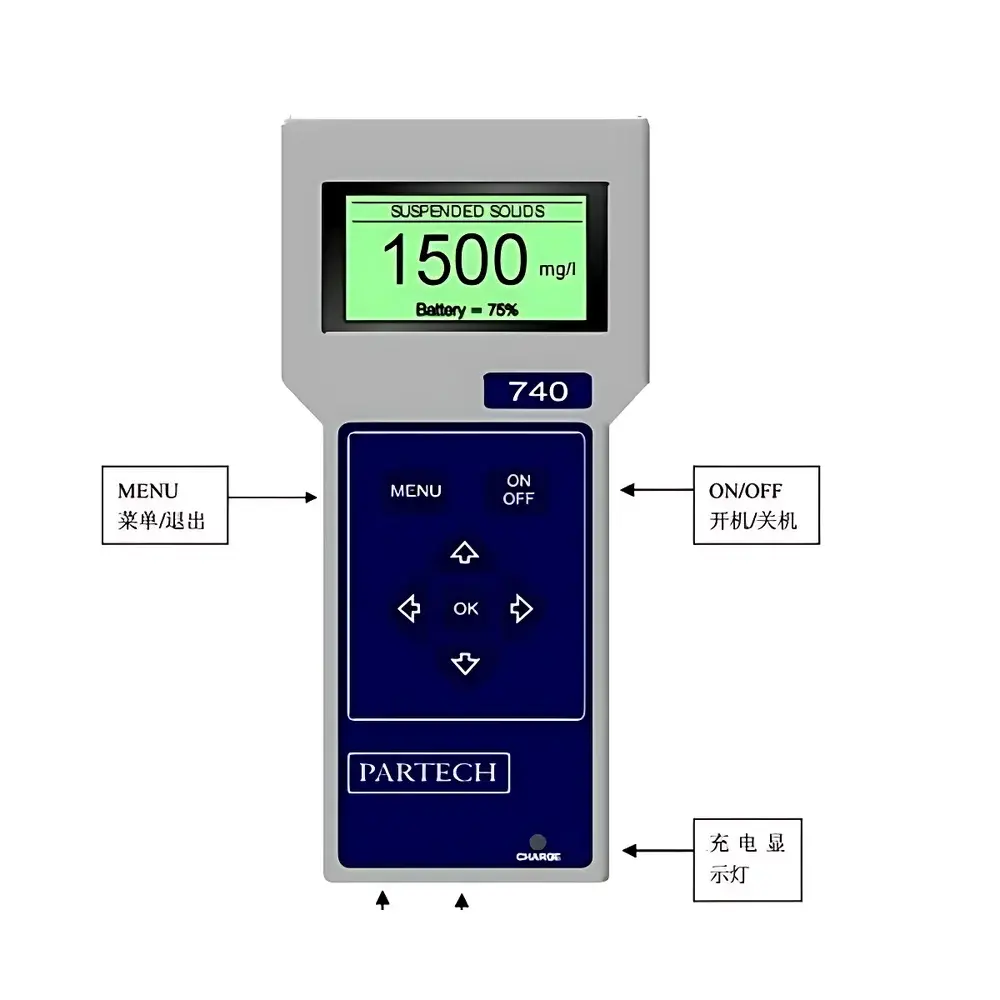
| Display | 5-digit graphical LCD |
| Measurement Ranges | 0–100 / 0–1,000 / 0–10,000 / 0–20,000 mg/L (user-selectable) |
| Max Range | 0–20,000 mg/L |
| Min Range | 0–50 mg/L |
| Units | mg/L, g/L, ppm, FTU, NTU, % SS |
| Resolution | 0.01 (full-scale dependent) |
| Repeatability | ±1% FSD |
| Storage Temp. | −20 °C to +60 °C |
| Operating Temp. | Host: −20 °C to +60 °C |
| Probe | 0 °C to +60 °C |
| Optical Principle | 880 nm infrared light scattering and attenuation |
| Ingress Protection | IP65 (host), IP68 (probe) |
| Housing Material | ABS (host), black acetal-acrylamide copolymer (probe) |
| Cable Length | Standard 5 m (marked every 1 m |
| Response Time | <0.5 s |
| Flow Independence | Immune to water velocity effects |
| Weight | 1.1 kg |
| Dimensions (H×W×D) | 224 × 106 × 39 mm |
| Calibration Kit | PTB-CAL-101940 (Fulcrum Earth suspension, 20 g × 5 vials) |
Overview
The PTB-740SS Portable Suspended Solids (SS), Turbidity & Sludge Interface Analyzer is an engineered field instrument designed for rapid, on-site quantification of suspended solids concentration, turbidity, and sludge blanket interface position in liquid-phase environmental and industrial process streams. Based on dual-mode 880 nm infrared optical detection—combining forward-scatter intensity and signal attenuation—the analyzer delivers high reproducibility across heterogeneous suspensions without reliance on sample filtration or centrifugation. Its measurement principle conforms to the physical basis of ISO 7027 (turbidity) and aligns with ASTM D3921 and EPA Method 160.2 for suspended solids estimation in non-settleable or colloidal-rich matrices. Unlike laboratory-based gravimetric analysis (e.g., EPA 160.1), the PTB-740SS enables real-time, in-situ monitoring at critical control points—including aeration basins, clarifier effluent channels, and sludge blanket zones—thereby supporting dynamic process optimization and regulatory compliance reporting.
Key Features
- Triple-parameter capability: Simultaneous output of suspended solids (mg/L), turbidity (NTU/FTU), and relative sludge interface level (% SS), configurable per application requirement.
- Ruggedized portable architecture: IP65-rated housing with ergonomic hand strap, shock-absorbing ABS casing, and extended operating temperature range (−20 °C to +60 °C) for outdoor deployment in wastewater infrastructure and remote sampling sites.
- Optically stable 880 nm LED source and matched photodiode array ensure minimal drift from ambient light interference, organic fouling, or color interference—critical for brown-water applications in pulp & paper or food processing effluents.
- Zero-flow dependency: Validated performance across turbulent and laminar flow regimes (0–3 m/s), eliminating need for flow conditioning or bypass loops during inline probe insertion.
- Fast response dynamics: Sub-second (<0.5 s) signal stabilization supports closed-loop control integration for coagulant dosing systems and real-time MLSS feedback in activated sludge processes.
- Modular calibration protocol: Includes traceable Fulcrum Earth reference suspensions (PTB-CAL-101940), enabling field recalibration per ISO/IEC 17025-compliant QA procedures without lab return.
Sample Compatibility & Compliance
The PTB-740SS is validated for use in raw sewage, secondary effluent, anaerobic digester supernatant, pulp mill whitewater, mining tailings slurries, and potable water pre-filtration streams. Its acetal-acrylamide probe body resists abrasion from grit-laden flows and chemical degradation from chlorine residuals (≤5 mg/L free Cl₂) and low-pH leachates (pH 4–10). The instrument meets EN 61326-1 (EMC for industrial environments), IEC 60529 (IP68 submersion rating for probe), and carries CE marking under the EU Measuring Instruments Directive (MID) Annex MI-004 for turbidity and suspended solids meters. Data integrity complies with ALCOA+ principles for environmental monitoring records, and audit trails support GLP-aligned validation documentation required by UK Environment Agency (EA), US EPA Region 9, and EU Water Framework Directive (WFD) reporting frameworks.
Software & Data Management
The device operates standalone via intuitive menu navigation with no external software dependency. All measurements are timestamped and stored internally (≥10,000 readings) with user-defined logging intervals (1 s to 24 h). USB-C interface enables direct export of CSV-formatted datasets compatible with LIMS platforms (e.g., LabWare, Thermo Fisher SampleManager) and SCADA historian systems (e.g., Ignition, Siemens Desigo). Optional Bluetooth 5.0 module (PTB-BT-01) supports wireless data streaming to Android/iOS field tablets running custom dashboards compliant with ISA-95 Level 0–1 data models. Firmware updates preserve calibration coefficients and adhere to IEC 62443-3-3 security requirements for embedded firmware integrity verification.
Applications
- MLSS monitoring in aerobic and anoxic bioreactors—reducing reliance on offline lab assays and enabling adaptive aeration control.
- Sludge blanket profiling in secondary clarifiers and lamella settlers to prevent washout events and optimize underflow pumping cycles.
- Coagulant/flocculant dosing optimization using real-time SS/turbidity feedback in drinking water treatment plants and industrial pretreatment systems.
- Effluent compliance verification against discharge permits (e.g., UK General Binding Rules, US NPDES limits) without time-delayed lab turnaround.
- Process troubleshooting in food & beverage facilities—tracking yeast/bacteria load in brewery fermenters or starch particulates in dairy whey streams.
- Construction site sediment pond management per ISO 4046-14 turbidity thresholds and local stormwater pollution prevention plans (SWPPP).
FAQ
What optical principle does the PTB-740SS use, and why is 880 nm selected?
It employs dual-signal infrared nephelometry at 880 nm, balancing particle scattering sensitivity with reduced chromophore absorption—minimizing interference from colored dissolved organic matter (CDOM) common in wastewater and surface waters.
Can the probe be submerged continuously, and what is its maximum depth rating?
Yes—the probe is rated IP68 for continuous submersion up to 10 m depth for indefinite periods, verified per IEC 60529 test protocols.
Is the instrument suitable for GMP-regulated pharmaceutical wastewater monitoring?
While not 21 CFR Part 11-certified out-of-the-box, its audit-trail-capable firmware, electronic signature-ready configuration, and calibration traceability enable qualification under GMP Annex 11 when deployed within validated analytical procedures.
How often must calibration be performed, and what standards are recommended?
Field calibration is recommended before each critical campaign or after 30 days of continuous operation; Fulcrum Earth suspensions (PTB-CAL-101940) provide matrix-matched traceability aligned with ISO 8795 for wastewater solids reference materials.
Does the device require routine cleaning, and how is fouling mitigated?
The probe’s smooth acetal-acrylamide surface and self-cleaning hydrodynamic profile minimize biofilm adhesion; optional ultrasonic cleaning sleeve (PTB-ULTRA-02) may be retrofitted for high-fouling installations.







