
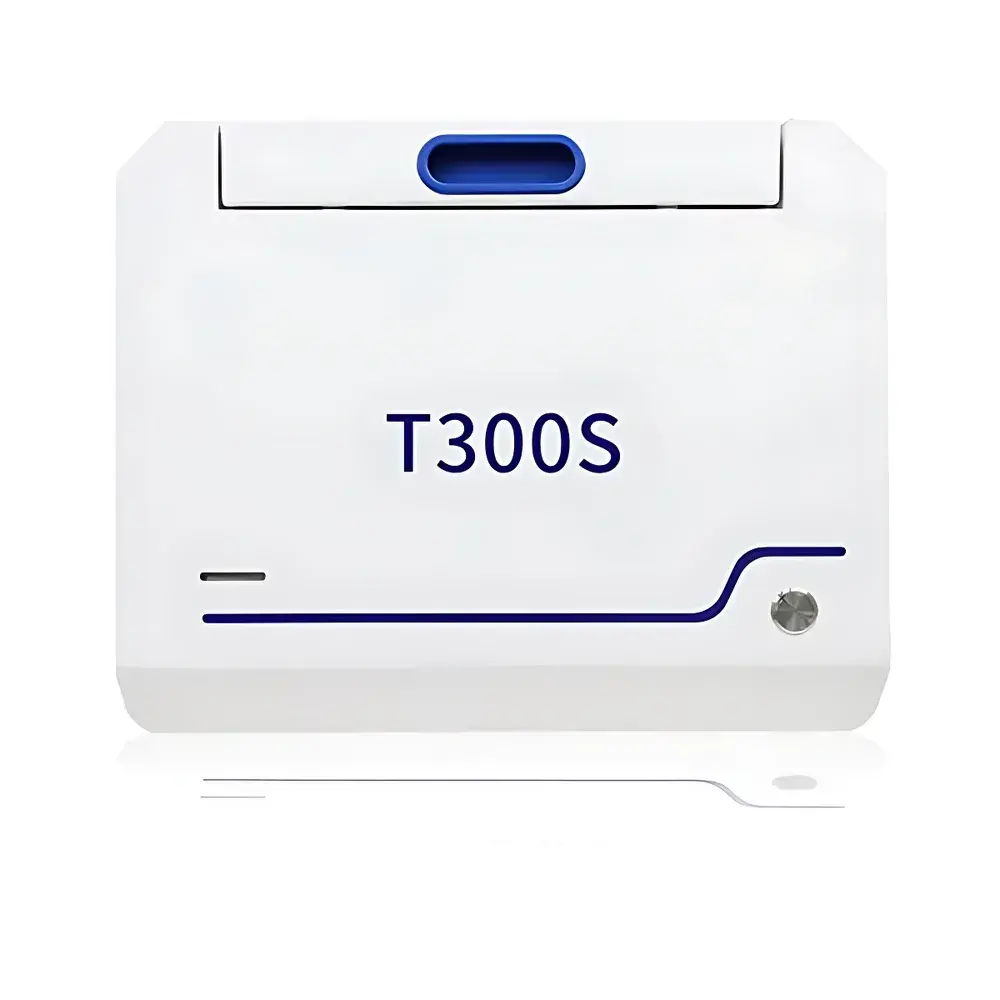
Senbe T300S X-Ray Fluorescence Coating Thickness Analyzer
| Brand | Senbe |
|---|---|
| Model | T300S |
| Origin | Jiangsu, China |
| Manufacturer Type | Direct Manufacturer |
| Detector | Si-Pin Semiconductor |
| Measurable Elements | S (16) to U (92) |
| X-ray Tube Voltage | 0–50 kV (intelligent programmable HV system) |
| Collimator | Standard Φ0.5 mm |
| Optical Magnification | 30× (industrial CCD camera) |
| Energy Resolution | ≤129 eV ±5 eV |
| Analysis Layers | Up to 5 simultaneous layers |
| Analyzable Elements per Measurement | Up to 24 |
| Algorithm | Fundamental Parameters (FP) method |
| Signal Processing | Digital Multi-Channel Analyzer (MCA) technology |
| Chamber Dimensions | 268 × 307 × 97 mm |
| Overall Dimensions | 414 × 416 × 362 mm |
| Safety Systems | Multi-dimensional thermal dissipation + dual interlock radiation shielding + real-time hardware status monitoring |
Overview
The Senbe T300S X-Ray Fluorescence Coating Thickness Analyzer is a benchtop energy-dispersive X-ray fluorescence (EDXRF) instrument engineered for non-destructive, quantitative measurement of metallic and alloy coatings on conductive substrates. It operates on the principle of primary X-ray excitation inducing characteristic secondary (fluorescent) X-ray emission from atoms within the sample; elemental composition and layer thickness are derived via intensity-based modeling using the Fundamental Parameters (FP) algorithm. Designed specifically for industrial quality control laboratories, electroplating facilities, and supplier assurance departments, the T300S delivers traceable, repeatable results for single- and multi-layer systems—without requiring reference standards or destructive cross-sectioning. Its open-slot chamber architecture enables rapid positioning of flat or low-profile components such as fasteners, stamped parts, and automotive brackets, while maintaining compliance with IEC 62495 and GB/T 32270-2015 safety requirements for analytical X-ray equipment.
Key Features
- High-resolution Si-Pin semiconductor detector with energy resolution ≤129 eV ±5 eV, ensuring robust peak separation for overlapping Kα/Kβ lines (e.g., Cr/Fe, Ni/Co, Zn/Ni) and improved quantification accuracy in complex multilayer stacks.
- Intelligent 0–50 kV programmable high-voltage generator optimized for excitation efficiency across light-to-heavy elements—from sulfur (S, Z=16) to uranium (U, Z=92)—with automatic kV selection based on target layer composition.
- Digital multi-channel analyzer (MCA) architecture supporting real-time spectral acquisition, dead-time correction, and pulse pile-up rejection for stable count statistics under variable beam currents.
- Integrated industrial-grade CCD imaging system with 30× optical magnification and adjustable LED illumination, enabling precise targeting of measurement areas down to Φ0.5 mm (standard collimator), with on-screen coordinate referencing and ROI annotation.
- Open-chamber mechanical design with ergonomic sample stage and tactile positioning guides—minimizing setup time while accommodating irregularly shaped parts up to 268 mm × 307 mm footprint.
- Multi-level radiation safety architecture: lead-lined cavity, dual mechanical shutter interlocks, beam-on indicator LEDs, and software-enforced exposure limits compliant with national regulatory frameworks for Class II X-ray devices.
Sample Compatibility & Compliance
The T300S supports analysis of planar or gently curved metallic substrates—including steel, copper, aluminum, and brass—with electrodeposited, electroless, or PVD/CVD coatings such as Zn, Ni, Cr, Sn, Au, Ag, Pb, and their alloys (e.g., Zn-Ni, Sn-Cu, Ni-P). It meets ISO 3497:2022 for metallic coating thickness measurement by XRF and is validated for ASTM B568–98(R2021) methodology equivalence. Instrument firmware and data handling routines support audit-ready operation under GLP and ISO/IEC 17025 environments, including user access control, electronic signature capability, and full measurement traceability (sample ID, operator, date/time, instrument parameters, raw spectrum, and calibration history).
Software & Data Management
The embedded analysis platform features a Windows-based GUI with intuitive workflow navigation, customizable report templates (PDF/Excel/CSV), and hierarchical project management. FP-based quantification supports up to five concurrent layers and 24 elements per measurement, with automated matrix correction for substrate effects and interlayer absorption/enhancement. Spectral deconvolution employs iterative least-squares fitting with certified reference library spectra. All raw data—including full-energy spectra, live count rates, and parameter logs—are stored in vendor-neutral binary format with SHA-256 checksums. Optional integration with LIMS via ASTM E1384-compliant XML export or OPC UA interface is available for enterprise-scale deployment.
Applications
- Quality assurance of electroplated fasteners (e.g., Zn-Ni/Fe thickness and Ni:Zn ratio verification per ISO 4042)
- In-process monitoring of plating bath composition via electrolyte analysis (Cr³⁺/Cr⁶⁺ differentiation not supported; quantification limited to total Cr)
- Supplier qualification testing for automotive trim components (e.g., Cu/Ni/Cr trilayer on ABS-plated steel)
- Routine verification of RoHS-restricted substances (Pb, Cd, Hg, Cr⁶⁺ surrogate via total Cr, Br) in finished goods per IEC 62321-5
- Failure analysis of coating delamination or burn-through during salt spray testing (cross-correlation with SEM/EDS recommended for root cause)
FAQ
Does the T300S require certified reference standards for routine operation?
No—its FP algorithm enables standardless quantification for most common coating systems. However, periodic verification using NIST-traceable standards (e.g., NIST SRM 2136) is recommended for ISO/IEC 17025 accreditation.
Can it measure organic coatings or paint films?
No—the T300S is optimized for inorganic, metallic, and alloy layers. Organic matrices lack sufficient XRF signal intensity and cannot be resolved without complementary techniques (e.g., FTIR or ellipsometry).
Is remote diagnostics or firmware update supported?
Yes—via secure HTTPS-based web interface with role-based authentication; updates comply with IEC 62443-3-3 for industrial cyber security.
What maintenance intervals are specified for the X-ray tube and detector?
The sealed X-ray tube has a rated lifetime of ≥15,000 hours; the Si-Pin detector requires no consumables but must be operated within specified temperature/humidity ranges (15–30°C, <70% RH non-condensing) to maintain resolution stability.
How is measurement uncertainty estimated for layered systems?
Uncertainty propagation follows ISO GUM (JCGM 100:2018) principles, incorporating contributions from counting statistics, FP model assumptions, geometry effects, and detector calibration drift—reported as expanded uncertainty (k=2) in all exported certificates.



