
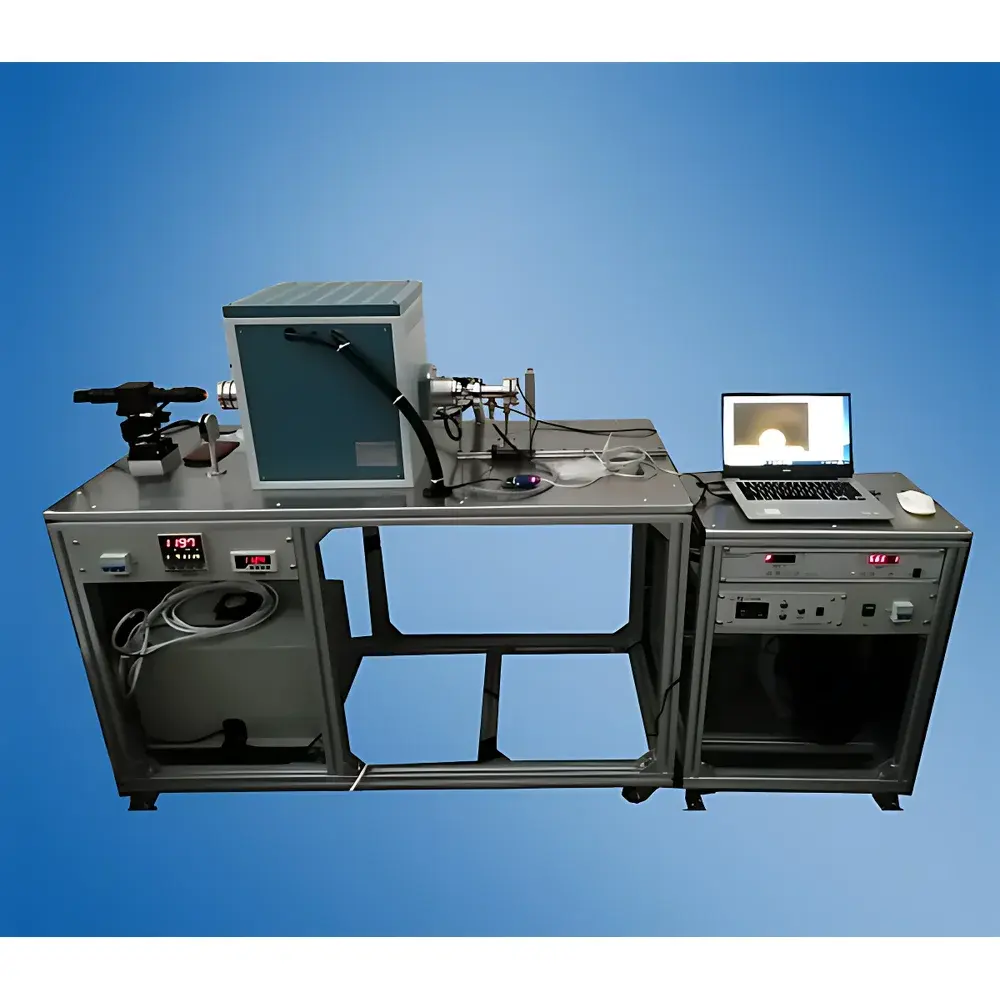
ZYKX SCI-1400 High-Temperature Vacuum Contact Angle Analyzer
| Brand | ZYKX |
|---|---|
| Origin | Beijing, China |
| Model | SCI-1400 |
| Instrument Type | Benchtop Laboratory System |
| Contact Angle Measurement Range | 0° < θ < 180° |
| Contact Angle Accuracy | ±0.1° (circle fitting method) |
| Sample Stage Dimensions | 20 × 20 mm |
| Optical Magnification | 55–320 pixels/mm |
| Surface/Interfacial Tension Range | 0.01–1000 mN/m |
| Surface/Interfacial Tension Accuracy | ±0.1 mN/m |
| Maximum Operating Temperature | 1400 °C (long-term), 1300 °C under vacuum |
| Base Vacuum Level | ≤5 × 10⁻⁵ Pa |
| Heating Control | 40-segment programmable PID with S-type thermocouple |
| Cooling System | Water-cooled, 1200 W capacity, flow rate 10–20 L/min, pressure 1.0–1.3 bar |
| Imaging System | Industrial color CCD (0.0005 lux sensitivity, 750 TV lines), 300 mm working distance telecentric lens, 0.7–5× continuous zoom |
| Software Analysis Methods | Tangent, Circle Fit, Ellipse Fit, Height Method, Angle Method, Automatic Image Analysis |
Overview
The ZYKX SCI-1400 High-Temperature Vacuum Contact Angle Analyzer is an engineered optical measurement platform designed for quantitative characterization of solid–liquid interfacial behavior under extreme thermal and environmental conditions. Based on the principle of video-based optical tensiometry, the system captures high-resolution silhouette images of liquid droplets on solid substrates in real time, enabling precise determination of contact angle (θ) and interfacial tension via geometric analysis of droplet profiles. Unlike ambient-pressure systems, the SCI-1400 integrates a high-vacuum furnace chamber (≤5 × 10⁻⁵ Pa) and inert-atmosphere compatibility (Ar, N₂, He), allowing stable operation up to 1400 °C—critical for studying molten metals, refractory ceramics, and active alloys where oxidation or vapor-phase interference would otherwise compromise data integrity. Its dual capability—measuring both static/dynamic contact angles and surface/interfacial tension (via pendant drop method)—supports fundamental research into wettability, spreading kinetics, and surface energy anisotropy across material science domains including metallurgy, electronic packaging, and high-temperature composite fabrication.
Key Features
- High-temperature vacuum furnace with programmable 40-segment PID control, S-type thermocouple feedback, and ±1 °C thermal stability at 1300 °C under vacuum
- Benchtop-integrated water-cooling system (1200 W cooling capacity, 10–20 L/min flow) ensuring thermal management of optical path and electronics during extended high-temperature runs
- Industrial-grade color CCD camera (0.0005 lux minimum illumination, 750 TV lines) coupled with a 300 mm working-distance telecentric lens (0.7–5× zoom, 55–320 pixels/mm resolution)
- Six validated contact angle calculation algorithms—including tangent, circle fit, ellipse fit, height method, angle method, and automated edge-detection analysis—with support for non-linear (curved) baselines
- Real-time dynamic acquisition: up to 25 fps standard; optional high-speed modules available (60/100 fps) for rapid wetting front tracking
- Temperature-triggered image capture: automatic frame acquisition at user-defined setpoints or ΔT intervals, synchronized with thermal ramp profiles
- Full AVI video recording with embedded metadata (temperature, timestamp, stage position), exportable for post-processing or presentation use
Sample Compatibility & Compliance
The SCI-1400 accommodates samples up to Ø14 × 10 mm within its quartz-encapsulated furnace chamber, featuring a Ø20 mm sapphire viewport for optical clarity under thermal stress. It supports both conductive (metals, carbides) and insulating (oxides, nitrides, glasses) substrates, and is routinely deployed in ASTM C1422-compliant ceramic sintering studies, ISO 20567-2 coating adhesion assessments, and USP compliant process validation workflows requiring traceable thermal history. All vacuum components conform to ISO 8573-1 Class 2 purity standards when operated with inert gas purging. The system’s electrical architecture meets IEC 61000-4 EMC requirements, and its temperature controller complies with EN 60519-2 safety standards for industrial heating equipment.
Software & Data Management
ZYKX’s proprietary AnalySIS Pro software provides GLP-compliant data handling: every captured image is time-stamped, geotagged with thermal and positional metadata, and linked to its corresponding raw thermal profile. Batch processing enables automated contact angle extraction across hundreds of frames, generating time-resolved θ(t) curves with statistical reporting (mean, SD, min/max). Surface energy calculations employ Owens–Wendt, Fowkes, and Wu harmonic mean models using user-input reference liquid libraries. Export options include CSV, Excel (.xlsx), and annotated PNG/JPEG files embedding measured values, curve fits, and confidence metrics. Audit trail functionality records all parameter changes, user logins, and analysis revisions—fully compatible with FDA 21 CFR Part 11 requirements when deployed with network authentication and electronic signature modules.
Applications
- Refractory metal brazing: quantifying Ag–Cu–Ti alloy wetting on SiC or Al₂O₃ substrates at 1200–1350 °C under ultra-high vacuum
- Ceramic matrix composite (CMC) development: evaluating melt infiltration kinetics of Si–Mo–B systems into carbon preforms
- Nuclear fuel cladding research: assessing U–Zr liquid phase interaction with MAX-phase barrier layers at 1100 °C
- Aerospace superalloy processing: mapping dynamic contact angle hysteresis during Ti–6Al–4V laser powder bed fusion pre-wetting simulations
- Electrochemical interface engineering: probing molten salt (LiF–CaF₂) wettability on Ni-based anodes for fluoride molten salt reactors
FAQ
What vacuum level can the SCI-1400 achieve, and how is it maintained during high-temperature operation?
The system achieves ≤5 × 10⁻⁵ Pa using a two-stage pumping configuration: a primary rotary vane pump backed by a turbomolecular pump (24,000 rpm, <4.5 min startup). Vacuum integrity is preserved at 1300 °C via double-layer molybdenum shielding, graphite insulation, and differential pressure monitoring with redundant Pirani/cold cathode gauges.
Can the instrument measure contact angle on non-planar or rough surfaces?
Yes—through curvature-corrected baseline detection algorithms and localized ROI selection. Users may define arbitrary regions of interest to isolate microstructural features (e.g., grain boundaries, pores) and compute spatially resolved θ distributions.
Is the software qualified for regulated environments (e.g., GMP labs)?
AnalySIS Pro supports 21 CFR Part 11 compliance when configured with role-based access control, electronic signatures, and immutable audit logs. Validation documentation (IQ/OQ/PQ protocols) is available upon request.
How is thermal drift compensated in optical measurements at >1000 °C?
The system employs real-time focus stabilization via motorized Z-axis lens positioning, calibrated against thermal expansion coefficients of the optical train. A reference fiducial grid etched onto the viewport enables sub-pixel registration correction across temperature ramps.
What interfacial tension methods are supported beyond pendant drop?
The platform implements axisymmetric drop shape analysis (ADSA) for pendant/sessile drops and supports Young–Laplace equation fitting with regularization constraints to minimize noise-induced artifacts in low-tension regimes (<1 mN/m).



