
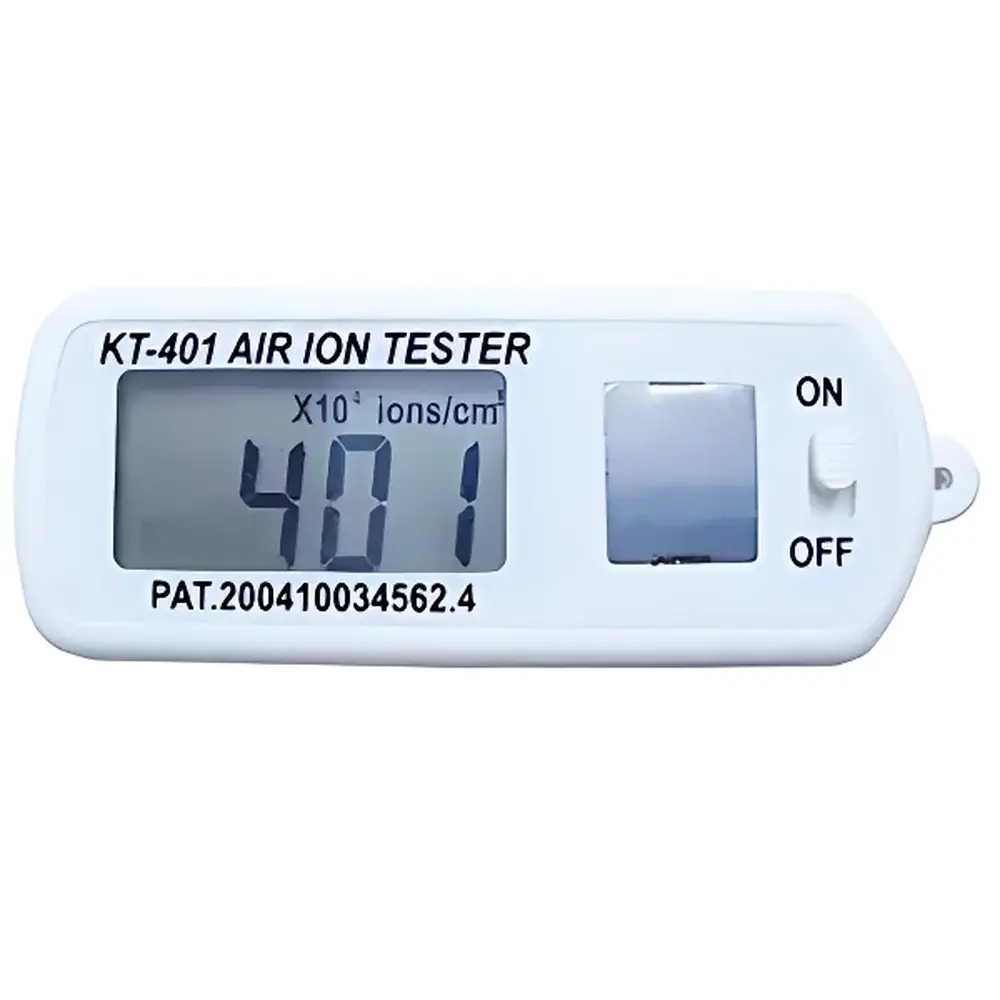
KT-401 Air Ion Counter
| Origin | Beijing, China |
|---|---|
| Manufacturer Type | Authorized Distributor |
| Origin Category | Domestic (PRC) |
| Model | KT-401 |
| Price Range | USD 0.15 – 750 (FOB) |
| Measurement Range | 1 × 10⁴ to 1999 × 10⁴ ions/cm³ |
| Resolution | 1 × 10⁴ ions/cm³ |
| Display | 3.5-digit LCD (max 1999) |
| Power Supply | LR44 button cell (x2) |
| Dimensions | 78 mm (L) × 27 mm (W) × 9 mm (H) |
| Ion Polarity Detection | Simultaneous positive and negative ion concentration readout |
| Sample Interface | Passive air sampling via integrated collector electrode |
| Compliance | Designed per IEC 61000-4-2 ESD immunity guidelines for handheld electrostatic sensors |
Overview
The KT-401 Air Ion Counter is a compact, battery-powered handheld instrument engineered for rapid, field-deployable quantification of unipolar and bipolar small air ions in ambient and controlled environments. It operates on the principle of Gerdien tube-based aspiration electrometry: airborne ions are drawn by natural convection or weak internal airflow across a polarized collector electrode; the resulting ion current is amplified and converted into concentration units (ions/cm³) using calibrated gain factors traceable to reference ion generators. Unlike optical or mass-spectrometric methods, this technique provides direct, real-time measurement of net charge carrier density without requiring vacuum systems or high-voltage ionization sources. The KT-401 is optimized for applications where portability, low power consumption, and polarity-resolved output are prioritized over ultra-high resolution or sub-second temporal response—making it suitable for routine validation of ionizer performance, indoor air quality spot checks, and preliminary textile electrostatic characterization.
Key Features
- Simultaneous dual-polarity detection: displays both positive and negative ion concentrations independently on a single 3.5-digit LCD screen
- Compact form factor (78 × 27 × 9 mm) with ergonomic grip design for one-handed operation in confined or mobile settings
- Passive sampling architecture eliminates need for external pumps or power adapters—enabling true walk-around measurements
- Calibrated measurement range from 1 × 10⁴ to 1999 × 10⁴ ions/cm³, covering typical emission levels from commercial negative ion generators (e.g., corona discharge, radioactive α-source, and photocatalytic emitters)
- Integrated collector electrode with guarded geometry minimizes stray capacitance and surface recombination artifacts
- Low-power operation using two standard LR44 alkaline cells (typical battery life >100 hours at room temperature)
- Electrostatic discharge (ESD)-hardened front-end circuitry compliant with IEC 61000-4-2 Level 2 (4 kV contact discharge) for stable readings near high-voltage equipment
Sample Compatibility & Compliance
The KT-401 is validated for use in non-hazardous, non-explosive atmospheric environments (IEC 60079-0 Class II, Group IIA). It accepts passive air samples at ambient pressure (80–106 kPa) and temperature (0–40 °C), with relative humidity tolerance up to 85 % RH non-condensing. While not certified for regulatory compliance testing under ISO 14644-1 (cleanroom classification) or ASTM D257 (surface resistivity), its output is routinely referenced during GLP-aligned QC procedures for ionizer maintenance logs. For textile evaluation, the device measures ion emission from fabric surfaces placed within 5–10 cm of the inlet aperture under still-air conditions—consistent with internal test protocols used by OEMs validating antistatic finishing efficacy. No calibration certificate is supplied ex-factory; users are advised to perform periodic zero checks using shielded Faraday cup verification or comparison against NIST-traceable reference ion chambers.
Software & Data Management
The KT-401 operates as a standalone analog-digital hybrid instrument with no embedded memory, Bluetooth, or USB interface. All data acquisition is manual: users record displayed values alongside timestamp, location, and environmental notes. To support auditability in regulated workflows, laboratories commonly integrate the KT-401 into electronic lab notebooks (ELNs) such as LabArchives or Benchling by logging entries with metadata tags (e.g., “Ion_Concentration_KT401_20240522_1423”). Though lacking FDA 21 CFR Part 11-compliant electronic signatures or audit trails, its simplicity ensures full transparency in raw data provenance—a critical advantage in root-cause analysis of ionizer drift or material charge decay anomalies.
Applications
- Verification of output stability and polarity balance in consumer-grade and industrial negative ion generators
- Routine QA screening of HVAC-integrated ionization modules prior to cleanroom commissioning
- Comparative assessment of ion emission profiles from functional textiles (e.g., silver-coated polyester, carbon-fiber blends) under standardized humidity conditions
- Educational demonstrations of atmospheric ion physics and electrostatic charge dissipation mechanisms
- Field surveys of natural ion concentrations near waterfalls, forests, or coastal zones—used in conjunction with meteorological loggers
- Preliminary troubleshooting of electrostatic discharge (ESD) events in electronics assembly areas where ionizer coverage is suspected to be insufficient
FAQ
Does the KT-401 require annual recalibration?
No formal recalibration schedule is defined; however, users should verify zero stability before each measurement session by shielding the inlet and confirming display reads “000” (±1 digit). Drift exceeding ±5 % of full scale warrants inspection of electrode cleanliness or battery voltage.
Can the KT-401 measure ions in moving air streams (e.g., ductwork)?
It is not designed for dynamic flow environments. Air velocity >0.2 m/s induces turbulence that disrupts laminar ion transport to the collector, leading to underestimation. For duct applications, pair with a static pressure probe and sample at isokinetic points using extension tubing.
Why must the rear metal plate never be touched during operation?
The exposed collector electrode resides directly behind the plastic housing. Contact introduces body capacitance and triboelectric charge, corrupting baseline current measurement and potentially saturating the front-end amplifier.
Is the KT-401 suitable for outdoor use in rain or direct sunlight?
No. Its IP rating is IP20 (indoor use only). Exposure to moisture or UV degradation compromises housing integrity and LCD contrast. Use only under sheltered, temperature-stable conditions.
What is the minimum detectable ion concentration?
The lower limit of quantitation (LOQ) is 1 × 10⁴ ions/cm³, determined by signal-to-noise ratio ≥3:1 under laboratory reference conditions (23 °C, 50 % RH, <0.1 ppm ozone). Below this threshold, readings are considered qualitative indicators only.







