
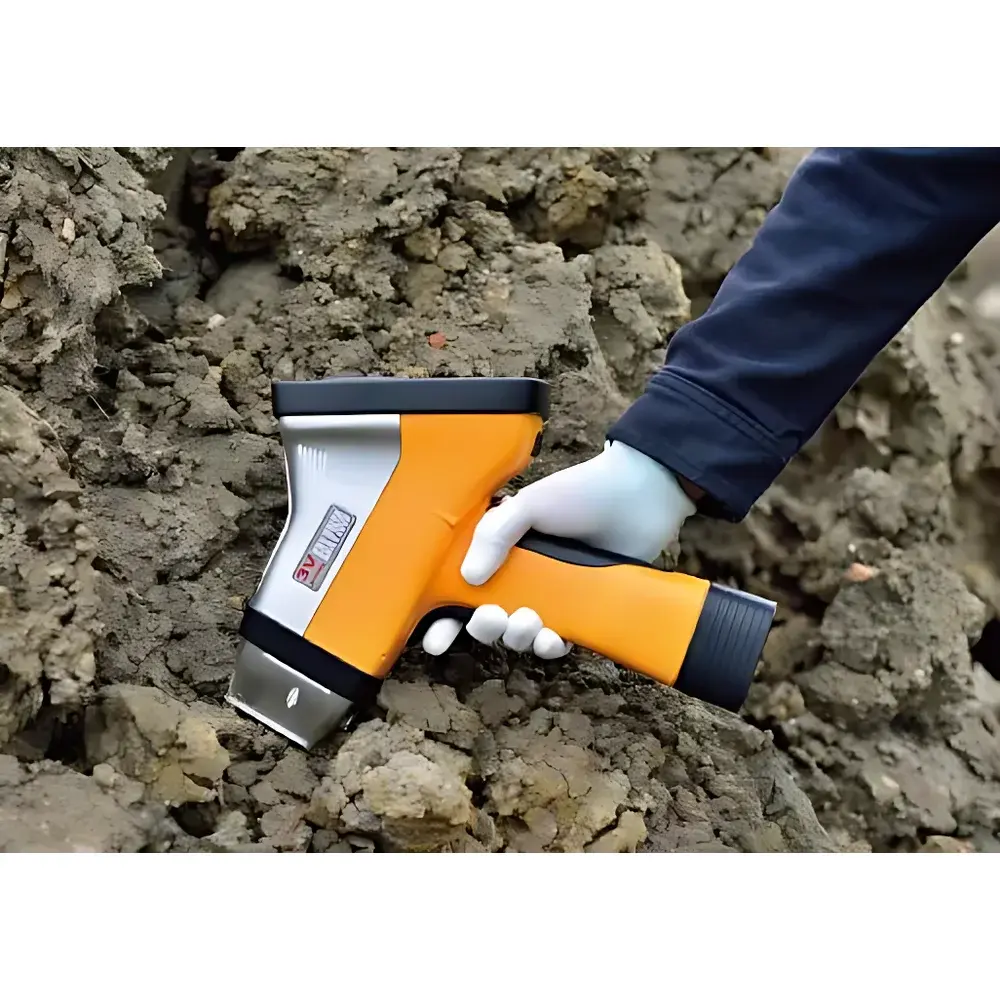
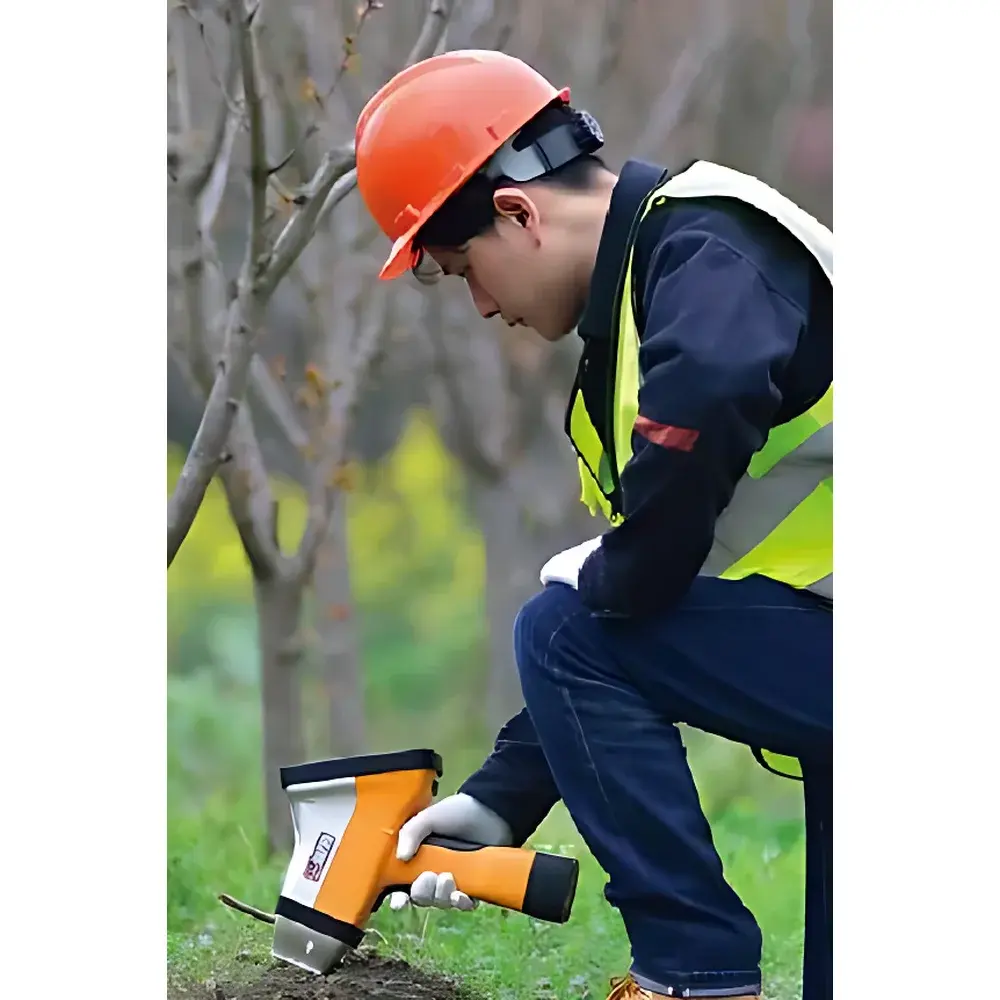
Senbe EDXP3600 Handheld X-Ray Fluorescence (XRF) Spectrometer
| Brand | Senbe |
|---|---|
| Origin | Jiangsu, China |
| Manufacturer Type | OEM Manufacturer |
| Country of Origin | China |
| Model | EDXP3600 |
| Price | Upon Request |
| Excitation Source | 50 kV / 200 µA Ag-target micro-focus X-ray tube, end-window configuration, ≤4 W power match |
| Detector | 25 mm² fast Silicon Drift Detector (SDD), 0.3 mil Be window, energy resolution ≤125 eV (Mn Kα), Peltier-cooled |
| MCA | 4096-channel digital pulse processor |
| Elemental Range | Na (11) to U (92) |
| Analysis Modes | Alloy, RoHS, Soil, Water |
| Soil LODs (SiO₂ matrix) | Pb <5 mg/kg, As <3 mg/kg, Cr <15 mg/kg, Cu <10 mg/kg, Zn <2 mg/kg, Ni <5 mg/kg, Mn <10 mg/kg, Hg <1 mg/kg, Cd <3 mg/kg |
| Water LODs (aqueous matrix) | Pb <1 mg/L, As <0.5 mg/L, Cr <2 mg/L, Cu <1 mg/L, Zn <2 mg/L, Ni <1 mg/L, Mn <2 mg/L, Hg <1 mg/L, Cd <1 mg/L |
| Quantification Time | 3–60 s (user-adjustable) |
| Repeatability | RSD <4% (for major elements in homogeneous alloys) |
| Collimation & Filters | 6 interchangeable filters + multiple collimators → 18 automatic combinations |
| Display | 5.5″ high-brightness capacitive touchscreen LCD |
| Processor | Intel quad-core @ 1.33 GHz |
| Memory | 2 GB RAM, 32 GB internal storage (expandable via microSD) |
| Connectivity | Wi-Fi 802.11 b/g/n, Bluetooth 4.0, USB 2.0, GPS module |
| Safety | Beam-on detection sensor, auto X-ray cutoff during air measurement |
| Weight | 1.5 kg (with battery) |
| Operating Environment | –20 °C to +50 °C, RH <90% non-condensing |
| Power | Rechargeable Li-ion, 6700 mAh, >6 h typical operation |
| Data Output | Excel, BMP, PDF reports |
| Compliance | Meets IEC 62471 (LED/X-ray safety), ISO 12885 (XRF safety guidance), and supports GLP/GMP audit trail requirements via timestamped, user-logged data export |
Overview
The Senbe EDXP3600 Handheld X-Ray Fluorescence (XRF) Spectrometer is an engineered field-deployable analytical instrument designed for rapid, non-destructive elemental quantification across heterogeneous sample matrices—including metals, soils, sediments, aqueous suspensions, and electronic components. Based on energy-dispersive XRF (ED-XRF) principles, the system utilizes a micro-focus silver-target X-ray tube (50 kV, 200 µA) to excite characteristic secondary X-ray emissions from atoms within the sample. These emissions are resolved by a high-performance 25 mm² silicon drift detector (SDD) with ≤125 eV energy resolution at Mn Kα, enabling precise identification and quantification of elements from sodium (Na, Z=11) to uranium (U, Z=92). The instrument’s real-time spectral processing architecture—integrated with a 4096-channel multichannel analyzer (MCA)—supports adaptive peak deconvolution, background subtraction, and matrix correction algorithms calibrated for alloy, RoHS-compliant electronics, environmental soil, and water-based samples. Its portability, ruggedized industrial design, and compliance with international radiation safety standards make it suitable for regulatory field screening, emergency response, mining exploration, and quality control in resource-limited or mobile laboratory environments.
Key Features
- Field-optimized ergonomics: Weighing only 1.5 kg (with battery), the unit features a balanced center-of-gravity grip and shock-absorbing polymer housing rated IP54 for dust and splash resistance.
- High-sensitivity detection: Fast SDD detector with Peltier thermoelectric cooling eliminates liquid nitrogen dependency and enables stable operation across –20 °C to +50 °C ambient conditions.
- Multi-mode analytical firmware: Preloaded, application-specific calibration libraries include ASTM E2857-compliant RoHS mode (Pb, Cd, Hg, Cr⁶⁺, Br as proxy for PBDE/PBB), ISO 12639-aligned alloy grade identification (e.g., ASTM B16/B117), EPA Method 6200 soil screening protocols, and customized aqueous-phase quantification.
- Intelligent beam control: Integrated proximity sensor automatically disables X-ray emission when no sample is detected—eliminating unnecessary exposure—and enables trigger-actuated measurement initiation for operator safety and reproducibility.
- Comprehensive connectivity suite: Onboard GPS geotags every spectrum with latitude/longitude/timestamp metadata; Wi-Fi and Bluetooth support secure over-the-air firmware updates, remote diagnostics, and live screen mirroring to tablets or laptops.
- Dual-layer security architecture: Role-based access control (operator vs. administrator), password-protected boot sequence, and encrypted local storage ensure data integrity and chain-of-custody compliance per ISO/IEC 17025 and FDA 21 CFR Part 11 requirements.
Sample Compatibility & Compliance
The EDXP3600 accommodates solid, powdered, and semi-solid samples without preparation—enabling direct analysis of scrap metal fragments, soil cores, filter membranes, painted surfaces, and circuit board substrates. For loose or low-density materials (e.g., sediment slurries, ash residues), optional lead-rubber shielding minimizes scatter and improves signal-to-noise ratio while maintaining <1 µSv/h operator exposure (verified per CNAS-accredited third-party testing). Analytical performance adheres to internationally recognized validation frameworks: soil mode LODs meet EPA Region 10 field-screening benchmarks; RoHS mode conforms to IEC 62321-5:2013 for restricted substance verification; alloy quantification satisfies ASTM E1999 precision criteria for handheld XRF. All calibrations are traceable to NIST SRM reference materials (e.g., SRM 2782 for Pb in soil, SRM 1250 for stainless steel).
Software & Data Management
Embedded firmware (v3.2+) provides full spectral acquisition, real-time element mapping, and automated reporting in Excel, PDF, or BMP formats. The software supports multi-spectrum statistical aggregation—calculating mean, standard deviation, min/max values across sequential measurements—and allows side-by-side spectral overlay for comparative analysis. Customizable report templates accommodate site-specific QA/QC workflows, including automatic flagging of results exceeding regulatory thresholds (e.g., EU CLP limits, China GB 15618-2018 soil standards). Data export includes raw spectra (.spe), processed results (.csv), and full audit logs containing user ID, timestamp, GPS coordinates, instrument settings, and calibration history—enabling retrospective review and regulatory submission readiness.
Applications
- Environmental Field Screening: Rapid in-situ assessment of contaminated land (As, Pb, Cd, Cr, Hg), dredged sediments, and landfill leachates per EPA SW-846 Method 6200.
- Scrap Metal Sorting & Recycling: Real-time alloy identification (stainless steels, aluminum grades, titanium alloys) with grade-matching accuracy exceeding 98% against ASTM material specifications.
- Electronics Compliance Verification: On-site screening of printed circuit boards, connectors, and casings for RoHS-restricted elements, supporting pre-shipment audits and supplier qualification.
- Mining & Exploration: Portable geochemical surveying for base metals (Cu, Zn, Ni), precious metals (Au, Ag), and pathfinder elements (As, Sb, Bi) in drill core or outcrop samples.
- Industrial Hygiene & Occupational Safety: Lead-in-paint, chromium-in-coatings, and cadmium-in-plating verification per OSHA 1910.1200 and EU REACH Annex XVII.
FAQ
Does the EDXP3600 require annual recalibration?
While factory calibration remains stable under normal use, users should perform daily energy calibration using the included certified standard (e.g., Fe/Ni/Cu alloy or SiO₂-based soil simulant) prior to critical measurements. Full recalibration is recommended annually or after physical impact, detector temperature drift (>±5 °C), or significant changes in ambient humidity.
Can the instrument analyze liquids directly?
Liquid samples must be contained in low-background XRF cups with polypropylene or Mylar film windows. Aqueous analysis is validated only for filtered, particulate-free solutions; turbidity or suspended solids degrade accuracy and increase detection limits.
Is spectral data export compatible with third-party chemometric software?
Yes—raw .SPE files (based on IAEA-compatible format) and processed CSV outputs are interoperable with Unscrambler®, GRAMS/AI®, and open-source tools such as PyMca for advanced multivariate modeling and PCA-based classification.
What safety certifications does the EDXP3600 hold?
The device complies with IEC 61010-1 (electrical safety), IEC 62471 (photobiological safety), and national Class II radiation-emitting device registration requirements in China (NMPA approval pending). Radiation leakage is independently verified to <1 µSv/h at 5 cm distance (CNAS Lab Report No. CMA2023-XRF-0874).
How is measurement repeatability ensured across operators?
Standardized measurement protocols—enforced via software-guided workflow steps, fixed geometry positioning aids, and automatic beam alignment compensation—minimize inter-operator variability. RSD <4% is achievable for homogenous alloys when using ≥10 s counting time and consistent sample surface contact pressure.







