
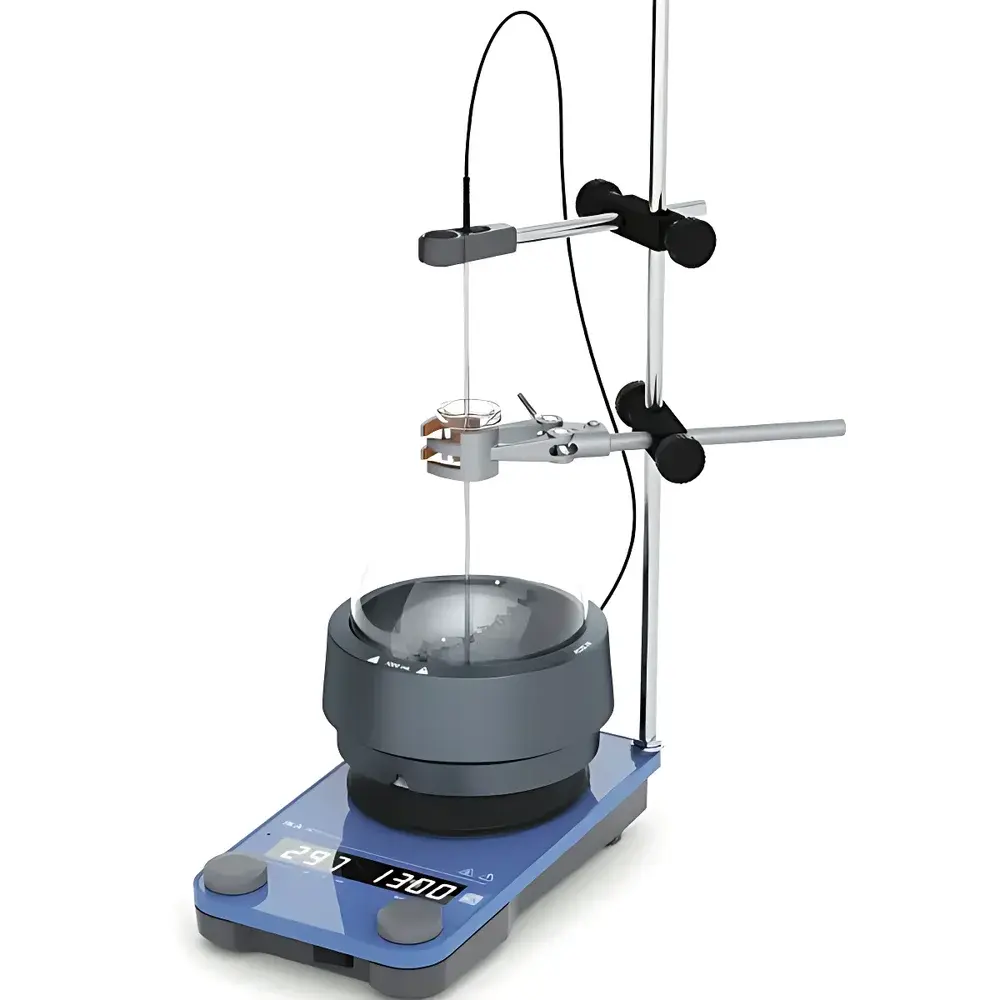
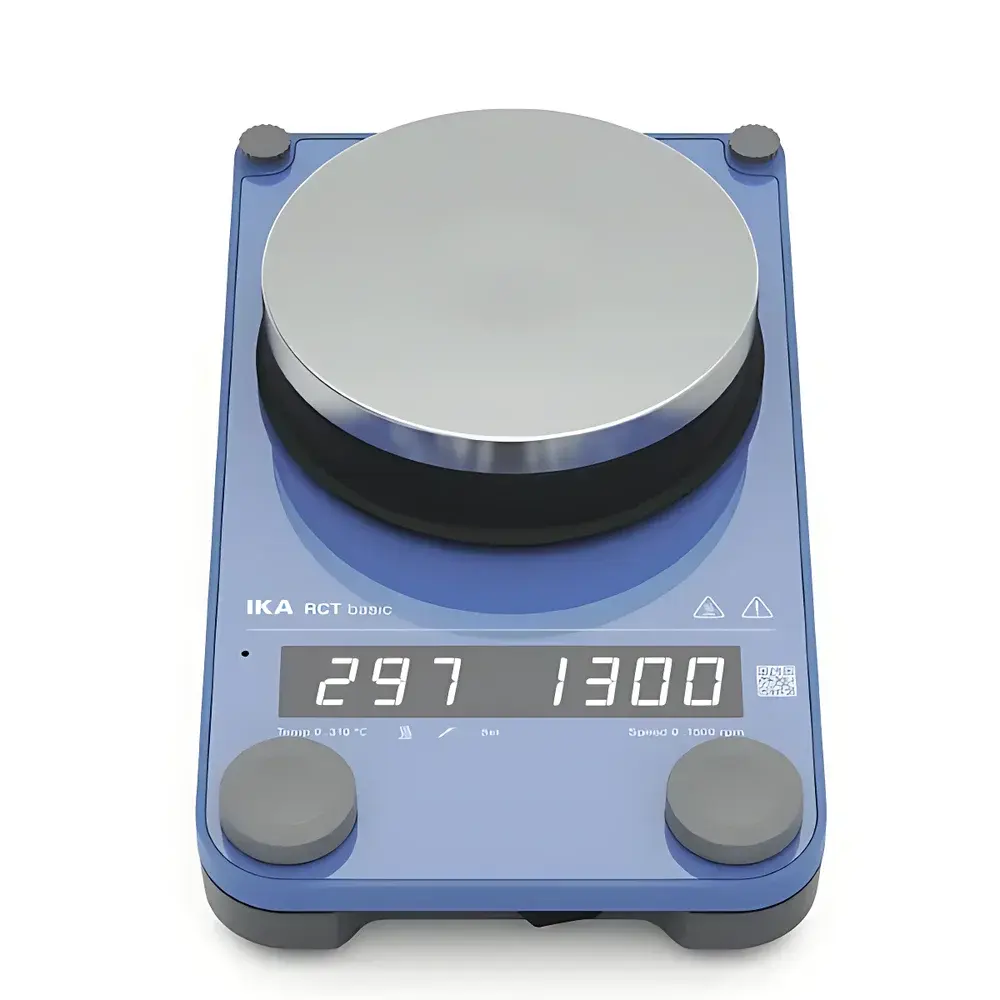
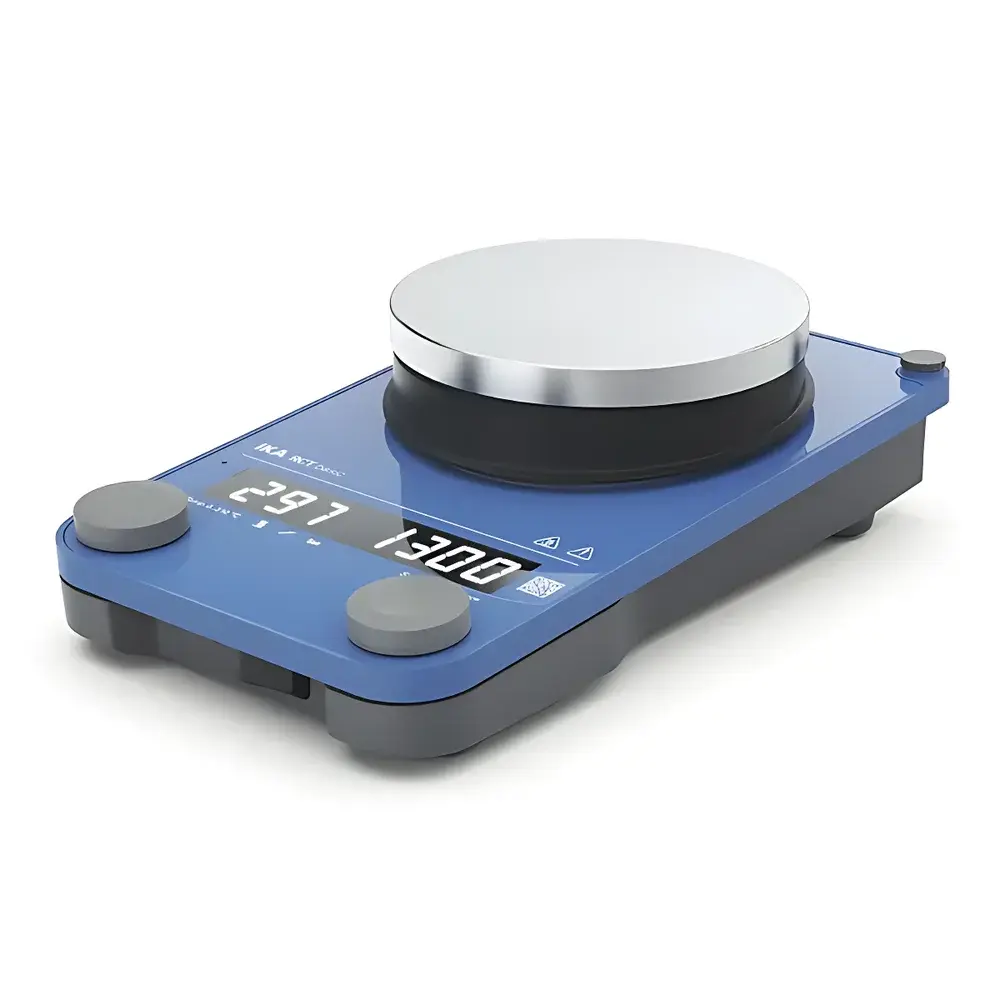
IKA Synthesis Solution 1000RCT Classic Magnetic Stirrer System
| Brand | IKA |
|---|---|
| Origin | Germany |
| Manufacturer | IKA Werke GmbH & Co. KG |
| Product Type | Magnetic Stirrer with Integrated Heating Plate |
| Max. Stirring Volume | 20 L (H₂O) |
| Speed Range | 50 – 1500 rpm |
| Temperature Control Range | Ambient + Self-Heating of Plate – 310 °C |
| Heating Power | 600 W |
| Plate Material | Anodized Aluminum |
| Plate Diameter | Ø 135 mm |
| Dimensions (W × H × D) | 160 × 270 × 85 mm |
| Weight | 2.4 kg |
| IP Rating | IP42 |
| Interface | RS232, USB-B |
| Compliance | DIN EN 60529, CE, RoHS |
Overview
The IKA Synthesis Solution 1000RCT Classic Magnetic Stirrer System is an integrated laboratory instrument engineered for precision-controlled heating and stirring in synthetic chemistry workflows. Unlike conventional setups combining separate magnetic stirrers and oil baths—prone to thermal instability, contamination, and safety hazards such as oil splashing—the RCT Classic eliminates these risks through a monolithic, PTFE-coated aluminum heating plate with embedded temperature sensing and closed-loop thermal regulation. It operates on the principle of contact-based conductive heating coupled with permanent-magnet-driven agitation, enabling reproducible reaction conditions under defined thermal and mechanical parameters. Designed for GLP-compliant environments, the system supports traceable temperature and speed control, making it suitable for method development, scale-up studies, and routine synthesis where repeatability, operator safety, and equipment longevity are critical.
Key Features
- Single-point magnetic stirring platform with integrated 600 W heating element and precision temperature feedback via built-in sensor or external PT1000 probe
- Adjustable safety temperature limit (50–360 °C) with automatic cut-off to prevent overheating during unattended operation
- LED-display interface showing both setpoint and real-time values for speed (50–1500 rpm, ±10 rpm resolution) and temperature (0–310 °C, ±1 K accuracy with external ETS-D6 sensor)
- Anodized aluminum heating plate (Ø 135 mm) offering uniform heat distribution, chemical resistance, and easy decontamination
- Dual-interface connectivity (RS232 and USB-B) enabling data logging, remote parameter adjustment, and integration into centralized lab management systems
- Compliance with DIN EN 60529 (IP42) for protection against solid objects >1 mm and vertically falling water drops—suitable for standard fume hood and benchtop use
- Low standby power consumption (1.6 W), supporting energy-efficient lab operations without compromising responsiveness
Sample Compatibility & Compliance
The RCT Classic accommodates vessels up to 20 L volume (water-equivalent), including round-bottom flasks, beakers, and jacketed reactors with compatible magnetic stir bars (20–80 mm length). Its heating plate surface tolerates common laboratory solvents and reagents when used with IKAFLON®-coated stir bars and accessories. The system meets essential regulatory expectations for research-grade instrumentation: CE marking confirms conformity with EU health, safety, and environmental standards; RoHS compliance ensures restricted substance limits are observed; and its architecture supports audit-ready documentation when paired with validated software platforms compliant with FDA 21 CFR Part 11 requirements for electronic records and signatures. While not certified for GMP production environments per se, its stability, calibration traceability, and hardware-level safety interlocks make it appropriate for preclinical synthesis and QC testing under ISO/IEC 17025 frameworks.
Software & Data Management
Data acquisition and instrument control are facilitated via IKA’s proprietary LabWorldSoft software (compatible with Windows OS), which supports real-time plotting of temperature and speed profiles, export of timestamped CSV logs, and configuration backup/restore functions. Through the RS232 or USB-B port, users can initiate automated sequences—including ramp-hold-cool protocols—and synchronize multiple instruments in parallel synthesis setups. All parameter changes are logged with timestamps and user IDs when connected to networked authentication systems. For laboratories implementing digital quality management systems (QMS), the device’s deterministic response time (<500 ms for setpoint changes) and minimal drift (<±0.2 K at 50 °C using ETS-D6) support validation of analytical methods per USP and ASTM E2500 guidelines.
Applications
- Controlled exothermic/endothermic reaction monitoring in organic synthesis, catalysis, and polymerization
- Standardized dissolution testing and solubility profiling under ISO 7888 and USP
- Preparation of homogeneous catalyst suspensions and nanoparticle dispersions requiring stable shear input
- Buffer equilibration and reagent warming prior to chromatographic or spectroscopic analysis
- Teaching labs requiring robust, low-maintenance equipment with intuitive operation and clear visual feedback
- Method transfer between R&D and pilot-scale processes where thermal inertia and mixing efficiency must remain consistent
FAQ
Can the RCT Classic be used with glass reactors equipped with cooling jackets?
Yes—provided the reactor base is flat and thermally conductive, and the jacket coolant flow does not induce excessive vibration that disrupts stir bar coupling.
Is external temperature feedback mandatory for achieving ±0.2 K accuracy?
Yes—this specification applies only when using the optional ETS-D6 external temperature sensor immersed directly in the medium; plate-sensor readings exhibit ±5 K deviation at 100 °C.
What is the maximum recommended vessel height for stable stirring performance?
Vessels exceeding 300 mm in height may require longer stir bars (up to 80 mm) and reduced speed settings to maintain vortex stability and avoid decoupling.
Does the USB interface support direct connection to modern Linux or macOS systems?
USB-B provides plug-and-play compatibility only with Windows-based LabWorldSoft; Linux/macOS users must rely on RS232 with appropriate serial-to-USB adapters and third-party terminal emulators.
How often should the heating plate surface be recalibrated?
Annual verification against a NIST-traceable reference thermometer is recommended; field checks using calibrated PT1000 probes can be performed before critical experiments.



