
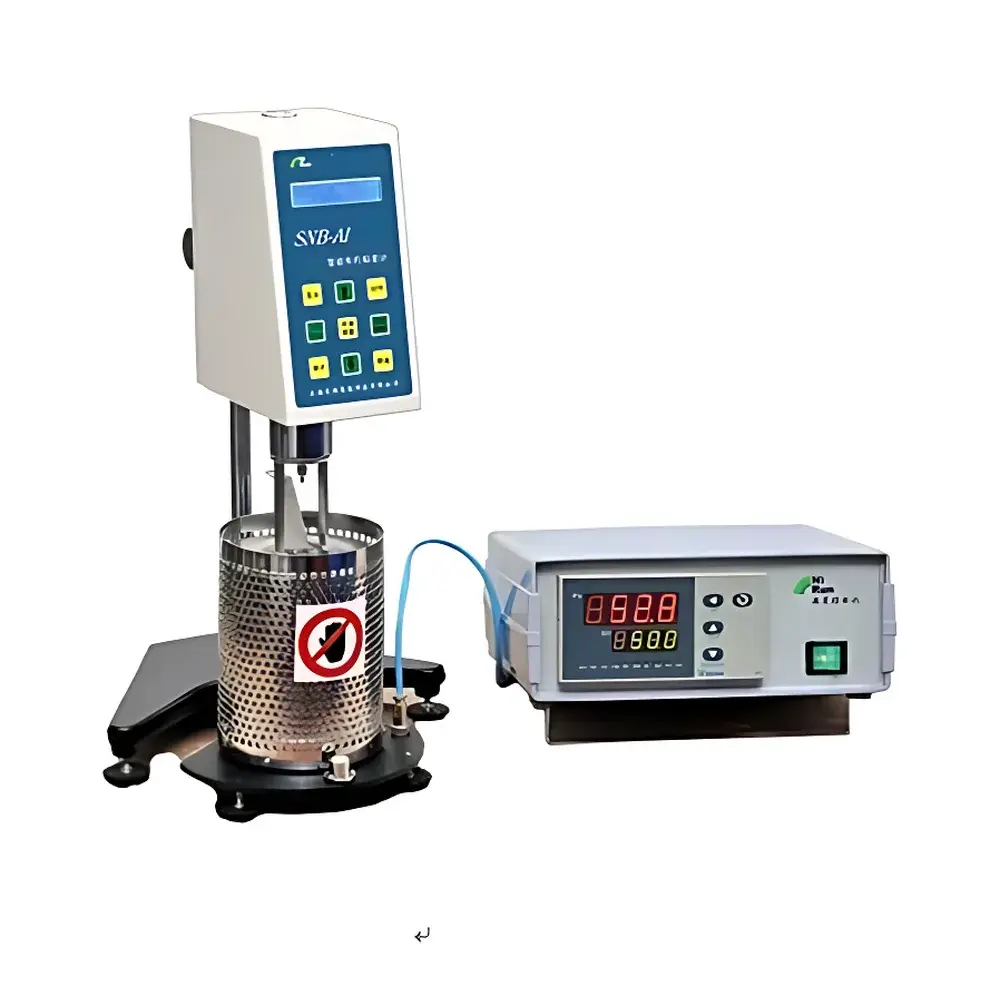
SNB-AI High-Temperature Rotational Viscometer for Hot-Melt Adhesives, Paraffin Wax, and Bitumen
| Origin | Beijing, China |
|---|---|
| Manufacturer Type | Authorized Distributor |
| Regional Origin | Domestic (China) |
| Model | SNB-AI |
| Pricing | Upon Request |
| Instrument Type | High-Temperature Viscometer |
| Viscosity Range (Medium) | 50–10,000,000 mPa·s (cP) |
| Viscosity Range (Low) | 5–1,000,000 mPa·s (cP) |
| Temperature Control Range | +10 °C to 250 °C (above 250 °C available upon specification) |
| Temperature Stability | ±0.1 °C |
| Speed Range | 0.1–200.0 rpm, gearless continuous adjustment |
| Accuracy | ±1.0% of full scale |
| Repeatability | ±0.5% of full scale |
| Power Input | 110/220 V AC, 50/60 Hz |
| Standard Spindles | 4 (SC-21, SC-27, SC-28, SC-29) |
| Optional Spindle | SC-0 (extends low-end sensitivity to 1 mPa·s) |
| Data Interface | RS-232 or USB (for optional SNB software and thermal profiling) |
Overview
The SNB-AI High-Temperature Rotational Viscometer is an engineered solution for precise dynamic viscosity characterization of thermally sensitive, molten-phase materials—including hot-melt adhesives, paraffin waxes, bituminous binders, polymer melts, and modified asphalt formulations. Based on the Couette principle, it employs a concentric cylinder geometry (spindle-in-cup configuration) to quantify torque resistance under controlled rotational shear, enabling rheological assessment within defined temperature and shear rate domains. Its integrated high-stability heating furnace—capable of maintaining ±0.1 °C accuracy from ambient +10 °C up to 250 °C—ensures reproducible thermal conditioning critical for ASTM D3236 (hot-melt adhesives), ASTM D4402 (asphalt binders), and ISO 2555 (aqueous polymer solutions). Designed for industrial QC labs and R&D facilities where melt processing behavior directly impacts end-product performance, the SNB-AI delivers calibrated, traceable viscosity data compliant with GLP documentation requirements.
Key Features
- Thermally isolated heating chamber with PID-controlled furnace, supporting extended dwell times at target temperatures without drift
- Gearless, high-subdivision stepper motor drive system ensures smooth, vibration-free rotation across the full 0.1–200.0 rpm range—immune to line-frequency fluctuations
- Real-time digital display (blue-backlit LCD) showing dynamic viscosity (mPa·s), rotational speed (rpm), % torque, maximum measurable viscosity per spindle/speed combination, and bath temperature
- Multi-sampling per revolution capability—enabled by proprietary firmware architecture—eliminates single-point-per-revolution limitations common in legacy analog viscometers
- Auto-speed optimization algorithm assists novice users by recommending optimal spindle/speed combinations based on preliminary viscosity estimates
- Full-scale linearity calibration performed via computer-interfaced metrological verification, aligning instrument response with NIST-traceable standard oils
- Modular spindle compatibility: standard set includes SC-21, SC-27, SC-28, and SC-29; optional SC-0 spindle extends measurement lower limit to 1 mPa·s for dilute melts or pre-melt intermediates
Sample Compatibility & Compliance
The SNB-AI accommodates viscous, non-Newtonian, and thixotropic melts requiring elevated temperature handling—such as ethylene-vinyl acetate (EVA) hot-melt adhesives, microcrystalline paraffin blends, SBS-modified bitumen, and thermoplastic elastomer melts. Its stainless-steel spindle and cup assembly resists thermal degradation and chemical interaction with hydrocarbon-based matrices. The system supports ASTM D1084 (adhesive viscosity), ASTM D2196 (non-Newtonian fluids), and ISO 3219 (rheology of polymer solutions and dispersions). When paired with certified reference oils (e.g., Cannon N-series or Brookfield Standard Oils), it satisfies internal calibration protocols required under ISO/IEC 17025 and supports audit readiness for FDA 21 CFR Part 11–aligned electronic records when used with validated SNB software.
Software & Data Management
The optional SNB Data Acquisition and Plotting Software provides time-resolved viscosity–temperature profiling, automated ramp-and-hold sequences, and export-ready CSV/TXT outputs compatible with MATLAB, Excel, and LIMS platforms. It enables full audit trail logging—including user ID, timestamp, temperature setpoint, spindle ID, and raw torque values—with configurable metadata fields for batch tracking. All software operations comply with ALCOA+ principles (Attributable, Legible, Contemporaneous, Original, Accurate, Complete, Consistent, Enduring, Available) for regulated environments. Thermal stability validation reports and calibration certificates can be generated directly from the software interface, supporting GMP/GLP documentation workflows.
Applications
- Quality control of hot-melt adhesive melt viscosity prior to extrusion or coating processes
- Temperature-dependent flow analysis of paving-grade and polymer-modified bitumen for rutting and fatigue resistance modeling
- Process optimization of paraffin wax melting behavior in candle manufacturing and phase-change material development
- Thixotropy evaluation of shear-thinning polymer melts during injection molding feedstock qualification
- Stability screening of thermally aged asphalt binders per AASHTO T315 protocols
- R&D of bio-based adhesives and renewable wax alternatives under controlled thermal ramp conditions
FAQ
What temperature range is supported, and can it exceed 250 °C?
The standard heating furnace operates from ambient +10 °C to 250 °C with ±0.1 °C stability. Custom configurations for operation up to 300 °C are available upon engineering review and quotation.
Is the instrument suitable for thixotropic materials?
Yes—the built-in timer function allows user-defined equilibration periods before measurement initiation, ensuring structural recovery and consistent shear history for thixotropic melts.
How is calibration traceability established?
Calibration uses NIST-traceable standard oils; optional certification with accredited metrology labs provides ISO/IEC 17025-compliant calibration reports.
Can the SNB-AI operate independently of a PC?
Yes—it functions as a standalone unit with full local display and manual control. PC connectivity is optional for advanced data logging, curve fitting, and regulatory reporting.
Which spindle set is recommended for asphalt binder testing per ASTM D4402?
SC-21 and SC-27 spindles are typically selected for unaged and RTFO-aged binders within the 100–600,000 mPa·s range; spindle selection must be verified against torque constraints at target test temperatures.



