
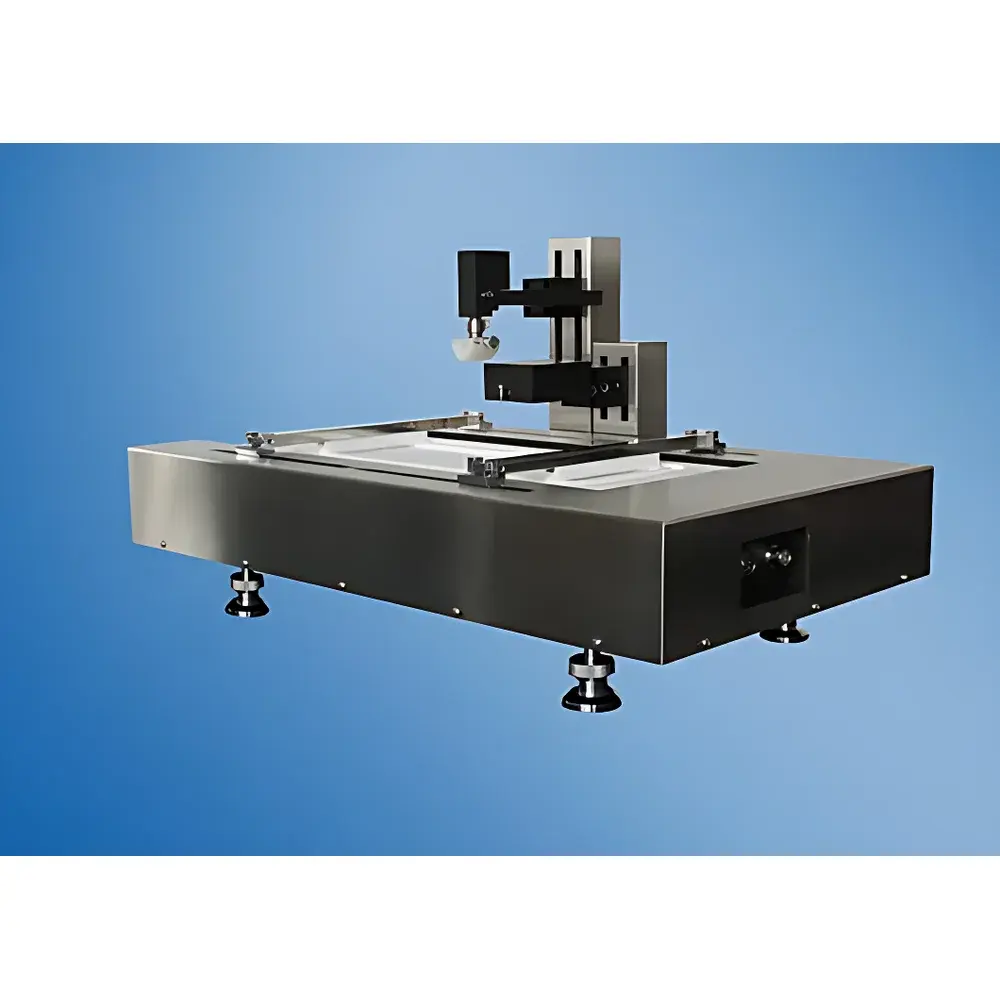
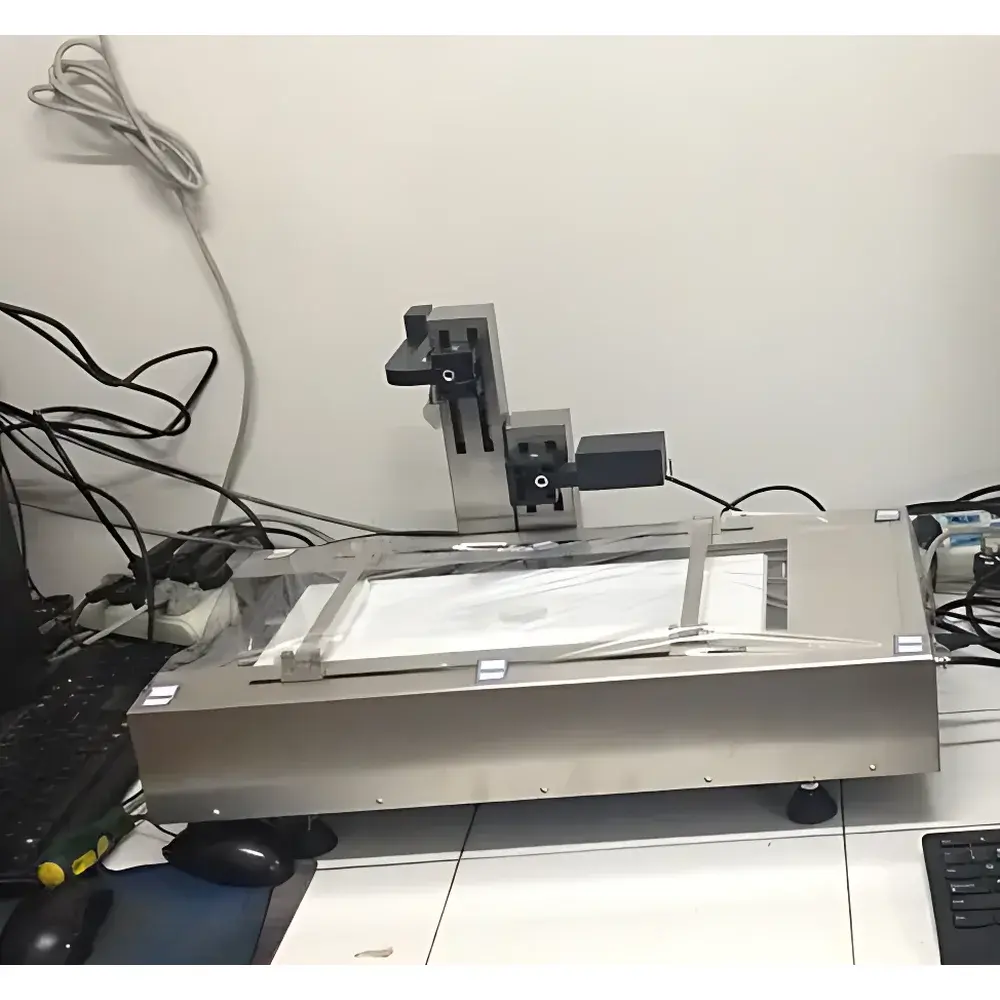
ZYKX JML04C2M Langmuir-Blodgett Trough with Wilhelmy Plate Surface Tensiometer
| Brand | ZYKX |
|---|---|
| Origin | Beijing, China |
| Model | JML04C2M |
| Surface Tension Range | 0–150 mN/m |
| Resolution | 0.05 mN/m |
| Measurement Method | Wilhelmy Plate |
| Trough Material | PTFE (Full Fluoropolymer) |
| Trough Dimensions | 300 mm × 100 mm |
| Compression Ratio | Up to 90% |
| Barrier Speed | 0.48–97 mm/min |
| Deposition Speed | 0.22–45 mm/min |
| Deposition Modes | Upward & Downward |
| Power Supply | AC 220 V ±10%, 50 Hz, 150 W Max |
| Operating Temperature | Ambient (with optional external thermostatic bath) |
| Relative Humidity | 30–85% RH |
| Compliance | ASTM D971, ISO 6295, ISO 1409, USP <721>, GLP-ready data logging |
Overview
The ZYKX JML04C2M Langmuir-Blodgett (LB) Trough is a precision surface science instrument engineered for quantitative characterization of monolayers formed by amphiphilic molecules at the air–liquid interface. It operates on the fundamental principles of interfacial thermodynamics and mechanical equilibrium, employing the Wilhelmy plate method—a gravimetric technique standardized in ASTM D971 and ISO 6295—to measure surface tension (γ) with high reproducibility. The system enables real-time acquisition of surface pressure (π = γ₀ − γ, where γ₀ is the surface tension of the clean subphase) versus molecular area (A) isotherms—critical for determining phase transitions, collapse pressure, compressibility modulus, and molecular packing density. Its robust PTFE-lined Langmuir trough eliminates chemical adsorption and minimizes background contamination, making it suitable for sensitive biological monolayers including phospholipids, pulmonary surfactant analogs, peptides, and synthetic polymers. Designed for integration into regulated laboratory environments, the JML04C2M supports GLP-compliant workflows through timestamped, audit-trail-capable data capture.
Key Features
- Fully automated operation via embedded microcontroller and Windows-based host software, minimizing operator-induced variability in barrier movement, compression cycles, and deposition control.
- High-precision Wilhelmy plate sensor with 0.05 mN/m resolution and full-scale range of 0–150 mN/m, calibrated traceably to NIST-traceable standards.
- PTFE monolithic trough construction (300 mm × 100 mm active area) ensures chemical inertness, ultra-low leakage (<1 µL/min), and thermal stability; custom multi-trough and dual-chamber configurations available upon request.
- Motorized barrier with programmable speed (0.48–97 mm/min) and position feedback enables precise, repeatable compression to ≥90% area reduction—essential for studying phase coexistence and domain formation.
- Vertical deposition module supporting upward and downward transfer modes, with adjustable deposition speed (0.22–45 mm/min) and real-time tension feedback for constant-π or constant-area protocols.
- Integrated surface tension auto-measurement function prior to monolayer formation, eliminating manual calibration steps and improving inter-experimental consistency.
- Low-vibration mechanical architecture and acoustic-damped base ensure stable measurements under standard lab conditions (no dedicated vibration isolation required).
Sample Compatibility & Compliance
The JML04C2M accommodates a broad spectrum of amphiphilic systems: natural and synthetic lipids (e.g., DPPC, POPG), lung surfactant extracts, membrane proteins (reconstituted in detergent micelles), block copolymers, dendrimers, and nanoparticle-lipid hybrids. Subphases include ultrapure water, buffered saline (e.g., PBS, HEPES), Ca²⁺- or Mg²⁺-containing solutions, and temperature-controlled aqueous media (via external recirculating chiller). The instrument meets material compatibility requirements for ISO 1409 (plastics—determination of surface tension of polymer melts), ASTM D971 (petroleum products), and USP (surface tension of pharmaceutical excipients). Data acquisition conforms to ALCOA+ principles (Attributable, Legible, Contemporaneous, Original, Accurate, Complete, Consistent, Enduring, Available), supporting FDA 21 CFR Part 11 readiness when deployed with validated software configurations.
Software & Data Management
The native Windows application provides intuitive graphical control of all hardware parameters—including barrier position, deposition direction/speed, target surface pressure, and cycle count—with real-time plotting of π–A, γ–A, and dπ/dA isotherms. All raw sensor outputs (force, position, time) are logged at ≥10 Hz with embedded metadata (operator ID, sample ID, environmental conditions, calibration status). Export formats include CSV, TXT, and XML for downstream analysis in MATLAB, OriginLab, or Python-based scientific stacks. Graphical overlays, derivative analysis, and automatic identification of onset-of-collapse and phase transition points are built-in. Audit trails record user actions, parameter changes, and software versioning—enabling full traceability for regulatory submissions or peer-reviewed publication.
Applications
- Biophysical characterization of pulmonary surfactant monolayers in NRDS and ARDS research, including evaluation of synthetic replacements and protein–lipid interactions.
- Development of LB-film-based biosensors, organic thin-film transistors (OTFTs), and nonlinear optical (NLO) coatings requiring controlled molecular orientation.
- Adsorption thermodynamics of natural organic matter (NOM) at water–air interfaces relevant to drinking water treatment and membrane fouling studies.
- Structure–function correlation in model biomembranes, lipid rafts, and peptide–membrane insertion kinetics.
- Quality control of surfactant formulations in pharmaceuticals, cosmetics, and agrochemicals per ICH Q5C and Q5D guidelines.
- Fundamental studies in soft matter physics: 2D phase transitions, critical phenomena, and hierarchical self-assembly of supramolecular architectures.
FAQ
What subphase temperature control options are supported?
The JML04C2M operates at ambient temperature but features standardized ports for connection to external thermostatic circulators (e.g., Julabo, Huber), enabling precise subphase temperature regulation from 5 °C to 60 °C.
Can the trough be configured for multi-layer deposition onto solid substrates?
Yes—vertical deposition mode supports sequential transfer of multiple monolayers onto hydrophilic/hydrophobic substrates (e.g., silicon wafers, mica, glass slides) with programmable dwell times and interlayer rinsing steps.
Is the software compliant with 21 CFR Part 11 requirements?
The base software provides electronic signatures, audit trails, and data integrity safeguards; full Part 11 compliance requires site-specific validation documentation and role-based access configuration, which ZYKX supports under GxP consultancy services.
What maintenance is required for long-term sensor accuracy?
Annual recalibration using certified reference liquids (e.g., pure water, diiodomethane) is recommended; Wilhelmy plates should be cleaned ultrasonically in ethanol and dried under nitrogen before each use to prevent organic residue buildup.
Are custom trough geometries available for specialized experimental designs?
Yes—ZYKX offers engineering support for custom trough dimensions, multi-compartment designs, integrated electrochemical cells, and in situ spectroscopy windows (UV-Vis, fluorescence, IR).



