
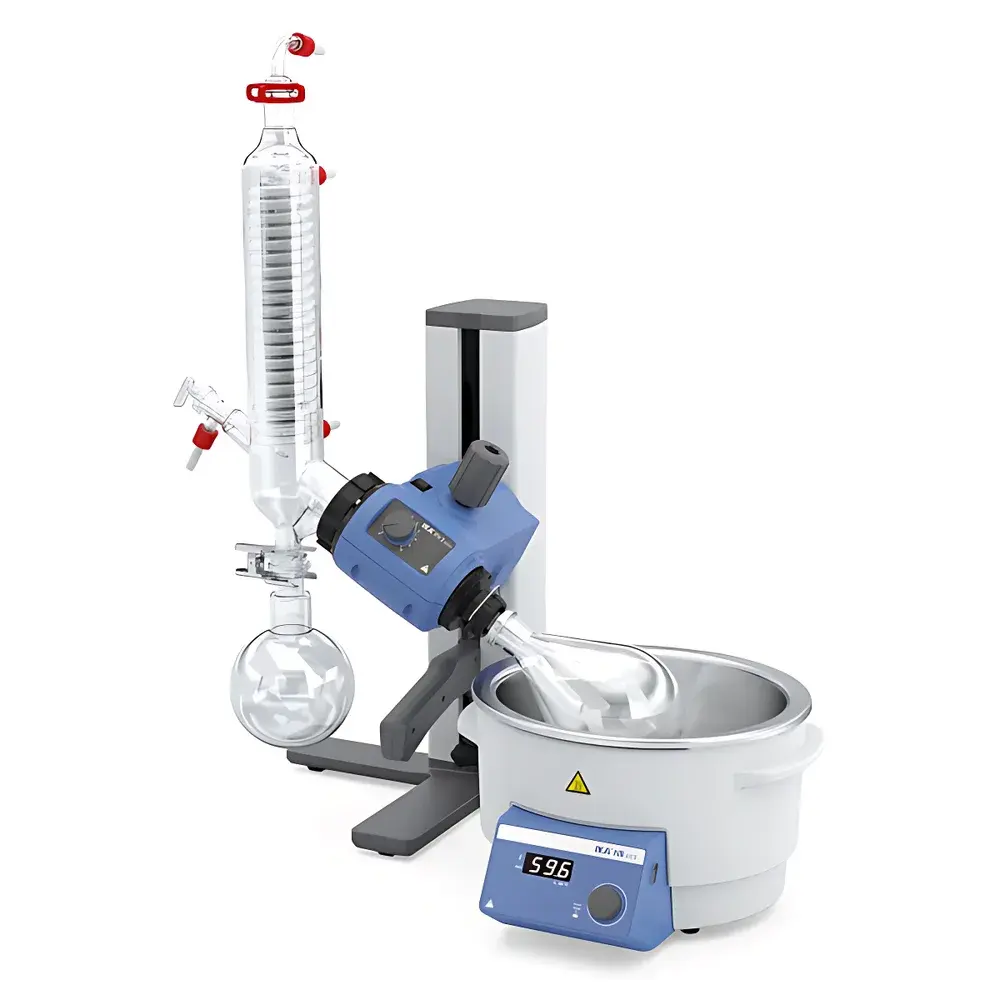
IKA RV 3 V Rotary Evaporator
| Brand | IKA |
|---|---|
| Origin | Germany |
| Manufacturer | IKA-Werke GmbH & Co. KG |
| Type | Imported Equipment |
| Model | RV 3 V |
| Evaporation Flask Capacity | 4 L |
| Ultimate Vacuum | 1 mbar |
| Rotation Speed Range | 5–300 rpm |
| Heating Bath Temperature Range | Ambient to 99 °C |
| Temperature Control Accuracy | ±1 K |
| Condenser Surface Area | 1500 cm² |
| Heating Bath Power Input | 1400 W |
| Protection Class | IP20 |
| Dimensions (W × D × H) | 440 × 530 × 330 mm |
| Weight | 28.3 kg |
| Operating Ambient | 5–40 °C, ≤80 % RH |
Overview
The IKA RV 3 V Rotary Evaporator is a precision-engineered, entry-level yet highly capable vacuum distillation system designed for routine solvent removal, concentration, and gentle sample recovery under reduced pressure. Based on the fundamental principle of rotary evaporation—where reduced pressure lowers the boiling point of solvents while controlled rotation increases surface area and heat transfer efficiency—the RV 3 V delivers reproducible performance across R&D, QC/QA, and pilot-scale production environments in chemical, pharmaceutical, and biotechnological laboratories. Its robust mechanical architecture, integrated safety features, and compliance-ready design make it suitable for GLP-aligned workflows and ISO 17025-accredited laboratories. The system operates with a 24 V DC motor drive for enhanced operational safety and electromagnetic compatibility, and its modular glass interface ensures seamless compatibility with the full IKA RV10 series condensers and vapor ducts.
Key Features
- 4 L heating bath with digital temperature display and ergonomic lifting handle for safe, single-hand operation
- Manually actuated vertical lift mechanism with adjustable endpoint positioning (150 mm travel) and dual mechanical locking system—including visual red-alert indicator when secondary lock is disengaged
- DC motor with continuously variable speed control (5–300 rpm), calibrated digital speed readout, and <±1 rpm accuracy at speeds ≤100 rpm / 100 rpm
- Vertically oriented triple-layer condenser offering 1500 cm² effective cooling surface area—engineered for high-efficiency condensation of low-boiling and moderately volatile solvents (e.g., acetone, ethyl acetate, dichloromethane)
- Heating bath temperature range from ambient to 99 °C with ±1 K control stability; thermally insulated housing minimizes external heat radiation
- Dedicated bottle-release knob enabling secure, simultaneous fixation and release of the evaporation flask
- Adjustable motor tilt angle for optimized film formation and uniform solvent evaporation across varying viscosities and volumes
- Compliant with DIN EN 60529 (IP20), CE-marked, and designed for continuous operation under 100–240 V AC, 50/60 Hz power supply
Sample Compatibility & Compliance
The RV 3 V supports standard ground-glass jointed glassware from the IKA RV10 family—including 1 L, 2 L, and 4 L round-bottom flasks, vertical condensers, and vapor duct assemblies—ensuring interchangeability and scalability within existing lab infrastructure. It is validated for use with common organic solvents, aqueous buffers, and thermally sensitive extracts. From a regulatory standpoint, the instrument’s stable temperature and rotational control, combined with traceable calibration points (temperature sensor and speed encoder), support documentation requirements under FDA 21 CFR Part 11 when paired with compliant data logging software. Its construction materials and electrical safety rating align with IEC 61010-1 for laboratory equipment, and its mechanical design facilitates cleaning and verification per GMP Annex 15 and EU GMP guidelines.
Software & Data Management
While the RV 3 V operates as a standalone analog-digital hybrid unit without built-in PC connectivity, its front-panel controls provide real-time, non-volatile parameter readouts (temperature, rpm) that can be manually logged or interfaced via optional third-party analog signal output modules (e.g., 0–10 V or 4–20 mA). For labs requiring electronic records, integration with IKA Labworldsoft™ (via compatible IKA accessories such as the RV 10 digital controller upgrade kit) enables remote monitoring, SOP-driven protocol execution, audit-trail generation, and export of time-stamped parameter sets compliant with ALCOA+ principles. All firmware updates and calibration logs are retained internally for traceability during internal audits or regulatory inspections.
Applications
- Solvent removal from reaction mixtures post-synthesis in medicinal chemistry and process development
- Concentration of natural product extracts (e.g., plant alkaloids, essential oils) without thermal degradation
- Recovery and recycling of high-purity solvents in QC laboratories per ASTM E260 and ISO 647
- Gentle drying of heat-labile biomolecules—including peptides, oligonucleotides, and enzyme preparations—under controlled vacuum and temperature
- Preparative purification steps prior to HPLC or GC analysis in environmental and food testing labs
- Teaching applications in university analytical chemistry courses, emphasizing vacuum physics, phase equilibria, and mass transfer fundamentals
FAQ
Is the RV 3 V compatible with vacuum controllers or automated pressure regulation systems?
Yes—its standard vapor duct port accepts IKA Vacstar® or other third-party vacuum controllers via standard 10/16 or 14/23 O-ring fittings, enabling programmable pressure ramping and endpoint detection.
What is the maximum recommended working vacuum level for optimal condensation efficiency?
For most applications, a stable vacuum between 1–10 mbar is advised; the system achieves ultimate vacuum down to 1 mbar when paired with a suitable diaphragm or rotary vane pump meeting ISO 8573-1 Class 3 purity standards.
Can the heating bath accommodate custom-shaped flasks or non-IKA glassware?
Only standard conical or round-bottom flasks with ISO 297 or DIN 12220 ground-glass joints (e.g., 24/29, 29/32) are supported; dimensional deviations may compromise sealing integrity and rotational balance.
Does the RV 3 V include a chiller interface or coolant circulation capability?
No—it relies on passive or external recirculating chillers connected to the condenser’s inlet/outlet ports (G 1/4″ BSP); coolant flow rate and temperature must be independently managed per application requirements.
How frequently should the PTFE sealing components and bath oil be replaced?
Sealing rings should be inspected before each use and replaced every 6–12 months depending on solvent exposure frequency; bath oil (e.g., silicone oil) requires replacement annually or after 1000 hours of cumulative operation to maintain thermal stability and viscosity.



