
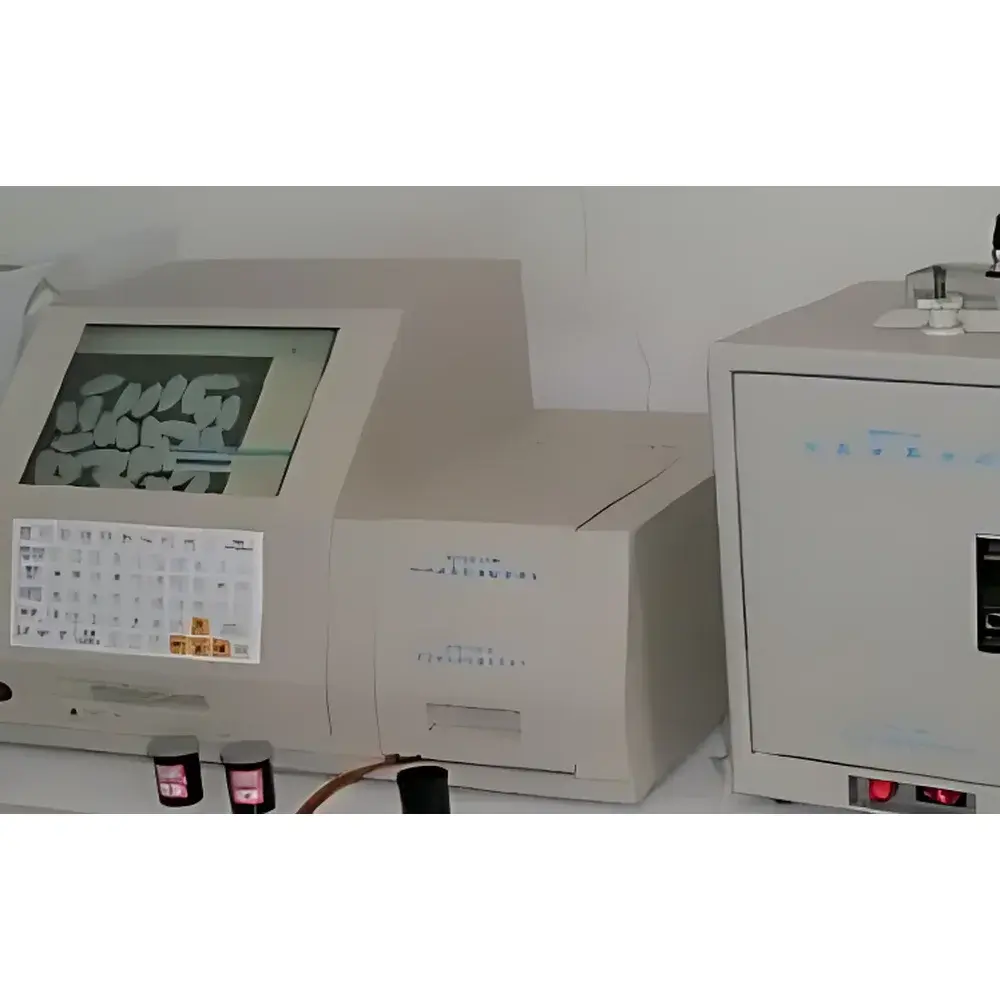
DPCZ-I Rice Quality Rapid Analyzer
| Origin | Beijing, China |
|---|---|
| Manufacturer Type | Authorized Distributor |
| Origin Category | Domestic (PRC) |
| Model | DPCZ-I |
| Price Range | USD 1,400 – 7,000 |
| Moisture Accuracy | ±0.5% |
| Amylose Content Accuracy | ±1% |
| Chalkiness Degree Accuracy | ±1% |
| Chalky Grain Ratio Accuracy | ±2% |
Overview
The DPCZ-I Rice Quality Rapid Analyzer is a multi-functional, integrated analytical platform engineered for objective, standardized assessment of paddy rice quality in agricultural commodity supply chains. Designed and validated under the technical guidance of China’s Ministry of Agriculture and Rural Affairs (MARA), the instrument implements a hybrid measurement architecture combining near-infrared (NIR) spectroscopy for moisture quantification, laser-based photometric absorption analysis for amylose content determination, and high-resolution CCD imaging coupled with morphological image processing algorithms for chalkiness degree and chalky grain ratio evaluation. Its operational principle aligns with established physicochemical and optical metrology standards for cereal grain analysis, enabling compliance-driven testing in grain procurement, storage management, milling operations, and quality certification workflows. The system was formally certified on January 6, 2004, by an expert panel convened by MARA’s Department of Science, Technology and Education, confirming its alignment with national standards GB 1350–1999 (Paddy Rice) and GB/T 17891–1999 (Superior Quality Paddy Rice).
Key Features
- Four integrated functional modules: moisture analyzer (NIR reflectance), amylose quantifier (laser photometry at optimized wavelength), appearance quality imager (CCD-based image acquisition with uniform backlighting), and integrated evaluation software.
- Simultaneous single-parameter and composite quality scoring—supports classification into grade categories per Chinese national rice grading criteria.
- Onboard data logging with timestamped results; exportable reports in CSV and PDF formats for traceability and audit readiness.
- Calibration traceable to reference materials certified by the National Grain Quality Supervision and Inspection Center (China) and the Institute of Grain Science, National Food and Strategic Reserves Administration.
- Rugged industrial enclosure rated for ambient operation in grain elevators, rural procurement stations, and QC laboratories without climate control.
Sample Compatibility & Compliance
The DPCZ-I accepts whole, unhusked paddy rice samples (Oryza sativa L.) in quantities of 50–100 g per test. It accommodates varietal diversity across indica, japonica, and hybrid cultivars commonly traded in East and Southeast Asian markets. All measurement protocols are aligned with the performance requirements defined in GB 1350–1999 and GB/T 17891–1999. While not pre-certified for FDA 21 CFR Part 11 or ISO/IEC 17025, the system supports GLP-aligned documentation practices—including user logins, calibration logs, and result audit trails—enabling integration into GMP-compliant food safety management systems where local regulatory frameworks permit instrument-based grading.
Software & Data Management
The proprietary RiceEval™ software suite provides real-time visualization of spectral curves, image segmentation overlays, and statistical summaries per batch. It includes built-in pass/fail thresholds configurable to regional grading specifications (e.g., China’s “Superior Grade” vs. “Standard Grade”). Raw data files retain original sensor outputs (intensity values, pixel matrices, absorbance spectra) for retrospective reprocessing. Audit trail functionality records operator ID, test time, calibration status, and software version—supporting internal quality audits and third-party verification. Data export conforms to FAO-recommended cereal quality metadata schemas, facilitating interoperability with enterprise grain management platforms.
Applications
- Grain procurement: rapid field-side or depot-level screening to enforce contractual quality clauses (e.g., amylose ≤20% for glutinous rice; chalkiness <5% for premium grades).
- Storage monitoring: longitudinal tracking of moisture drift and chalk development during silo holding periods to mitigate spoilage risk.
- Mill feedstock qualification: pre-processing verification to optimize husking, polishing, and blending parameters based on starch composition and kernel integrity metrics.
- Regulatory inspection: official testing by provincial grain bureaus and market supervision authorities for labeling compliance and origin authenticity verification.
- Research applications: phenotypic trait correlation studies linking imaging-derived chalkiness indices with genomic markers in breeding programs.
FAQ
What standards does the DPCZ-I comply with?
It meets the accuracy and methodology requirements of GB 1350–1999 and GB/T 17891–1999 for paddy rice quality assessment.
Can the instrument be used for brown rice or milled rice?
No—it is specifically calibrated for unhusked paddy rice; performance validation does not extend to dehulled or polished samples.
Is external calibration required before each use?
Daily verification using certified reference paddy samples is recommended; full recalibration is performed annually or after major hardware servicing.
Does the system support network connectivity or LIMS integration?
Yes—Ethernet and RS-232 interfaces enable direct connection to local networks; API documentation is available for custom LIMS middleware integration.
What maintenance is required for the CCD imaging module?
Lens cleaning with optical-grade solvent every 200 tests and annual alignment verification using NIST-traceable grayscale targets.
Related Products





