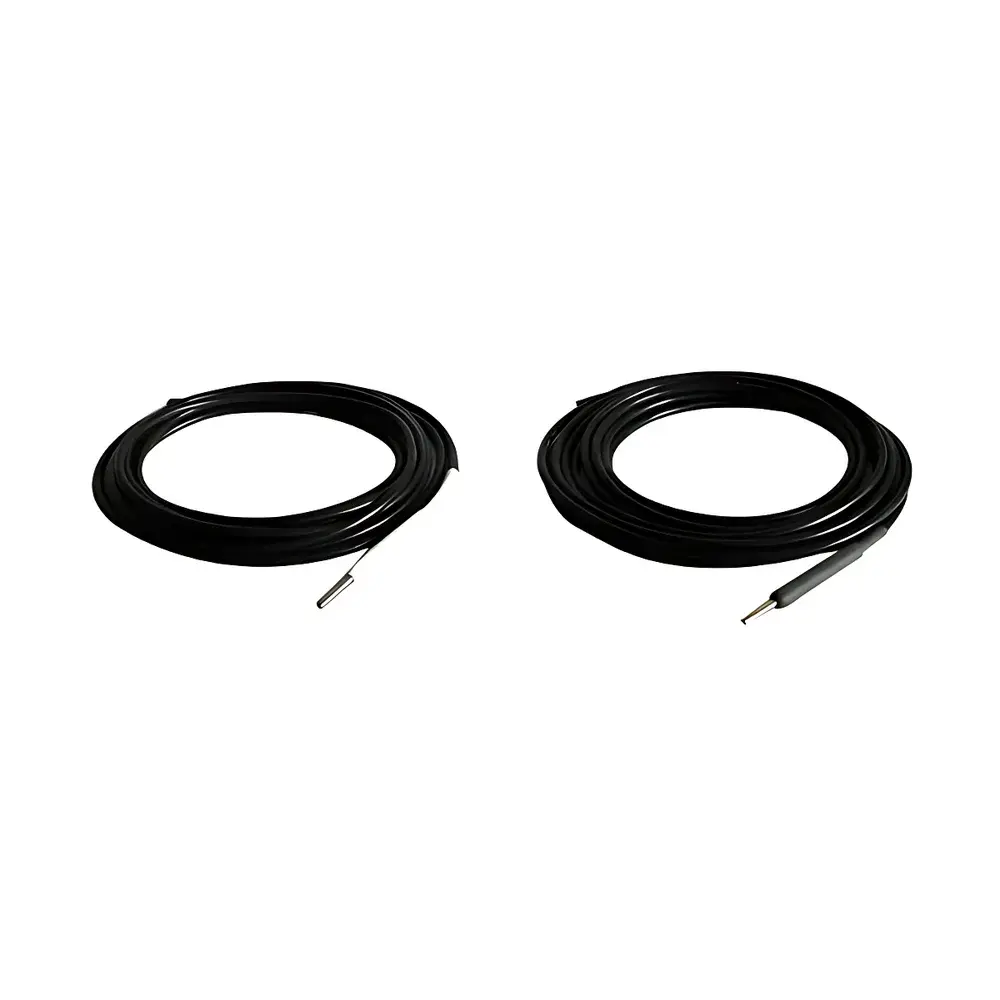
HBW Series Platinum Resistance Temperature Sensors (PRTs)
| Origin | Imported |
|---|---|
| Manufacturer Type | Distributor |
| Model | HBW Series |
| Pricing | Upon Request |
| Accuracy Class | A (±0.1 °C), B (±0.2 °C to ±0.3 °C) |
| Measurement Range | HBW-1: −50 °C to +50 °C |
| HBW-2 | −50 °C to +80 °C |
| Sensor Element | IEC 60751-compliant Pt100 (α = 0.00385 Ω/Ω/°C) |
| Configuration | 4-wire RTD |
| Cable | Shielded 4-core, standard 10 m (custom lengths available) |
| Probe Dimensions | 70 mm sheath length, 4 mm sensing tip diameter, 10 mm sheath OD |
| Mass | 0.35 kg (including 10 m cable) |
| Calibration Interval | 2 years |
| Compliance | IEC 60751:2022, EN 60751, ASTM E1137/E1137M |
Overview
The HBW Series Platinum Resistance Temperature Sensors are precision-grade, industrial-strength RTDs engineered for high-fidelity temperature monitoring in demanding environmental and metrological applications. Based on the fundamental principle of platinum’s predictable and monotonic resistivity–temperature relationship, these sensors implement the standardized Pt100 resistance thermometer configuration defined in IEC 60751:2022. Each unit integrates a high-stability, thin-film or wire-wound platinum sensing element housed within a corrosion-resistant, thermally optimized stainless steel or ceramic-coated protective sheath—engineered to minimize thermal lag and mechanical stress-induced drift. The four-wire (Kelvin) connection architecture eliminates lead resistance error, enabling traceable measurement uncertainty down to ±0.1 °C (Class A) across the full operating range. Designed explicitly for long-term deployment in uncontrolled ambient conditions—including open-air meteorological stations, soil profiling arrays, aquatic monitoring buoys, and environmental chamber validation—the HBW series delivers reproducible performance under cyclic thermal loading, humidity exposure, and mechanical vibration.
Key Features
- IEC 60751-compliant Pt100 sensing element with α = 0.00385 Ω/Ω/°C, certified to Class A (±0.1 °C) or Class B (±0.2 °C at −50 °C to +50 °C; ±0.3 °C at +50 °C to +80 °C)
- Robust 4-wire configuration with color-coded, shielded 4-core cable (standard 10 m; optional extended lengths up to 100 m with low-noise twisted-pair construction)
- Thermally optimized probe assembly: 70 mm active sheath length, 4 mm diameter sensing zone, 10 mm outer sheath diameter—designed for rapid thermal equilibration and minimal conduction error
- Hermetically sealed junction and moisture-resistant termination to IP67 rating, ensuring operational integrity in rain, fog, saturated soil, and submerged freshwater environments
- Traceable calibration certificate available per ISO/IEC 17025-accredited laboratory, including as-found/as-left data, uncertainty budget, and compliance statement against IEC 60751
- Long-term stability: ≤0.05 °C drift over 24 months under continuous operation at 25 °C ambient, verified via accelerated aging protocols per IEC 60751 Annex D
Sample Compatibility & Compliance
The HBW Series is validated for direct-contact measurement in gaseous (ambient air), liquid (freshwater, wastewater, process water), and solid-phase (mineral soil, asphalt, concrete) media. Its chemically inert sheath material resists oxidation, chloride attack, and biological fouling—making it suitable for EPA Method 100.1–compliant water quality monitoring and ISO 14644-3 cleanroom environmental qualification. All units conform to IEC 60751:2022 for tolerance, temperature coefficient, self-heating limits (<0.05 °C at 1 mA excitation), and insulation resistance (>100 MΩ at 500 V DC). For regulated environments—including GLP laboratories, environmental testing facilities governed by ISO/IEC 17025, and EPA-certified air/water monitoring networks—the sensor supports documented metrological traceability, 2-year calibration interval recommendation, and audit-ready calibration records compliant with FDA 21 CFR Part 11 when integrated with validated data acquisition systems.
Software & Data Management
While the HBW sensor itself is analog-output (resistance-only), it is fully interoperable with industry-standard DAQ platforms—including National Instruments CompactDAQ, Keysight 34972A, Campbell Scientific CR6, and Siemens Desigo CC—when paired with a precision 4-wire RTD input module. Resistance-to-temperature conversion follows the ITS-90 polynomial specified in IEC 60751 (Callendar-Van Dusen equation for sub-zero ranges). Validation-grade software packages (e.g., LabVIEW RTD Toolkit, MATLAB Instrument Control Toolbox, or proprietary calibration suites such as Fluke Metrology Software) support automated linearization, cold-junction compensation (if used with reference junctions), uncertainty propagation, and generation of calibration reports aligned with ISO/IEC 17025 requirements. Audit trails, electronic signatures, and version-controlled configuration files are maintainable when deployed within 21 CFR Part 11–compliant instrument control architectures.
Applications
- Meteorological surface observation networks (WMO-compliant air and ground temperature profiling)
- Environmental monitoring: soil temperature mapping for agricultural research, permafrost studies, and landfill leachate tracking
- Aquatic ecosystem surveillance: lake/river temperature stratification, wastewater treatment basin profiling, and aquaculture pond control
- Industrial HVAC commissioning and indoor air quality (IAQ) verification per ASHRAE Standard 62.1
- Calibration laboratory transfer standards for dry-block calibrators and liquid-bath temperature references
- Validation of climatic test chambers, stability storage rooms, and pharmaceutical cold-chain logistics infrastructure
FAQ
What is the recommended excitation current for HBW-series RTDs to minimize self-heating error?
A constant current of 0.5–1.0 mA is recommended; at 1 mA, self-heating remains below 0.05 °C in still air and <0.02 °C in flowing water.
Can HBW sensors be used in saline or seawater environments?
Yes—when equipped with marine-grade 316 stainless steel or PTFE-coated sheaths (optional configuration); standard white-sheathed units are rated for freshwater only.
Is four-wire connection mandatory for achieving Class A accuracy?
Yes—two-wire or three-wire configurations introduce uncompensated lead resistance error exceeding Class A tolerances; only 4-wire measurement guarantees full specification compliance.
How is interchangeability ensured across HBW units?
Each sensor undergoes individual characterization at multiple temperature points (−50 °C, 0 °C, +50 °C, +80 °C) and is supplied with a unique resistance vs. temperature lookup table or coefficients for direct integration into data loggers.
What documentation accompanies each HBW sensor shipment?
Standard delivery includes a factory test report listing R₀ (100.000 Ω at 0 °C), R₈₀, and deviation from IEC 60751 curve; optional ISO/IEC 17025 calibration certificate with measurement uncertainty is available upon request.