
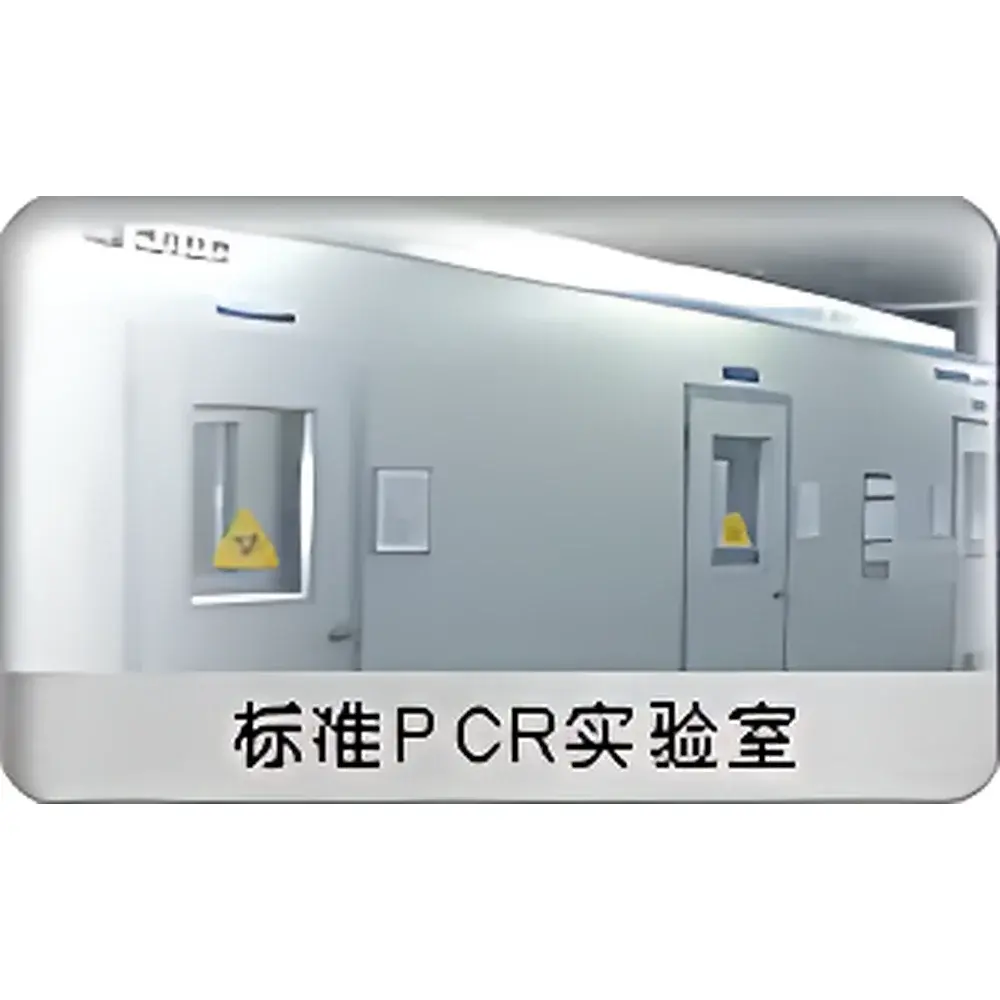
Bioer GeneLab Standard PCR Laboratory (SL-6040A)
| Brand | Bioer |
|---|---|
| Origin | Zhejiang, China |
| Manufacturer Type | Authorized Distributor |
| Country of Origin | China |
| Model | SL-6040A |
| Pricing | Available Upon Request |
| Minimum Installation Space | 6.0 × 4.5 × 3.0 m (L×W×H) |
| Floor Levelness Requirement | ≤5 mm per 2 m |
| Layout Zones | Reagent Preparation Area, Specimen Processing Area, PCR Amplification Area |
| Construction Materials | Sandwich Panels (Color-Coated Steel), Aluminum Alloy Structural Framing, Tempered Glass |
| Air Pressure Control | Negative-to-Neutral Gradient Across Zones |
| UV Disinfection | Fixed Ceiling-Mounted UV Lamps in All Zones & Transfer Window |
| Air Handling | Dedicated Exhaust Ducts with Adjustable Return Air Grilles on Exterior Walls and Doors |
Overview
The Bioer GeneLab Standard PCR Laboratory (Model SL-6040A) is a fully integrated, prefabricated cleanroom system engineered to meet the stringent spatial, airflow, and contamination control requirements outlined in the National Health Commission of the People’s Republic of China’s “Basic Standards for Clinical Gene Amplification Testing Laboratories.” Designed specifically for clinical diagnostics and translational research environments, this modular laboratory implements a unidirectional workflow based on the four-zone principle—reagent preparation, specimen processing, PCR amplification, and post-amplification analysis (though SL-6040A configures three core zones as standard). Its architecture enforces physical separation, pressure differentials, and air-handling protocols aligned with ISO 14644-1 Class 7 (10,000) cleanroom performance under operational conditions, minimizing cross-contamination risk from aerosolized nucleic acids—a critical failure mode in molecular diagnostics.
Key Features
- Zonal Segregation with Pressure Cascade: The laboratory comprises three functionally isolated areas—Reagent Preparation Zone (slightly positive pressure relative to corridor), Specimen Processing Zone (neutral pressure), and PCR Amplification Zone (negative pressure)—each separated by anteroom-style buffer zones. This differential pressure gradient prevents airborne carryover of amplicons or template DNA.
- Dedicated Mechanical Ventilation System: Each zone features independent exhaust ducting connected to external roof-mounted fans. Return air enters via adjustable grilles mounted on exterior walls and door frames, enabling precise air exchange rate tuning (typically 12–15 ACH) without recirculation between zones.
- Interlocked Stainless Steel Pass-Through Window: Equipped with dual-door electromagnetic interlock logic, ensuring only one side opens at a time. Constructed from 304 stainless steel with seamless welds and EPDM gaskets, it maintains integrity during material transfer while supporting ISO 14644-1 particle retention standards.
- Structural Integrity & Sealing: Wall and ceiling panels are 50 mm thick color-coated steel sandwich panels with polyurethane core (thermal conductivity ≤0.022 W/m·K). Aluminum alloy corner posts and precision-machined connecting clips eliminate thermal bridging and ensure long-term dimensional stability. All joints are sealed with neutral-cure silicone compliant with ISO 8573-1 Class 2 particulate limits.
- Multi-Level UV Sterilization Strategy: Fixed 254 nm low-pressure mercury UV-C lamps are installed in ceilings of all zones and inside the pass-through window. Additional portable UV units (254 nm, 15 W) provide targeted decontamination of work surfaces in reagent and specimen zones prior to daily operation.
Sample Compatibility & Compliance
The SL-6040A is not a sample-processing instrument but a certified infrastructure platform supporting all standard PCR-based assays—including real-time qPCR, digital PCR, RT-PCR, and multiplex amplification—as defined in CLSI MM19-A3 and ISO 15189:2022 Annex B. Its design facilitates compliance with China’s WS/T 687–2020 “Technical Specifications for Clinical Molecular Diagnostic Laboratories” and aligns with international best practices referenced in CAP MOL.02.02.01 (Contamination Prevention) and UK NEQAS Molecular Pathology guidelines. While not FDA-cleared as a medical device, its construction materials comply with GB/T 25971–2010 (Cleanroom Sandwich Panels) and GB 50346–2011 (Biological Safety Laboratories). Full documentation packages—including as-built drawings, pressure mapping reports, and UV intensity validation records—are provided for internal audit and regulatory readiness.
Software & Data Management
As a physical infrastructure solution, the SL-6040A does not include embedded software. However, its architectural design integrates seamlessly with laboratory information management systems (LIMS) and electronic lab notebooks (ELN) through standardized facility interface protocols. Environmental monitoring data—including real-time pressure differentials (±0.5 Pa resolution), temperature (±0.3°C), humidity (±2% RH), and UV lamp operational status—can be logged via optional IoT sensors compatible with Modbus TCP or BACnet MS/TP. All sensor outputs support CSV export and are structured to satisfy GLP/GMP traceability requirements, including user-defined audit trails, electronic signatures per 21 CFR Part 11 Annex 11, and secure data retention for ≥10 years.
Applications
The Bioer GeneLab SL-6040A serves as foundational infrastructure for accredited clinical laboratories performing infectious disease testing (e.g., SARS-CoV-2, HBV, HIV), oncology biomarker detection (BRAF, EGFR, KRAS), pharmacogenomic screening, and forensic DNA profiling. It is equally suited for academic core facilities conducting CRISPR validation, single-cell RNA-seq library prep, and NGS target enrichment workflows where pre-PCR contamination control is non-negotiable. Its modular footprint enables rapid deployment in existing hospital basements, university research wings, or mobile diagnostic units—reducing commissioning timelines by up to 60% compared to traditional build-out methods.
FAQ
Does the SL-6040A include HVAC equipment or is it supplied separately?
The unit includes integrated exhaust fans, ductwork, and pressure-sensing manometers—but does not include primary AHUs or chilled water systems. These are specified and installed by local MEP contractors per site-specific load calculations.
Can the layout be customized beyond the standard three-zone configuration?
Yes. Bioer offers engineering consultation for four-zone layouts (adding a separate post-PCR analysis room) and integration of biosafety cabinets (Class II A2/B2) with dedicated canopy exhaust connections.
What validation documentation is provided upon installation?
Commissioning includes ISO 14644-3-compliant air balance reports, smoke visualization tests, UV irradiance mapping (per ISO 15858), and full pressure cascade verification across all operational modes.
Is the system compatible with automated liquid handling platforms?
All zones feature reinforced flooring (load capacity ≥500 kg/m²), 20% extra power outlets (220 V/16 A), and cable raceways beneath raised access floors—enabling seamless integration of robotic workstations such as QIAGEN QIAgility or Hamilton STAR.
How often must UV lamps be replaced to maintain sterilization efficacy?
Lamp replacement is recommended every 1,000 operating hours or annually—whichever occurs first—validated using calibrated radiometers traceable to NIM (China National Institute of Metrology).



