
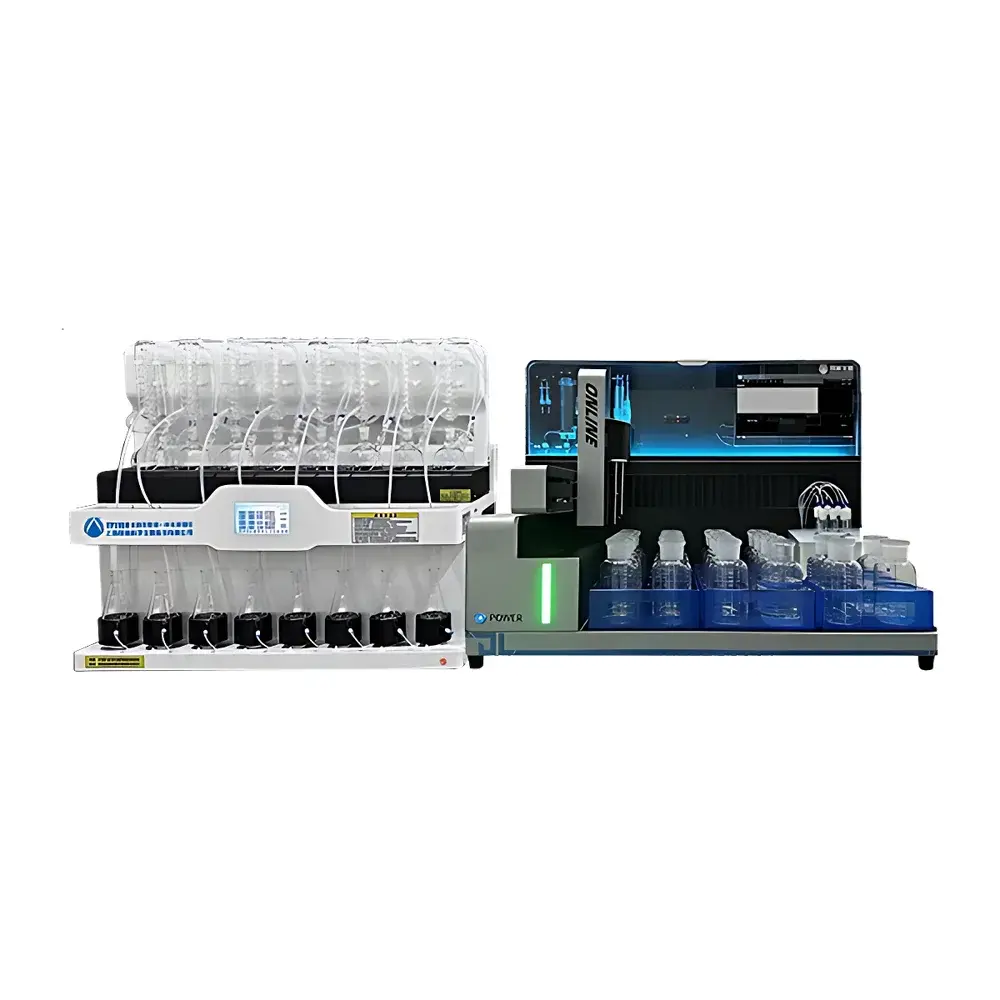
Online Instrument OL2500N Fully Automated Cyanide Analyzer
| Brand | Online Instrument |
|---|---|
| Model | OL2500N |
| Origin | Shanghai, China |
| Instrument Type | Laboratory-Based Analyzer |
| Compliance Standards | HJ 484–2009, HJ 745–2015, GB/T 5750.5–2023 |
| Sample Capacity | 36 positions |
| Distillation Stations | 8 |
| Fluid Handling | Precision syringe + peristaltic pump hybrid delivery |
| Temperature Control | Programmable water bath with ±0.5 °C stability |
| Reagent Management | Auto-low-reagent alert, auto-standard preparation (multi-level calibration curves), sealed waste & off-gas collection |
| Data Interface | LIMS-compatible, remote monitoring via web-based dashboard, audit-trail-enabled operation logs |
Overview
The Online Instrument OL2500N Fully Automated Cyanide Analyzer is a laboratory-grade analytical system engineered for the precise, trace-level quantification of free cyanide, total cyanide, and cyanide species in aqueous and solid-phase environmental matrices. It implements the standardized colorimetric methodology based on pyridine-barbituric acid (or isonicotinic acid-barbituric acid) derivatization following distillation—fully aligned with Chinese national standards HJ 484–2009 (for water), HJ 745–2015 (for soil and sediment), and GB/T 5750.5–2023 (for drinking water). Unlike semi-automated or manual benchtop systems, the OL2500N integrates sample introduction, reagent addition, steam distillation, condensate transfer, thermal reaction incubation, photometric measurement at 578 nm (±2 nm bandwidth), and post-run cleaning into a single unattended workflow—eliminating operator-induced variability and ensuring method reproducibility across high-throughput regulatory testing environments.
Key Features
- Fully integrated 36-position autosampler with independent vial cooling (4–10 °C) to preserve sample integrity prior to analysis
- Dual-mode fluid handling architecture: high-precision syringes (0.1–5 mL range, ±0.5% volumetric accuracy) for critical reagent dosing, complemented by chemically resistant peristaltic pumps for bulk transfer and distillate handling
- Eight parallel distillation modules with individually controlled steam generation, condensation rate, and distillate collection timing—enabling true batch parallelism without cross-contamination
- Automated standard preparation: prepares up to six concentration levels from stock solutions, generates calibration curves in real time, and validates linearity (R² ≥ 0.999) before each analytical run
- Sealed distillation and reaction manifold with integrated activated carbon filtration and NaOH scrubbing for HCN vapor capture—meeting OSHA PEL and ISO 15190 laboratory safety requirements
- Embedded industrial-grade touchscreen PC with intuitive GUI; also supports external Windows-based control via Ethernet or Wi-Fi with full remote desktop capability
Sample Compatibility & Compliance
The OL2500N accommodates liquid samples (surface water, wastewater, leachates) and solid matrices (soil, sludge, sediments) after appropriate pretreatment per HJ 745–2015. Solid samples are processed using optional integrated microwave-assisted acid digestion or ultrasonic extraction modules (sold separately). All operational parameters—including distillation time, pH adjustment, buffer volume, and reaction temperature—are programmable to match method-specific requirements. The system maintains full traceability per GLP and ISO/IEC 17025:2017, with electronic signatures, user access levels (admin/operator/auditor), and 21 CFR Part 11–compliant audit trails for all instrument events, method changes, and data exports.
Software & Data Management
The proprietary CyanSoft™ v4.2 software provides end-to-end method configuration, real-time process visualization, and automated report generation in PDF/CSV/XLSX formats compliant with CNAS reporting templates. It supports direct integration with enterprise LIMS platforms via ASTM E1384-compliant HL7 or XML-based API protocols. Raw absorbance data, calibration metadata, QC flagging (e.g., blank drift >0.005 AU, recovery outside 85–115%), and instrument diagnostics are timestamped and stored locally with optional cloud backup. All data modifications are logged with user ID, timestamp, and pre/post values—ensuring full compliance during regulatory audits.
Applications
- Regulatory monitoring of effluent discharges under China’s “Emission Standard of Pollutants for Wastewater Treatment Plants” (GB 18918–2002)
- Drinking water safety verification per GB 5749–2022, including routine surveillance and emergency response for accidental cyanide contamination
- Environmental site assessment (ESA) and remediation validation at former electroplating, mining, or chemical manufacturing sites
- Wastewater treatment plant process control—tracking cyanide removal efficiency across oxidation, chlorination, and biological treatment stages
- Research laboratories studying cyanide speciation kinetics, ligand-binding behavior, or degradation pathways under varying pH/redox conditions
FAQ
Does the OL2500N comply with international cyanide testing standards such as ISO 6703-1 or ASTM D2036?
The system is validated against Chinese national standards (HJ 484, HJ 745, GB/T 5750.5); method equivalence to ISO 6703-1 can be demonstrated through comparative interlaboratory studies using certified reference materials.
Can the instrument analyze complex wastewater with high sulfide or nitrite content?
Yes—the integrated pretreatment module includes sulfide masking (with cadmium sulfate) and nitrite interference correction (via ammonium sulfamate addition), both automatically dosed per HJ 484–2009 Annex B.
What maintenance intervals are recommended for long-term reliability?
Daily: waste container emptying and optical path cleaning; Quarterly: syringe seal replacement and distillation coil descaling; Annually: photometer wavelength verification and temperature sensor calibration—documented in the included PM checklist.
Is method validation support provided for laboratory accreditation?
Yes—Online Instrument supplies full IQ/OQ/PQ documentation templates, CRM test reports (using NIST SRM 2710a and EPA 6010D), and on-site validation assistance upon request.







