
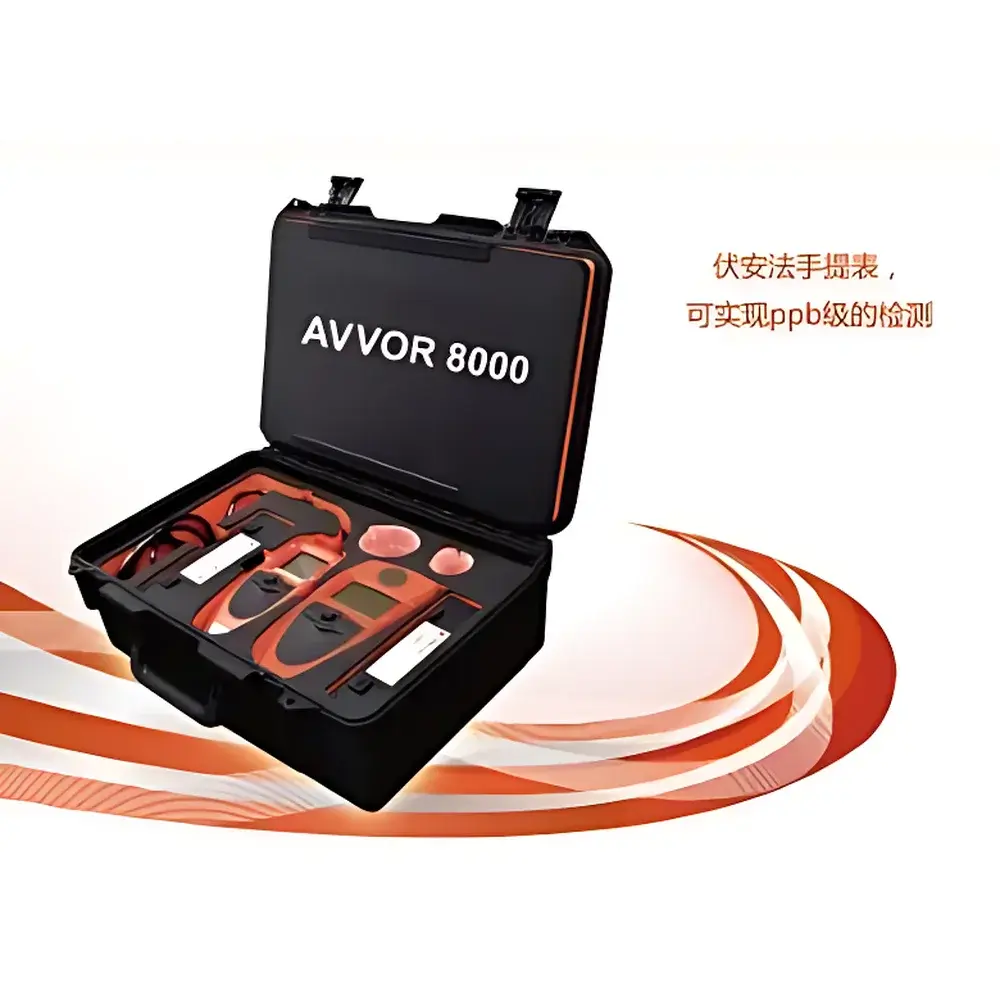
AVVOR 8000 HM-2 Portable Heavy Metals Analyzer (Anodic Stripping Voltammetry)
| Brand | AVVOR |
|---|---|
| Origin | Canada |
| Model | AVVOR 8000 HM-2 |
| Instrument Type | Portable |
| Detection Principle | Anodic Stripping Voltammetry (ASV) |
| Target Analytes | Al, As, B, Cd, Cr(VI), Cu, Fe, Hg, Mn, Ni, Pb, Zn (12 metals) |
| Detection Range | ppb to ppm |
| Accuracy | ±7.5% |
| Compliance | IP68-rated enclosure |
| Power Options | Rechargeable battery / AC adapter / Vehicle cigarette lighter socket |
| Data Logging | Internal timestamped storage with LCD backlight display |
| Interface | Touch keypad, USB for data export |
| Sample Preparation | Minimal—buffer addition and direct water sampling |
| Analysis Time | Rapid (typically < 5 min per metal, multi-parameter in sequence) |
| Electrode System | Triple-electrode immersed probe with integrated stirrer and temperature sensor |
| Expandability | Up to three working electrodes in one probe housing |
| Software | On-device guided workflow with step-by-step visual prompts |
| Language Support | Multilingual UI |
Overview
The AVVOR 8000 HM-2 is a field-deployable, dual-technology heavy metals analyzer engineered for regulatory-grade water quality assessment in situ. It combines anodic stripping voltammetry (ASV)—a highly sensitive electrochemical technique for trace metal quantification—with complementary photometric detection capabilities, enabling simultaneous or sequential analysis of up to 12 regulated toxic metals in aqueous matrices. ASV operates on the principle of pre-concentrating metal ions onto a mercury-film or bismuth-film working electrode at a controlled negative potential, followed by oxidative stripping under a linearly scanned voltage ramp; the resulting current peaks are directly proportional to analyte concentration. This method delivers sub-ppb detection limits for metals such as Pb, Cd, Cu, and Hg—well within the sensitivity requirements of EPA Method 7000B, ISO 11969, and ASTM D3559. Designed for environmental professionals conducting rapid site assessments, compliance monitoring, and emergency response, the AVVOR 8000 HM-2 eliminates laboratory dependency without compromising metrological integrity.
Key Features
- Dual-instrument architecture: Two rugged handheld units—one dedicated to ASV electrochemistry, the other to photometric analysis—enabling cross-validated measurements and extended dynamic range (ppb to ppm) across all 12 target elements.
- IP68-rated probe assembly: Fully submersible, dust-tight, and waterproof immersion probe featuring a three-electrode configuration (working, reference, counter), built-in magnetic stirrer, and integrated Pt100 temperature sensor for real-time thermal compensation.
- Modular electrode system: Push-fit, maintenance-free working electrodes—including mercury-film, bismuth-film, and gold-film variants—swappable in-field without tools; probe accommodates up to three electrodes for multi-analyte sequential testing.
- Zero-computer operation: All calibration, measurement, and data review performed on-device via intuitive touch keypad and backlit LCD interface with multilingual support (English, French, Spanish, German, Chinese).
- Automated sample handling: Self-leveling sample cup design minimizes operator error; buffer addition, blank measurement, reagent dosing, and result generation follow guided visual workflows with embedded step-by-step illustrations.
- Regulatory-ready data management: Internal memory stores timestamped results with instrument ID, operator ID, GPS metadata (optional external module), and audit trail; data export via USB adheres to GLP-compliant file structure.
Sample Compatibility & Compliance
The AVVOR 8000 HM-2 is validated for use with raw surface water, groundwater, wastewater effluents, drinking water, and industrial process streams. Matrix tolerance has been verified per ISO 5667-3 for turbidity (< 100 NTU) and dissolved organic carbon (< 20 mg/L). Interference mitigation protocols are embedded for common ions (e.g., Cl⁻, SO₄²⁻, NO₃⁻) and complexing agents. The system meets IEC 61326-1 (EMC for laboratory and field equipment) and IEC 60529 (IP68 ingress protection). While not certified to FDA 21 CFR Part 11 out-of-the-box, its data logging architecture supports ALCOA+ principles (Attributable, Legible, Contemporaneous, Original, Accurate) and can be configured for GMP/GLP-aligned validation packages upon request.
Software & Data Management
Firmware includes embedded analytical algorithms compliant with ISO/IEC 17025:2017 clause 7.2.2 (validation of non-standard methods). Calibration curves are stored per electrode lot and metal species, with automatic drift correction using internal reference standards. Data files (.csv and proprietary .avv) contain raw voltammograms, peak integration parameters, and uncertainty estimates derived from replicate measurement statistics. Optional PC software provides trend analysis, spatial mapping (when paired with GNSS), and automated report generation aligned with ISO 17025 documentation requirements. Audit logs record all user actions—including method changes, calibration events, and data deletions—with immutable timestamps.
Applications
- Field screening of contaminated sites under EPA Region 10 or provincial remediation guidelines
- Real-time monitoring of mine drainage and tailings pond leachate for As, Cd, and Pb compliance
- Verification of point-of-use treatment efficacy for municipal and rural drinking water systems
- Industrial pretreatment verification for electroplating, semiconductor, and battery manufacturing effluents
- Academic and NGO-led watershed health assessments requiring trace-metal speciation (e.g., Cr(VI) vs total Cr)
- Emergency response during chemical spills or flood-related contamination events
FAQ
What regulatory methods does the AVVOR 8000 HM-2 align with?
It implements core principles of EPA Method 7000B (ASV for metals), ISO 11969 (voltammetric determination of heavy metals in water), and ASTM D3559 (lead in water). Full method validation reports are available under NDA.
Can the instrument quantify Cr(VI) separately from total chromium?
Yes—the ASV module includes a selective Cr(VI) reduction protocol prior to deposition, enabling speciation without HPLC separation.
Is electrode recalibration required between samples?
No. The system performs automatic baseline correction and uses internal standard spikes for every analysis cycle.
How is temperature variation compensated during field use?
The integrated Pt100 sensor feeds real-time thermal data to the voltammetric algorithm, adjusting deposition time and scan rate per ISO 11969 Annex C.
Does the device support remote data transmission?
Standard USB export is provided; optional Bluetooth or LTE modules enable secure cloud upload to LIMS platforms compliant with ISO/IEC 27001.
Related Products







