
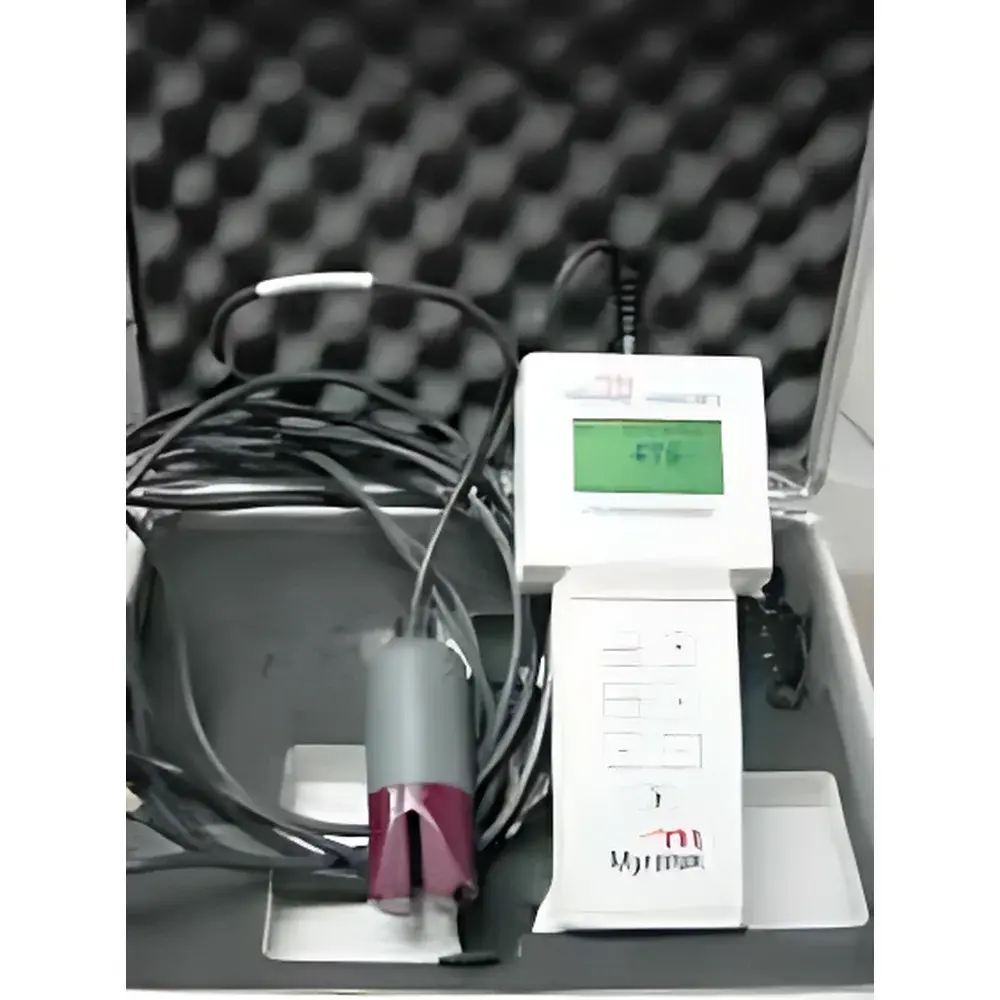
MSS-2 Portable Suspended Solids (SS) Analyzer
| Origin | USA |
|---|---|
| Manufacturer Type | Authorized Distributor |
| Origin Category | Imported |
| Model | MSS-2 |
| Instrument Type | Portable |
| Measurement Range | 0–30,000 mg/L (standard), 0–1,500 mg/L (low-range option) |
| Accuracy | ±3% of reading or ±20 mg/L, whichever is greater |
| Resolution | 1 mg/L (<1,000 mg/L), 10 mg/L (1,000–9,999 mg/L), 100 mg/L (≥10,000 mg/L) |
| Repeatability | ±0.5% |
| Drift | <1% per year |
| Operating Temperature (Sensor) | 0–65°C |
| Environmental Operating Range | −20 to +70°C |
| Humidity | 0–100% RH |
| IP Rating | IP66 |
| Max Pressure | 100 PSI |
| Sensor Cable Length | 6.0 m |
| Display | Backlit graphical LCD with UV-resistant housing and adjustable contrast |
| Data Storage | 50 internal records with non-volatile memory backup |
| Output Interface | RS-232 serial |
| Power | Rechargeable battery pack |
| Real-Time Clock | Integrated with date/time stamping |
| Diagnostic Capability | Automated self-test and sensor health monitoring |
Overview
The MSS-2 Portable Suspended Solids (SS) Analyzer is an engineered solution for rapid, on-site quantification of total suspended solids in aqueous matrices using infrared (IR) absorption photometry. Based on the principle of single-beam optical attenuation—where IR light at a fixed wavelength (typically 850 nm) is absorbed proportionally to particle concentration—the MSS-2 delivers robust, field-deployable measurements without reliance on lab-based gravimetric filtration. Its microprocessor-controlled architecture supports dual calibration modes (for MLSS and RAS applications), enabling accurate differentiation between mixed liquor and return activated sludge suspensions—a critical distinction in activated sludge process control. Designed for wastewater treatment plants, environmental monitoring agencies, and regulatory field teams, the MSS-2 eliminates daily laboratory analysis while maintaining metrological traceability to standard reference methods such as EPA Method 160.2 and ISO 11923.
Key Features
- Infrared optical sensing technology minimizes interference from water color, turbidity, and dissolved organic matter—significantly improving measurement specificity over visible-light alternatives.
- Dual independent calibration capability for Mixed Liquor Suspended Solids (MLSS) and Return Activated Sludge (RAS), supporting adaptive process optimization in biological nutrient removal systems.
- IP66-rated ruggedized enclosure constructed from UV-stabilized epoxy, polyurethane, and PVC—engineered for continuous exposure to outdoor, wet, and chemically aggressive environments.
- Backlit graphical LCD display with user-adjustable contrast and real-time clock/date stamping ensures legibility under variable ambient lighting and supports GLP-compliant data logging.
- Integrated rechargeable battery system provides ≥12 hours of continuous operation; auto-diagnostic routines verify sensor integrity, optical path cleanliness, and electronic stability prior to each measurement cycle.
- RS-232 serial interface enables direct connection to laptops or data loggers; all stored readings retain time/date stamps and calibration identifiers for audit-ready traceability.
Sample Compatibility & Compliance
The MSS-2 is validated for use across diverse water matrices including secondary effluent, aerated basin influent, clarifier underflow, and digester supernatant. It meets operational requirements defined in US EPA Guidance for Wastewater Treatment Plant Monitoring (EPA 832-B-08-002) and aligns with performance criteria outlined in ASTM D5907 (Standard Test Method for Total Dissolved Solids and Total Suspended Solids in Water). While not a replacement for certified gravimetric SS determination per ISO 11923 in compliance reporting, the MSS-2 satisfies routine process control needs under ISO 9001:2015 and ISO/IEC 17025:2017 quality management frameworks when operated within its specified range and calibrated per manufacturer protocol. Its 0–65°C sensor operating window accommodates both temperate and tropical wastewater infrastructure conditions.
Software & Data Management
Data export is performed via ASCII-formatted RS-232 transmission compatible with common spreadsheet and LIMS platforms (e.g., LabWare, Thermo Fisher SampleManager). Each record includes measurement value (mg/L), timestamp (YYYY-MM-DD HH:MM:SS), calibration ID, sensor temperature, and diagnostic status flag. Internal memory retains up to 50 entries with non-volatile backup—ensuring data persistence during power loss. No proprietary software is required; terminal emulation tools (e.g., PuTTY, Tera Term) suffice for configuration and retrieval. For integration into automated SCADA environments, optional TTL-level digital output modules are available through authorized distributors. All firmware updates adhere to IEC 62443-2-4 security practices for industrial control systems.
Applications
- Real-time monitoring of clarifier sludge blanket depth and settling velocity via vertical profiling (with optional pole mount).
- Routine verification of membrane bioreactor (MBR) effluent quality prior to discharge.
- Optimization of chemical dosing in coagulation-flocculation units by tracking upstream SS fluctuations.
- Field validation of online turbidity sensors where correlation drift is suspected.
- Regulatory sampling support for NPDES permit compliance reporting—particularly for facilities requiring rapid turnaround on SS excursions.
- Research-grade characterization of suspended particulate dynamics in stormwater retention basins and constructed wetlands.
FAQ
Does the MSS-2 require annual recalibration against gravimetric standards?
Yes—while the instrument features stable IR optics and temperature-compensated emitters, EPA and ISO guidelines recommend verification against filtered, dried, and weighed samples at least once per quarter for critical process control applications.
Can the MSS-2 be used in seawater or high-salinity brines?
It is validated for freshwater and secondary-treated wastewater only; salinities exceeding 5,000 µS/cm may induce refractive index artifacts that affect IR attenuation linearity.
Is the RS-232 interface compatible with modern USB-C laptops?
Yes—when paired with a certified FTDI-based USB-to-serial adapter meeting USB-IF compliance, full bidirectional communication is supported without driver conflicts.
How does the MSS-2 handle fouling in high-solids environments like anaerobic digesters?
The sensor face incorporates a hydrophobic coating and optional wiper mechanism (accessory); routine cleaning with deionized water and soft lint-free cloth is recommended after each deployment in viscous sludges.
Does the device meet FDA 21 CFR Part 11 requirements for electronic records?
No—while audit trails and timestamps are embedded, the MSS-2 lacks role-based access control, electronic signatures, and system validation documentation required for regulated pharmaceutical or food processing applications.







