
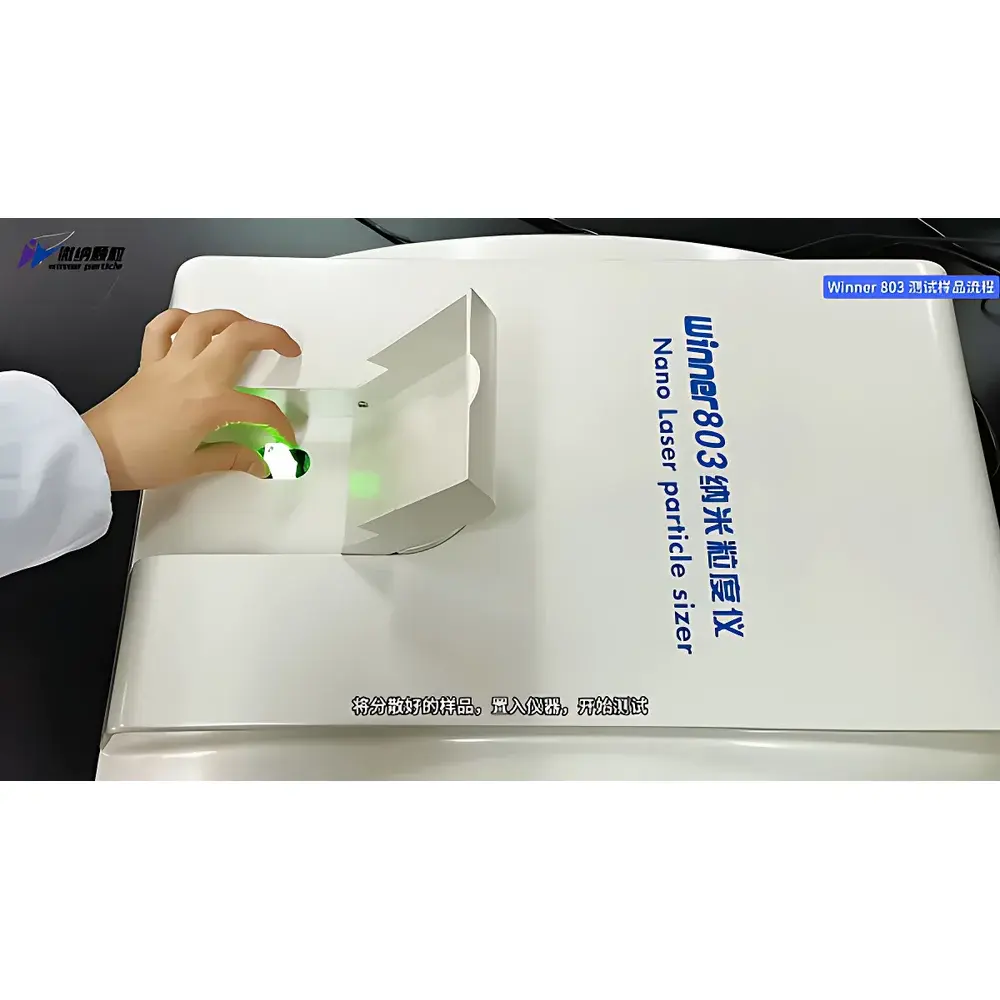
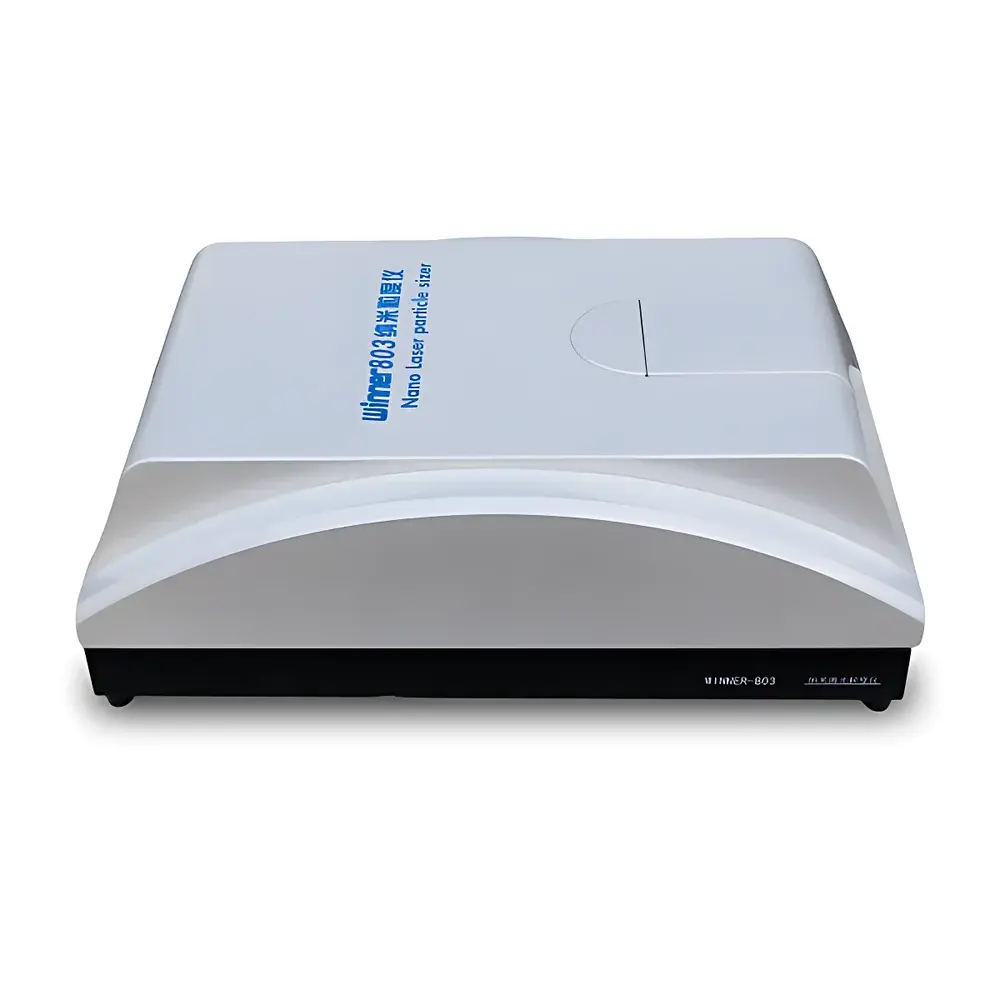
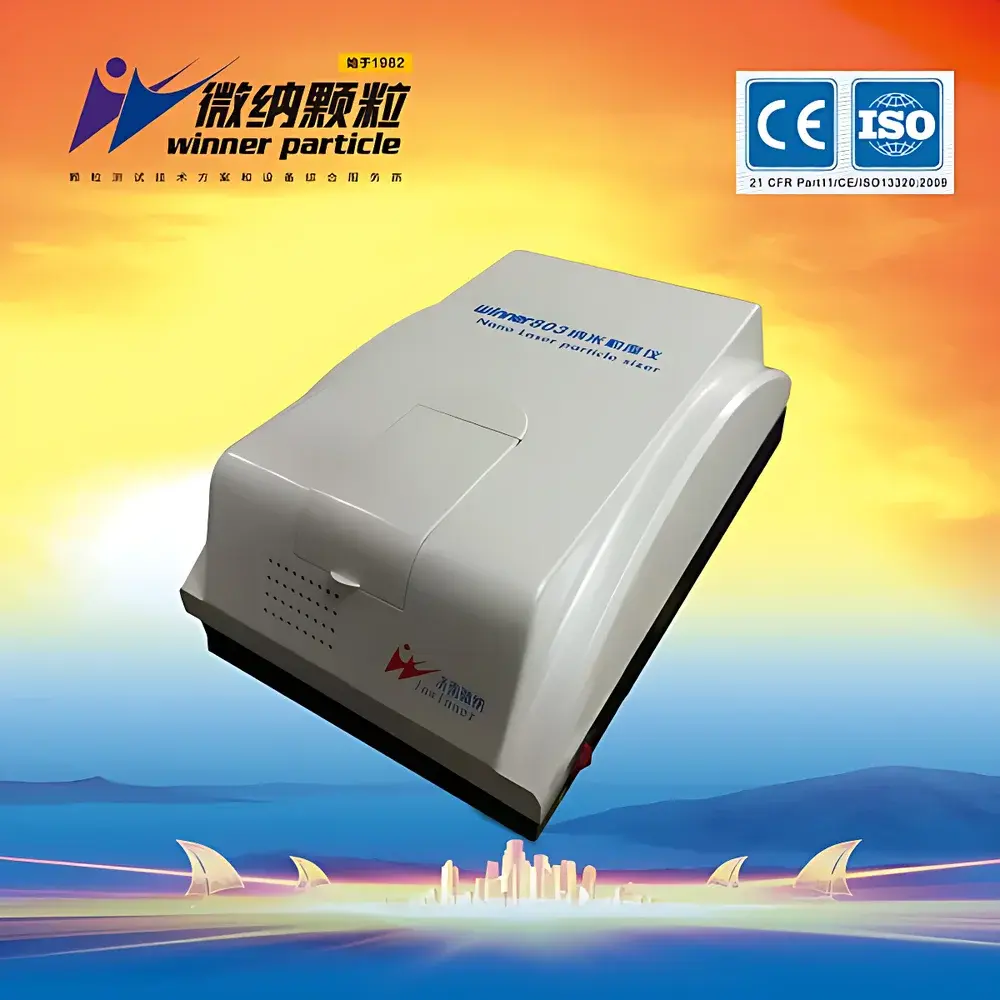
Winner803 Dual-Wavelength Photon Correlation Nanoparticle Size Analyzer
| Brand | Jinan Winner |
|---|---|
| Origin | Shandong, China |
| Manufacturer Type | Direct Manufacturer |
| Model | Winner803 |
| Price Range | USD 14,000–28,000 (FOB) |
| Particle Size Range | 1–10,000 nm |
| Size Measurement Repeatability | ≤1% RSD |
| Temperature Control Range | 5–90 °C |
| Temperature Stability | ±0.1 °C |
| Correlator Sampling Frequency | 10 kHz |
| Measurement Principle | Dynamic Light Scattering (DLS) |
| Sample Volume Requirement | 1–4 mL |
| Sample Concentration Range | 0.1–100 mg/L |
| Zeta Potential Capability | Not integrated |
| Typical Measurement Time | <5 minutes |
Overview
The Winner803 Dual-Wavelength Photon Correlation Nanoparticle Size Analyzer is a high-precision instrument engineered for reliable, non-invasive characterization of colloidal and nanoscale dispersions using dynamic light scattering (DLS). Based on the principles of Brownian motion and photon correlation spectroscopy, the system measures temporal fluctuations in scattered laser intensity to extract diffusion coefficients. These are then converted into hydrodynamic diameter distributions via the Stokes–Einstein equation. Unlike conventional single-wavelength DLS instruments, the Winner803 incorporates two independently switchable semiconductor lasers—532/639 nm (green/red) and 405 nm (violet)—enabling robust detection of optically absorbing or highly colored samples such as organic pigments, dye nanoparticles, and carbon-based nanomaterials where traditional 532 nm excitation suffers from excessive absorption or signal attenuation. Its optical architecture employs fiber-coupled detection at a fixed 90° scattering angle, minimizing alignment drift and enhancing long-term measurement stability.
Key Features
- Dual-wavelength laser excitation (405 nm + 532/639 nm) with automatic wavelength selection based on sample absorbance profile
- High-sensitivity Hamamatsu photomultiplier tube (PMT) detector optimized for low-light photon counting
- Proprietary CR512 digital autocorrelator with 512 lag channels, 10000 physical delay steps, and adjustable time resolution (100 ns – 10 ms)
- Integrated Peltier-based temperature control system maintaining ±0.1 °C stability across the full 5–90 °C operating range
- Fiber-optic light path design reducing mechanical vibration sensitivity and improving optical alignment retention
- Compact benchtop footprint (600 × 380 × 230 mm) and lightweight construction (12 kg) for flexible lab integration
Sample Compatibility & Compliance
The Winner803 supports aqueous and organic suspensions with particle concentrations ranging from 0.1 to 100 mg/L—ideal for dilute biological colloids (e.g., exosomes, protein aggregates), industrial pigment dispersions, and functional nanomaterials. It complies with ISO 22412:2017 (formerly ISO 22412:2008) and GB/T 29022–2012 for DLS methodology, and meets the performance validation criteria outlined in GB/T 19627–2005 (equivalent to ISO 13321:1996 for photon correlation spectroscopy). While not FDA 21 CFR Part 11–compliant out-of-the-box, its software architecture supports audit-trail-enabled SOP execution when deployed in GLP/GMP environments with appropriate IT validation protocols. All measurements are traceable to NIST-traceable polystyrene latex standards used during factory calibration.
Software & Data Management
The instrument is operated via Windows-based WinPDA software featuring intuitive workflow navigation, one-click automated measurement, and customizable SOP templates. The interface supports real-time correlation function fitting using cumulant, CONTIN, and NNLS algorithms, with optional multimodal deconvolution for polydisperse systems. Data export options include CSV, TXT, and PDF formats compatible with third-party statistical analysis tools (e.g., OriginLab, MATLAB). Language switching between English and Chinese is supported without software reinstallation. Raw correlator data (intensity autocorrelation functions) and processed size distribution histograms are stored with full metadata—including temperature, laser wavelength, acquisition time, and correlator settings—for full experimental reproducibility.
Applications
The Winner803 serves critical quality control and R&D functions across multiple regulated and advanced materials sectors. In pharmaceutical development, it characterizes liposomal drug carriers, protein therapeutics, and mRNA nanoparticle formulations under controlled thermal conditions. In coatings and ink manufacturing, it quantifies pigment dispersion stability and agglomeration kinetics in colored systems where 405 nm excitation overcomes absorption limitations. Academic and industrial users apply it to exosome isolation validation, nanocellulose sizing, quantum dot synthesis monitoring, and nanocatalyst batch consistency assessment. Its rapid (<5 min) turnaround enables high-throughput screening in formulation labs and production QC environments where speed and repeatability are essential.
FAQ
Does the Winner803 support zeta potential measurement?
No. This model is dedicated exclusively to hydrodynamic size analysis via DLS. Zeta potential requires electrophoretic light scattering (ELS), which is not implemented in this platform.
What sample volume is required for a valid measurement?
Standard quartz cuvettes (10 × 10 × 40 mm) accommodate 1–4 mL. Minimum usable volume is 1 mL; optimal signal-to-noise is achieved at ≥2 mL with appropriate concentration.
Can the instrument operate unattended overnight?
Yes—temperature stabilization, laser safety interlocks, and auto-shutdown after idle timeout ensure safe extended operation. Scheduled batch runs can be programmed via SOP sequences.
Is calibration verification possible with user-supplied standards?
Yes. Users may load custom reference materials and compare measured D50 values against certified values to verify instrument performance per ISO 22412 Annex B guidelines.
How is laser power adjusted during testing?
Laser output is digitally regulated from 1–40 mW per channel. Power levels are automatically optimized by the software based on sample turbidity and detector saturation thresholds.



