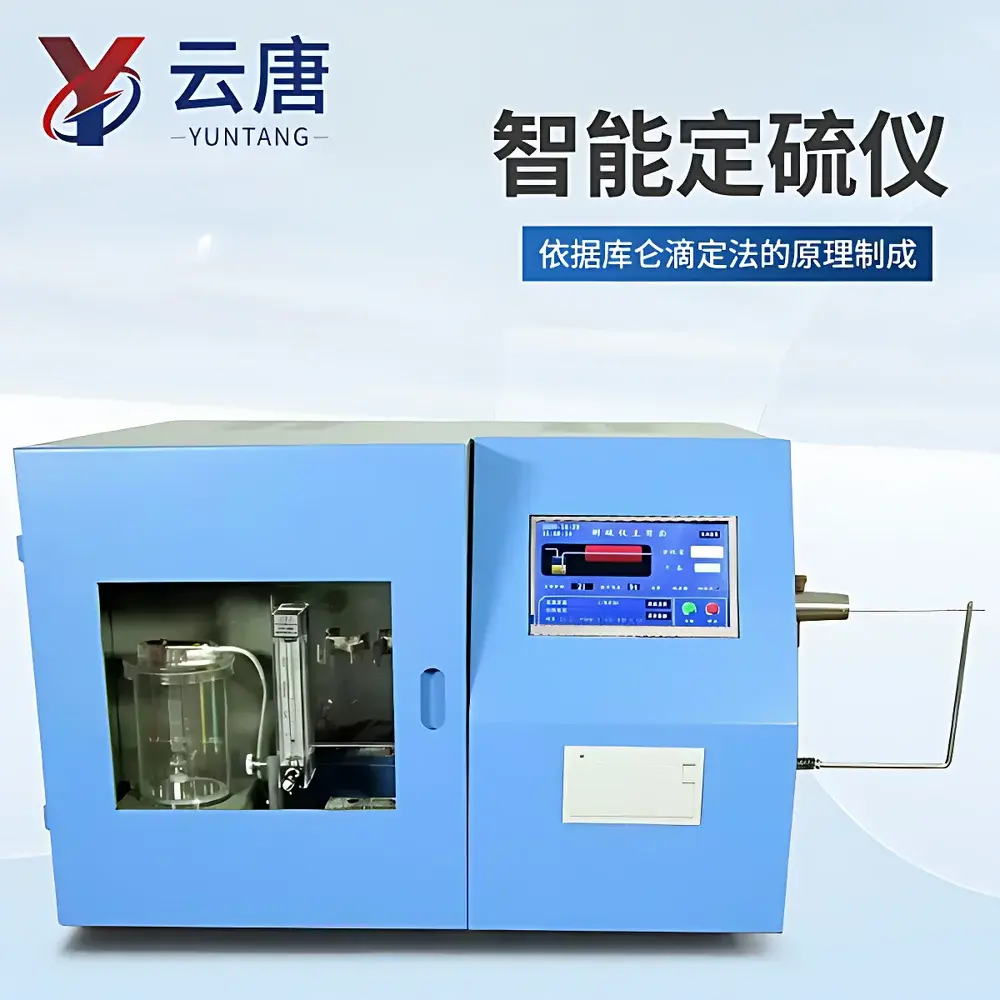
Yuntang YT-CSL· Microcomputer Multi-Sample Coulometric Sulfur Determinator
| Brand | Yuntang |
|---|---|
| Origin | Shandong, China |
| Manufacturer Type | Direct Manufacturer |
| Country of Origin | China |
| Model | YT-CSL· |
| Detection Principle | Coulometric Titration (ASTM D3177, ISO 351, GB/T 214-2007) |
| Sulfur Range | 0–40 wt% |
| Sample Capacity | 1–15 samples per batch (continuous loading enabled) |
| Analysis Time | ~5–7 min per sample |
| Furnace Temp Control | 1050 °C ±5 °C (adjustable), High-Temp Zone ≥90 mm |
| Heating Element | Silicon Carbide Tube |
| Electrolytic Cell Volume | 450 mL |
| Pt Electrode Area | 150 mm² |
| Temp Sensor Accuracy | Class 0.5 |
| Repeatability | ≤0.05% (St <1%), ≤0.10% (1%≤St≤4%), ≤0.20% (St>4%) |
| Reproducibility | ≤0.10% (St <1%), ≤0.20% (1%≤St≤4%), ≤0.30% (St>4%) |
| Power Supply | AC 220 V ±10%, 50 Hz, ≤3 kW |
| Dimensions (L×W×H) | 770×460×410 mm |
Overview
The Yuntang YT-CSL· Microcomputer Multi-Sample Coulometric Sulfur Determinator is an ASTM D3177-22 and ISO 351:2022 compliant instrument engineered for precise, high-throughput sulfur quantification in solid fuels—primarily coal, coke, and petroleum coke. It operates on the principle of controlled-potential coulometric titration: samples are combusted in a high-temperature quartz tube furnace (1050 °C ±5 °C), converting all sulfur species to SO2, which is carried by oxygen flow into a titration cell. Here, SO2 is oxidized at a platinum working electrode under constant potential, generating a stoichiometric current proportional to sulfur mass. The integrated microprocessor calculates sulfur content (wt%) based on Faraday’s law, with automatic endpoint detection and charge integration. Unlike gravimetric or XRF methods, coulometric determination offers inherent calibration traceability, minimal reagent consumption, and immunity to matrix interferences common in heterogeneous coal matrices.
Key Features
- Multi-sample batch processing: Accommodates 1–15 crucibles per run; continuous sample loading enabled without interrupting ongoing analysis—ideal for QC labs handling >50 samples/day.
- Intelligent thermal management: Dual-zone silicon carbide furnace with active temperature compensation; ramp rate 20–25 °C/min, stabilized at 1050 °C within ≤30 minutes; high-temp zone length ≥90 mm ensures uniform combustion efficiency across sample positions.
- Self-calibrating measurement system: Automatic drift correction via blank subtraction and real-time electrolyte conductivity monitoring; eliminates manual recalibration between batches.
- Robust safety architecture: Integrated overcurrent protection, automatic silicon carbide tube power cutoff on thermal runaway, and cold-start safeguard preventing premature heating before gas purge completion.
- Modular data interface: RS-232/USB output supports direct connection to LIMS or centralized lab PCs; up to 8 instruments can share a single database server under networked configuration.
- Long-term data integrity: All results—including raw current-time curves, temperature profiles, and user audit trails—are stored in non-volatile memory with timestamp, operator ID, and method version tagging.
Sample Compatibility & Compliance
The YT-CSL· is validated for use with standard ASTM D3177-certified ceramic boats (12 mm × 25 mm) and accepts pulverized coal (≤200 mesh), coke fines, and desulfurized petroleum coke. It meets the essential performance criteria of GB/T 214–2007 (Chinese national standard for coal sulfur determination), ISO 351:2022 (solid mineral fuels—determination of total sulfur—coulometric method), and aligns with USP General Chapter 281 requirements for elemental impurity verification in energy-related feedstocks. Its design incorporates GLP-ready features: electronic signature support, configurable password-protected method libraries, and full 21 CFR Part 11–compliant audit trail generation (user actions, parameter changes, result modifications).
Software & Data Management
Bundled Yuntang SulfurView™ v3.2 software provides ISO/IEC 17025-aligned reporting: automated calculation of repeatability (r) and reproducibility (R) per ISO 5725-2, uncertainty budgeting per GUM (JCGM 100:2008), and customizable PDF/CSV export with embedded metadata (sample ID, prep date, analyst, instrument serial). Raw data files (.SUL) retain full electrochemical transient records for forensic review. Network deployment enables centralized method validation, remote firmware updates, and role-based access control (admin, analyst, reviewer) with session logging.
Applications
- Coal quality assurance in power generation plants: Monitoring total sulfur to comply with EPA MATS and EU IED emission limits (e.g., ≤1.0 g/MJ for sub-bituminous coal).
- Coke oven battery optimization: Quantifying sulfur carryover from coal blends to predict blast furnace burden chemistry and slag basicity.
- ISO 19732-compliant trading assays: Supporting contractual sulfur specifications in international coal contracts (FOB, CIF) with certified uncertainty <0.08% (k=2).
- Research on low-sulfur alternative fuels: Characterizing sulfur speciation in biomass co-firing blends and carbon capture feedstock screening.
- Regulatory compliance testing: Fulfilling mandatory reporting under China’s “Blue Sky Defense Campaign” (Guo Fa [2018] No.22) for coal-fired industrial boilers.
FAQ
What standards does the YT-CSL· comply with for sulfur determination in coal?
It is fully aligned with ASTM D3177-22, ISO 351:2022, GB/T 214–2007, and supports method validation per ISO/IEC 17025:2017 Annex A.
Can the instrument analyze samples other than coal?
Yes—validated for coke, petroleum coke, and char; not recommended for high-chlorine or high-ash samples (>25%) without prior acid-wash pretreatment.
How is measurement traceability maintained?
Via NIST-traceable sulfur reference materials (SRMs 1632e, 1633c); built-in calibration verification using certified coal standards at start-up and every 20 analyses.
Is the electrolyte solution proprietary?
No—uses standardized 0.05 mol/L KI + 0.005 mol/L KBr + 0.05% (v/v) glacial acetic acid; compatible with commercial electrolytes meeting ASTM D3177 Annex A specifications.
What maintenance intervals are recommended for routine operation?
Daily: Ceramic boat cleaning, electrolyte level check; Weekly: Electrode polishing, furnace tube inspection; Quarterly: Thermocouple calibration verification and gas flow rate validation per ISO 10723.
Related Products