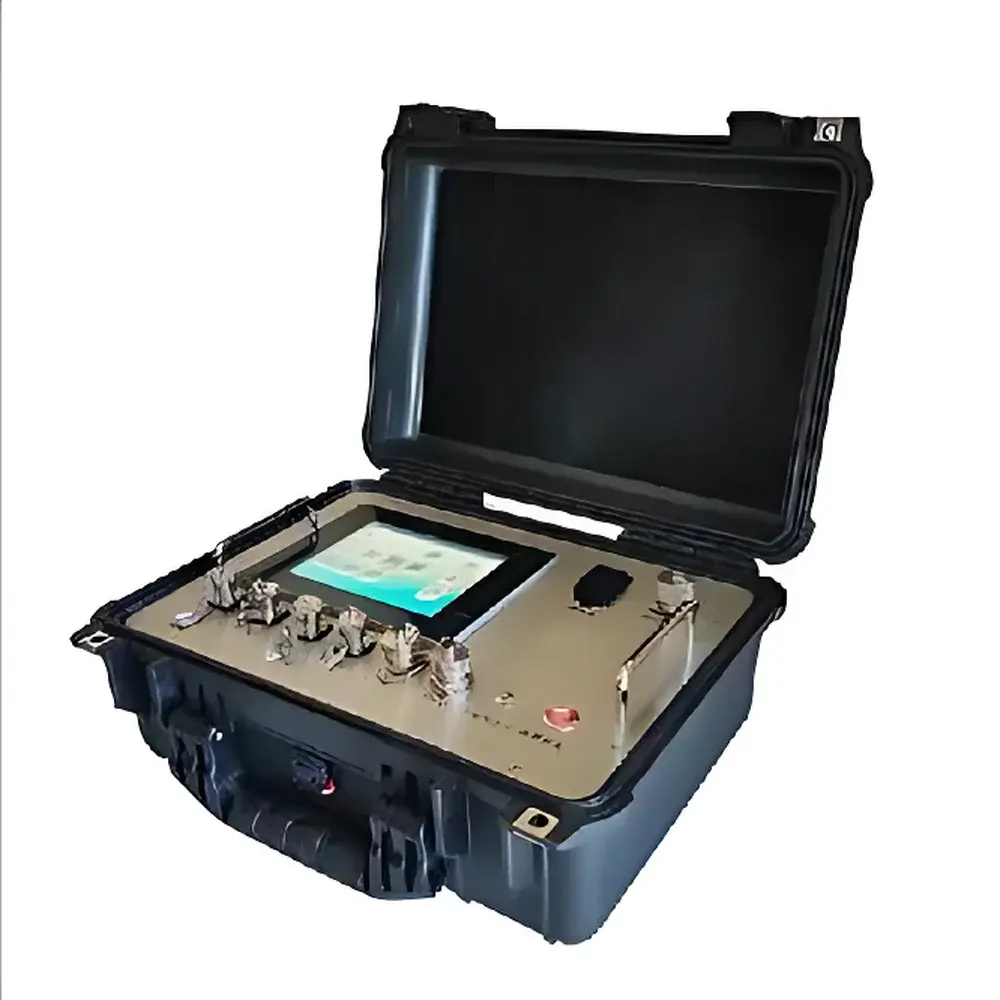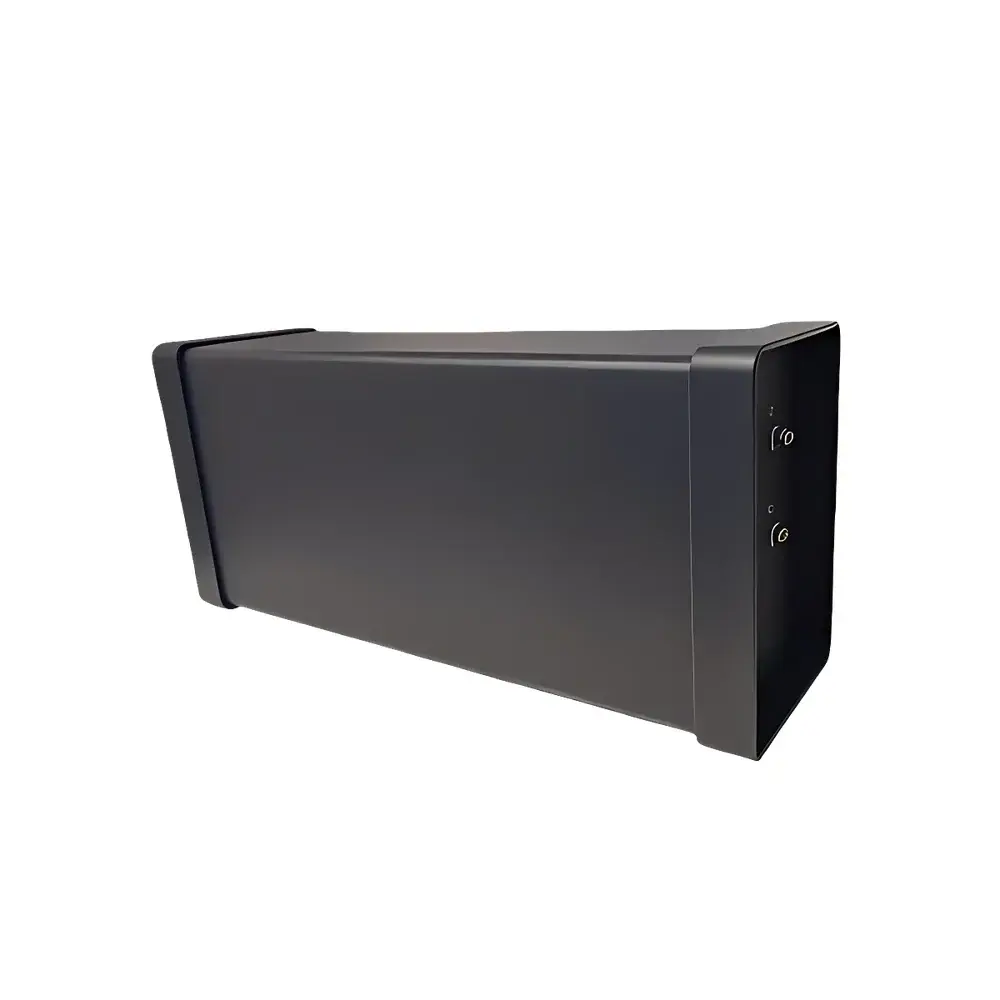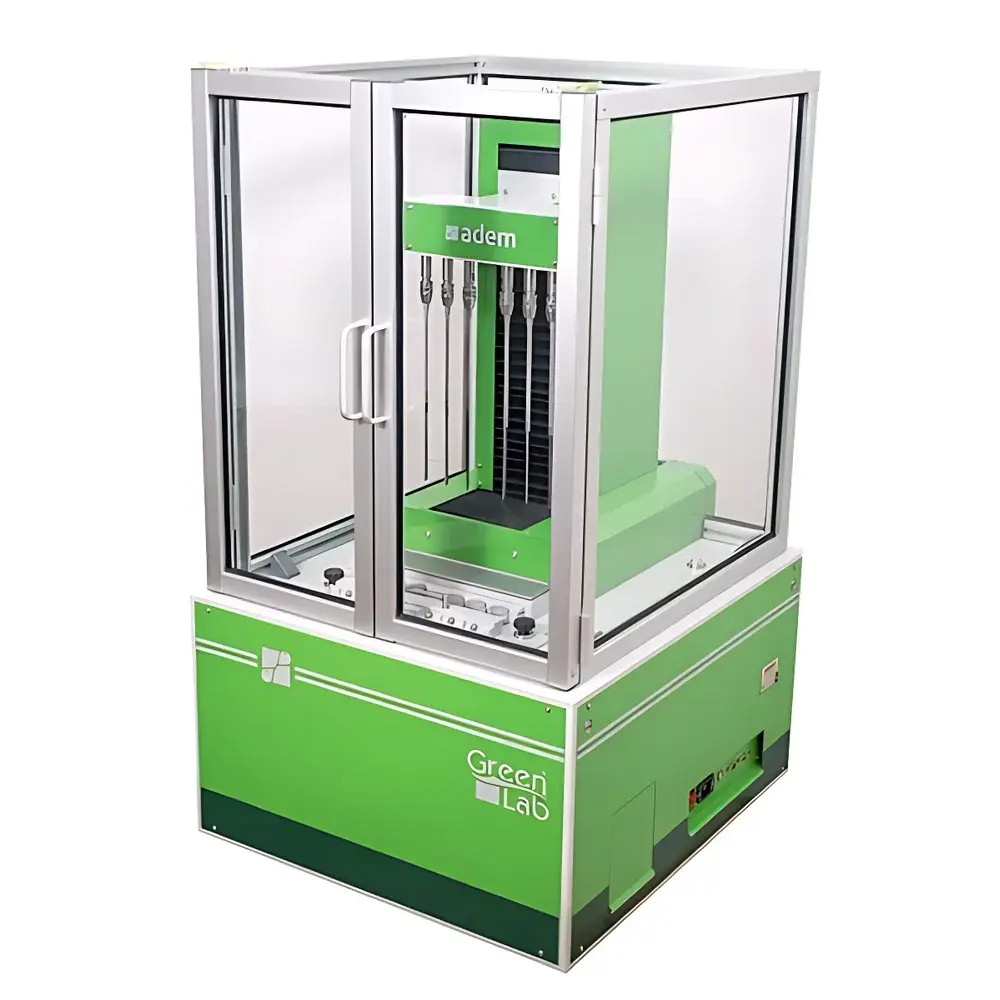
Green Lab ADEM Fully Automated Petroleum Demulsibility Tester
| Brand | Green Lab |
|---|---|
| Origin | Imported |
| Manufacturer Type | Authorized Distributor |
| Model | ADEM |
| Compliance | ASTM D1401, ISO 6614 |
| Automation Level | Fully Automated with Audit-Traceable Test Execution |
| Sample Volume | 40 mL per test (standard) |
| Temperature Control | ±0.5 °C over 54 °C and 82 °C test points |
| Test Duration | Up to 120 min with programmable endpoint detection |
| Data Output | CSV/Excel-compatible timestamped reports with operator ID, method version, and environmental log |
Overview
The Green Lab ADEM Fully Automated Petroleum Demulsibility Tester is an engineered solution for quantifying the separation behavior of oil–water emulsions under standardized thermal and gravitational conditions. Based on the fundamental principle of gravity-driven phase separation kinetics, the ADEM precisely measures the time required for a defined volume of oil–water mixture to separate into distinct layers—oil, water, and interfacial emulsion—under controlled temperature (54 °C or 82 °C per ASTM D1401 and ISO 6614). Unlike manual or semi-automated systems, the ADEM integrates real-time optical sensing, programmable heating profiles, and motorized sample handling to eliminate operator-induced variability. Its architecture supports full traceability from test initiation to final report generation—critical for laboratories operating under GLP, GMP, or ISO/IEC 17025 frameworks.
Key Features
- Fully automated test execution: No manual timing, visual observation, or layer interface marking required.
- Dual-temperature capability: Independent thermal control at 54 °C and 82 °C, compliant with both ASTM D1401 Method A and Method B.
- Optical interface detection: High-contrast photometric sensors continuously monitor the oil–water–emulsion boundary with sub-millimeter resolution.
- Audit-ready data logging: Each test records operator ID, calibration status, ambient temperature/humidity, method revision, and raw sensor timestamps.
- Modular vial handling: Accommodates standard 100 mL graduated glass cylinders; compatible with optional barcode-labeled vial tracking.
- Fail-safe thermal management: PID-controlled heating jacket with redundant overtemperature cutoff and thermal drift compensation.
Sample Compatibility & Compliance
The ADEM is validated for use with mineral-based and synthetic lubricants, turbine oils, hydraulic fluids, compressor oils, engine oils (including low-SAPS formulations), marine distillate fuels, and aviation turbine oils (MIL-PRF-23699, MIL-PRF-6081). It accommodates samples containing additives such as demulsifiers, rust inhibitors, and anti-wear agents without interference. All operational parameters and reporting structures conform to ASTM D1401–22 “Standard Test Method for Determining the Separability of Oil and Water by Gravity” and ISO 6614:2021 “Petroleum products — Determination of demulsibility”. The system supports 21 CFR Part 11-compliant electronic signatures when integrated with validated LIMS environments.
Software & Data Management
The ADEM Control Suite (v3.2+) provides intuitive workflow configuration, method library management, and role-based user access (Administrator, Analyst, Reviewer). Test methods are stored as encrypted XML templates with embedded compliance metadata. Raw sensor data (light transmission vs. time) is retained in native binary format alongside processed results (separation time, % water separated, % emulsion remaining). Export options include PDF reports with digital signature fields, CSV for statistical process control (SPC), and direct API integration with enterprise quality systems (e.g., TrackWise, MasterControl). Audit trails meet ALCOA+ principles—attributable, legible, contemporaneous, original, accurate, complete, consistent, enduring, and available.
Applications
- Petroleum refining: QC of finished lubricants and base oil blends; optimization of demulsifier dosing in blending units.
- R&D laboratories: Screening of novel demulsifier chemistries; evaluation of additive synergy and thermal stability limits.
- Aviation maintenance: Routine demulsibility verification of in-service jet engine oils per OEM service bulletins (e.g., Rolls-Royce SB 72-A-1241).
- Marine engineering: Assessment of fuel and lube oil resistance to seawater contamination in dual-fuel engine applications.
- Automotive OEM testing: Monitoring demulsibility degradation across extended drain intervals using used-oil sampling protocols.
- Personal care & pharma: Adapted methodology for evaluating emulsion stability of topical formulations where aqueous–lipid phase separation correlates with product shelf life and sensory performance.
FAQ
Does the ADEM require daily calibration?
No—calibration is performed during installation and verified annually or after major hardware service; routine performance qualification (PQ) uses NIST-traceable reference oils.
Can the ADEM handle viscous samples above 100 cSt at 40 °C?
Yes, with optional pre-heating module (up to 90 °C) and extended settling time configuration; viscosity does not impair optical detection accuracy.
Is method validation support available for regulatory submissions?
Yes—Green Lab provides IQ/OQ/PQ documentation packages, validation protocols aligned with ASTM E2500, and technical assistance for FDA or EMA audit readiness.
What maintenance is required beyond routine cleaning?
Annual thermocouple verification, optical window inspection, and firmware updates—no consumables or proprietary reagents are needed.
How does the ADEM ensure reproducibility across different operators and shifts?
By eliminating subjective endpoints: all separation criteria (e.g., “≥90% water separated”) are algorithmically enforced, and every action is logged with immutable timestamps and user credentials.