
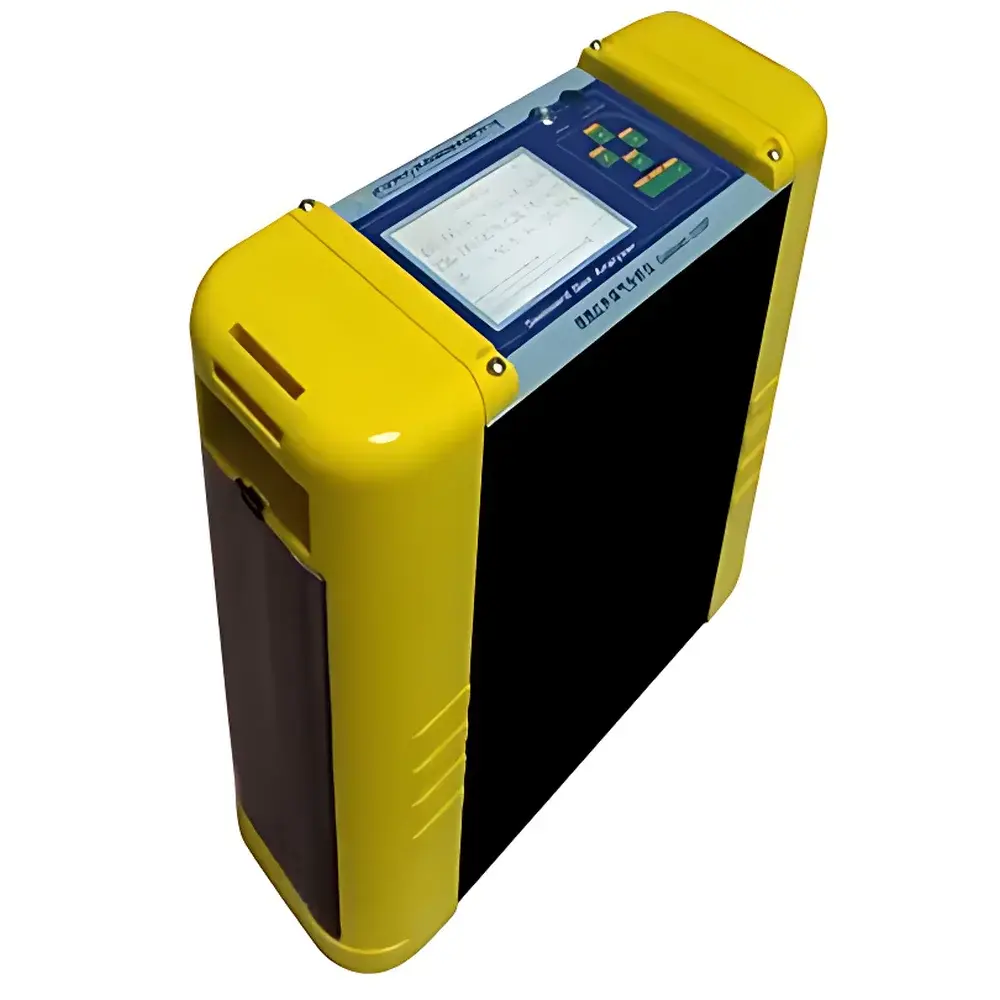
GB-5030 Portable Multi-Gas Automotive Exhaust Analyzer
| Origin | Beijing, China |
|---|---|
| Manufacturer Type | Authorized Distributor |
| Origin Category | Domestic (PRC) |
| Model | GB-5030 |
| Price Range | USD 1,400 – 2,800 |
| Instrument Type | Portable |
| Detection Principle | Non-Dispersive Infrared (NDIR) and Electrochemical (O₂, NO) |
| Maximum Permissible Error | ±10% of full scale |
| Zero Drift | ±1% FS / 8 h |
| Span Drift | ±3% FS / 24 h |
| Repeatability | ≤2% RSD |
Overview
The GB-5030 Portable Multi-Gas Automotive Exhaust Analyzer is an engineered field-deployable instrument designed for regulatory-grade measurement of key combustion byproducts in vehicle exhaust streams. It employs dual detection methodologies: non-dispersive infrared (NDIR) spectroscopy for CO, CO₂, and HC (hydrocarbons as propane-equivalent), and electrochemical sensors for O₂ and NO. This hybrid architecture ensures compliance with internationally recognized test protocols for in-use vehicle emissions verification—including roadside inspections, periodic technical inspections (PTI), workshop diagnostics, and pre-certification screening. The analyzer operates independently of external power sources via its integrated rechargeable lithium-ion battery, enabling uninterrupted operation for up to 6 hours under continuous sampling conditions. Its compact form factor (320 × 220 × 120 mm), ruggedized enclosure (IP54-rated), and ergonomic carrying handle make it suitable for mobile enforcement units, mobile emission laboratories, and decentralized testing facilities.
Key Features
- Multi-fuel compatibility: validated for gasoline, diesel, LPG, CNG, and ethanol-fueled vehicles—supporting global fuel diversity without hardware modification.
- Proprietary NDIR optical platform with temperature-stabilized reference cell and dual-beam compensation, minimizing thermal drift and enhancing long-term signal stability.
- Simultaneous real-time quantification of five critical gases: CO (0–10% vol), HC (0–9999 ppm C₃H₈), CO₂ (0–20% vol), O₂ (0–25% vol), and NO (0–5000 ppm).
- Integrated micro-diaphragm sampling pump with adjustable flow rate (0.8–1.2 L/min) and built-in particulate filter and water trap to protect sensor integrity during high-humidity or soot-laden sampling.
- Large backlit LCD display (128 × 64 pixels) with fully localized Chinese GUI, intuitive menu navigation, and on-device calculation of air–fuel ratio (λ) using stoichiometric coefficients per fuel type.
- RS-232C serial interface compliant with EIA/TIA-232-F standard; supports bidirectional data exchange with PC-based configuration and reporting software (optional).
Sample Compatibility & Compliance
The GB-5030 is calibrated and verified against traceable NIST-traceable gas standards (certified by CNAS-accredited labs). It meets the performance requirements outlined in China’s HJ 845–2017 and HJ 638–2011 standards for motor vehicle exhaust analyzers, and aligns with functional equivalency to ISO 3930:2000 (Road vehicles — Exhaust gas analyzers — Performance requirements and test methods). While not certified to EU Directive 2014/45/EU or U.S. EPA 40 CFR Part 1065 Annexes, its measurement uncertainty profile (±5% relative error for CO, CO₂, O₂; ±4% for NO; ±12 ppm or ±5% for HC) satisfies baseline verification needs for Tier 1 inspection regimes. All sensors undergo factory zero/span calibration with documented audit trails; user-accessible calibration routines support field recalibration using certified span gases.
Software & Data Management
The optional PC software (GB-Link v3.2) provides secure data acquisition, configurable report generation (PDF/CSV), and time-stamped logging with operator ID tagging. It supports GLP-compliant audit trail functionality—including user login history, calibration event logs, and parameter change timestamps. Data export complies with ISO/IEC 17025 documentation requirements for accredited testing laboratories. Firmware updates are delivered via encrypted USB stick to maintain system integrity and prevent unauthorized modification—consistent with IEC 62443-3-3 cybersecurity principles for industrial measurement devices.
Applications
- Regulatory enforcement: roadside emission screening by environmental protection bureaus and traffic police departments.
- Maintenance diagnostics: real-time feedback during engine tuning, catalytic converter efficiency assessment, and misfire detection in repair shops.
- Manufacturing QA: final-line exhaust verification for OEM assembly plants and Tier-1 suppliers.
- Research & development: transient emission profiling during chassis dynamometer testing and cold-start characterization studies.
- Academic training: hands-on instruction in combustion chemistry, sensor physics, and emissions regulation frameworks in university engineering labs.
FAQ
What gases does the GB-5030 measure, and what are their respective detection ranges?
CO (0–10% vol), HC (0–9999 ppm, reported as propane equivalent), CO₂ (0–20% vol), O₂ (0–25% vol), and NO (0–5000 ppm).
Does the instrument require external power during operation?
No—it operates autonomously on its internal rechargeable lithium-ion battery (7.4 V, 4400 mAh), providing ≥6 hours of continuous use at nominal flow rate.
Can the GB-5030 be used for diesel vehicles with DPFs or SCR systems?
Yes—its robust particulate filtration and condensate management enable stable sampling from aftertreatment-equipped engines; however, NO₂ is not measured directly, and total NOₓ estimation assumes NO dominance under typical operating conditions.
Is firmware upgrade supported, and how is calibration traceability maintained?
Firmware updates are performed via authenticated USB media; each calibration event is digitally signed and stored with UTC timestamp, sensor ID, and standard gas lot number—enabling full metrological traceability per ISO/IEC 17025 Clause 6.6.
What communication protocols are supported for integration into automated inspection systems?
RS-232C ASCII command set (Modbus RTU optional via firmware update); no native Ethernet, Wi-Fi, or Bluetooth interfaces are included in base configuration.







