
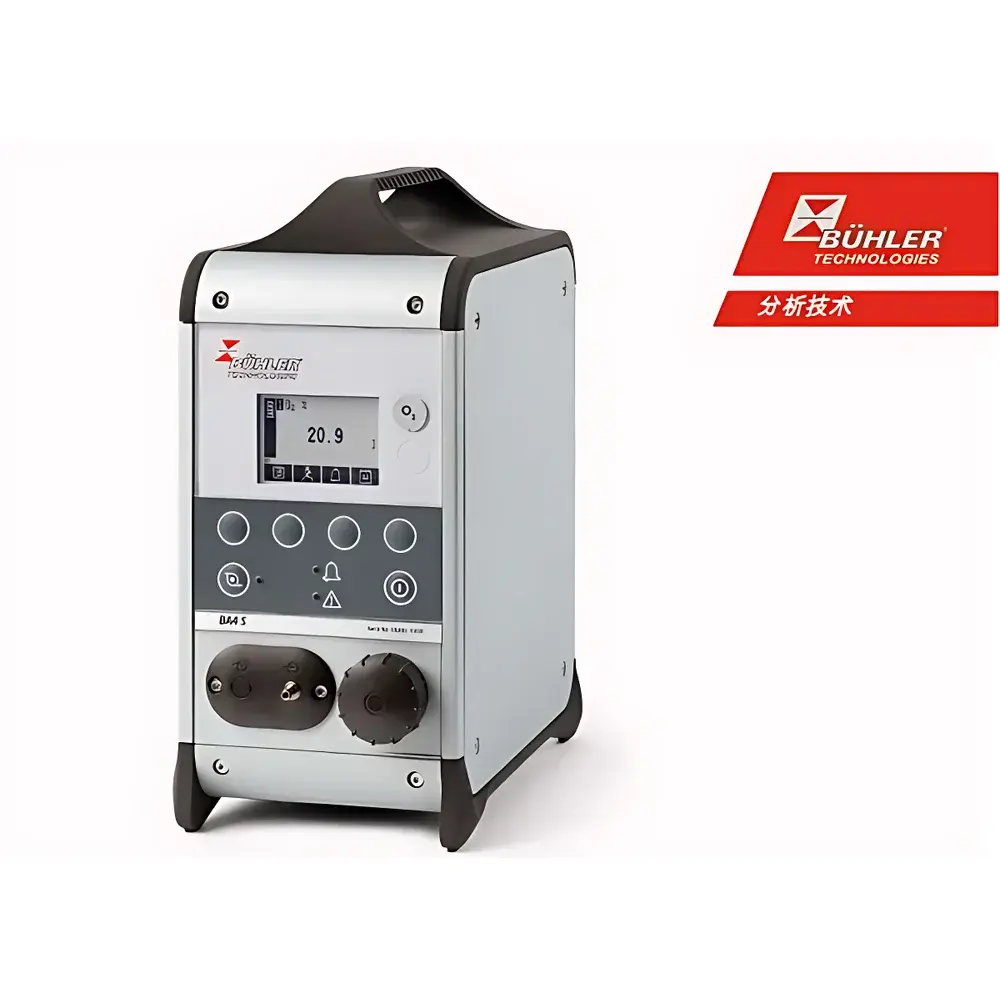
BA 4S Portable Paramagnetic O₂ and NDIR CO₂ Analyzer
| Origin | Germany |
|---|---|
| Type | Portable Multicomponent Gas Analyzer |
| Model | BA 4S |
| Measurement Principle | Paramagnetic (O₂) / Non-Dispersive Infrared (CO₂) |
| Response Time (T₉₀) | <15 s (O₂), <10 s (CO₂) |
| Repeatability | ±0.1% O₂ (basic), ±0.05% O₂ (Pro variant), ±2% FSR CO₂ |
| Operating Temperature | −10 to +50 °C (O₂), +5 to +45 °C (CO₂) |
| Dimensions | 150 × 300 × 260 mm |
| Weight | 2.6–3.9 kg |
| Power Supply | Rechargeable battery or AC adapter |
| Sample Flow | 1.5–6 L/min (unpumped) |
| Gas Inlet/Outlet | 5 mm OD tubing |
| Enclosure Material | 316 stainless steel |
Overview
The BA 4S Portable Paramagnetic O₂ and NDIR CO₂ Analyzer is a field-deployable, dual-gas measurement instrument engineered for high-reliability quantitative analysis of oxygen and carbon dioxide in clean, dry, non-flammable, and non-toxic gas streams. Its core sensing architecture leverages two physically distinct, industry-validated detection principles: paramagnetism for O₂—exploiting the strong magnetic susceptibility of molecular oxygen—and non-dispersive infrared (NDIR) absorption spectroscopy for CO₂, targeting its characteristic vibrational band near 4.26 µm. This orthogonal sensor design ensures minimal cross-sensitivity, stable baseline performance, and compliance with fundamental metrological requirements for trace and percent-level gas quantification. Designed for operation across diverse ambient conditions (−10 to +50 °C for O₂ channel; +5 to +45 °C for CO₂), the BA 4S delivers consistent accuracy without requiring frequent recalibration—making it suitable for both short-term spot checks and extended unattended monitoring campaigns. A 1-hour warm-up period is recommended to achieve full thermal stabilization and specified measurement uncertainty.
Key Features
- Paramagnetic O₂ sensor with inherent specificity—no consumables, no electrochemical degradation, long-term zero stability (±0.2% O₂/week drift)
- NDIR CO₂ sensor with dual-beam optical path and temperature-compensated detector for enhanced signal integrity
- Robust 316 stainless steel housing rated for industrial environments and routine laboratory handling
- Integrated sample pump (700 mL/min) with programmable timer for controlled aspiration and flow consistency
- Dual power mode: rechargeable Li-ion battery (enabling >8 hours continuous operation) or universal AC adapter
- Configurable output resolution: 0.1% (standard), 0.01% (Pro variant) for O₂; 0.01% (all variants) for CO₂
- Gas inlet/outlet via standardized 5 mm OD stainless-steel ferrule fittings—compatible with common sampling lines and regulators
Sample Compatibility & Compliance
The BA 4S is validated for use with clean, dry, non-corrosive, non-condensing gas matrices. It is not intended for direct analysis of humid, particulate-laden, acidic, or solvent-saturated streams without prior conditioning (e.g., Nafion dryer, particulate filter, chemical scrubber). While capable of measuring CO₂ concentrations up to 100%, analysis of samples containing >5% CO₂ requires adherence to occupational exposure limits (OSHA PEL, ACGIH TLV) and appropriate local safety protocols. The analyzer meets CE marking requirements per Directive 2014/30/EU (EMC) and 2014/35/EU (LVD). Its measurement traceability aligns with ISO 17025-accredited calibration practices using NIST-traceable standard gases. For regulated environments—including medical gas verification (ISO 8573-1, USP ) and combustion emissions pre-screening—the BA 4S supports audit-ready documentation when paired with optional timestamped data logging.
Software & Data Management
Data acquisition is supported via RS-232 or USB-C interface, enabling real-time streaming to host PCs or PLCs. Optional firmware includes configurable alarm thresholds (high/low, latching/non-latching), analog 4–20 mA output (isolated), and Modbus RTU protocol support for SCADA integration. All logged measurements include UTC timestamps, sensor status flags (e.g., low battery, flow fault), and diagnostic codes. Raw data exports as CSV files compliant with ASTM E2655-21 for post-processing in MATLAB, Python (Pandas), or LabVIEW. No proprietary software installation is required—basic configuration is accessible via front-panel menu; advanced settings are managed through ASCII command set documented per IEC 61158. Audit trail functionality (user login, parameter changes, calibration events) satisfies GLP/GMP documentation expectations where electronic records are governed by FDA 21 CFR Part 11.
Applications
- Medical gas quality assurance: verification of O₂ purity in hospital pipelines, cylinder filling stations, and anesthesia delivery systems per ISO 8573-1 Class 2 and EN 13544-1
- Respiratory physiology studies: real-time exhaled CO₂ and inspired O₂ profiling during metabolic cart calibration and exercise testing
- Controlled atmosphere storage & fermentation: headspace O₂/CO₂ monitoring in bioreactors, wine tanks, and modified-atmosphere packaging (MAP) validation
- Combustion efficiency assessment: flue gas O₂ trim adjustment and CO₂ stoichiometric ratio calculation in boiler and furnace commissioning
- Environmental chamber validation: periodic verification of O₂ depletion or CO₂ enrichment in climate-controlled test enclosures
- Underwater diving gas blending: pre-fill and post-fill analysis of nitrox, heliox, and trimix blends for partial pressure compliance
FAQ
What is the recommended calibration frequency?
Annual calibration against certified reference gases is advised for routine use; more frequent calibration (quarterly) is recommended when operating under extreme temperature cycling or after mechanical shock.
Can the BA 4S measure O₂ and CO₂ simultaneously in a single gas stream?
Yes—both sensors operate concurrently with independent optical and magnetic pathways, providing synchronized dual-parameter output with no time-multiplexing delay.
Is the instrument suitable for measuring CO₂ in humid biogas streams?
No—direct measurement of raw biogas is not supported due to condensate risk and H₂S interference; sample must be dried and filtered prior to inlet.
Does the BA 4S comply with EPA Method 3A or ISO 12039 for stack gas analysis?
It is not certified for regulatory stack testing per those methods; however, it serves as an effective pre-test verification tool and for process optimization where formal certification is not mandated.
How is zero and span calibration performed?
Zero calibration uses certified nitrogen (99.999% purity); span calibration employs certified O₂-in-N₂ and CO₂-in-air standards at user-defined concentration points—procedure guided by on-screen prompts.
Related Products







